Thesis
Bringing a new drug from discovery to market takes 10-15 years, and the average cost to develop a single approved asset rose to $2.7 billion in 2025. Despite that investment, nine out of ten drug candidates that enter clinical trials still fail before reaching approval. About 30% of those failures are driven by unmanageable toxicity, and one systematic review published in 2021 found that drug-induced liver injury (DILI) accounts for one in every 4.5 drug failures in clinical trials. Those failures are most expensive when they surface late, in Phase III. By one estimate, catching just 10% more clinical failures preclinically would save about $100 million per drug program, and large pharma companies already spend eight-figure sums on computational ADMET (absorption, distribution, metabolism, excretion, and toxicity) infrastructure that produces no direct revenue.
As of 2026, the dominant proxy for human toxicity remained animal testing in rats and dogs, and those models translate poorly to humans. The gap persisted in part because, until December 2022, US law required "preclinical tests (including tests on animals)" before a drug could enter human trials. That month, the Food and Drug Administration (FDA) Modernization Act 2.0 replaced the phrase with "nonclinical tests," formally opening the door to non-animal alternatives.
Regulators have since gone further. In April 2025, the FDA published a roadmap to phase out animal testing requirements, starting with monoclonal antibodies and explicitly endorsing "AI-based computational models of toxicity and cell lines and organoid toxicity testing." FDA Commissioner Martin Makary called it a "paradigm shift" in drug evaluation, and the agency aims to make animal studies "the exception rather than the norm" within three to five years. The bipartisan FDA Modernization Act 3.0, which would require the FDA to write rules implementing the 2022 law, passed the Senate in December 2025, and a House version passed in July 2026. In September 2026, before either became law, the FDA issued a rule replacing references to animal tests with "nonclinical" tests across its drug and biologics regulations.
Axiom describes its product as agentic intelligence that connects experimental data to human clinical outcomes, starting with whether a compound will injure the human liver. By June 2025, the company had screened over 130K compounds on primary human liver cells, imaging them at single-cell resolution, and had linked a subset of those readouts to documented clinical outcomes to build what it calls the world's largest human toxicity dataset. Public toxicity resources such as Tox21 rely mainly on single-readout assays and non-primary cell lines, while Axiom pairs detailed cellular responses with what happened in patients, letting a cell-level signal stand in for a human result. The company's founders believe that toxicity prediction follows the kind of scaling law seen in language models, improving predictably as the training dataset grows, so the company with the most human data should be able to make the most accurate toxicity predictions.
Founding Story
Source: BioPharmaTrend
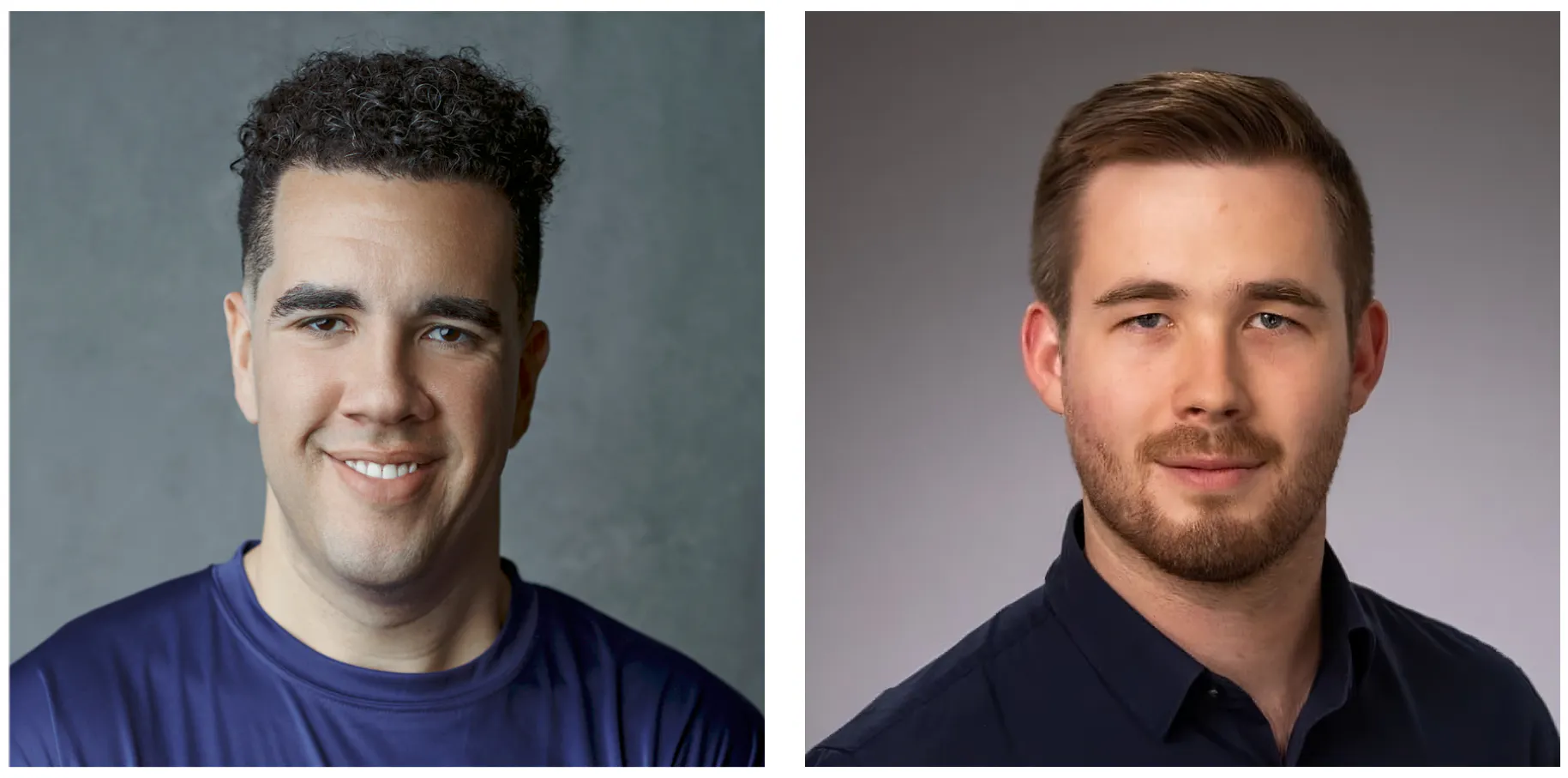
Axiom was founded in 2023 by Brandon White (CEO) and Alex Beatson (CTO), two machine learning engineers who had spent most of the previous decade in biotech and drug discovery. White joined Uber as a machine learning engineer in 2014, where he helped build its machine learning platform. He later became one of the first employees at Freenome, helping scale the cancer diagnostics company past 400 employees while leading product for an AI-based blood test.
White then spent about four years as head of product at Spring Discovery, building machine learning tools for drug development, before its AI platform was acquired by a Bay Area biotech. Beatson came from the research side. He earned a PhD in machine learning from Princeton and trained at Google on speech and generative models. He later worked at Genesis Molecular AI, then called Genesis Therapeutics, and Redesign Science, building systems for molecular generation, property prediction, and physics-based simulation.
During White’s career before Axiom, many AI drug discovery companies focused on generating new molecules, but pharma already had large libraries of compounds and unresolved drug candidates. The harder problem was predicting whether a molecule would actually work in a human. White saw toxicity as the most immediate commercial wedge, since companies would pay to identify unsafe compounds earlier in development.
Axiom’s founding premise was that toxicity prediction might improve the same way language models did, with performance rising predictably as more high-quality data was added. If that held true, the company that generated the largest human-cell toxicity dataset could build the more powerful predictive toxicity model.
Building on that idea, Axiom focused on liver toxicity, the most common cause of drug-trial discontinuation and market withdrawal. Human liver cells are the closest laboratory stand-in for how drugs affect the liver, but they are fragile and quickly lose function outside the body. That made generating reliable data at scale one of the company's early technical hurdles. Katherine Titterton, Axiom's founding biologist, built the automated assays needed to keep those cells stable long enough to measure drug effects across thousands of experiments.
Solving that problem gave Axiom the data foundation to train its first toxicity models. About 18 months after its founding, the company debuted its first liver model at the Society of Toxicology conference in March 2025. It came out of stealth the following month, announcing $15 million raised across its first two rounds from Amplify Partners, Dimension Capital, and Zetta Venture Partners.
Product
Translate
Source: Axiom
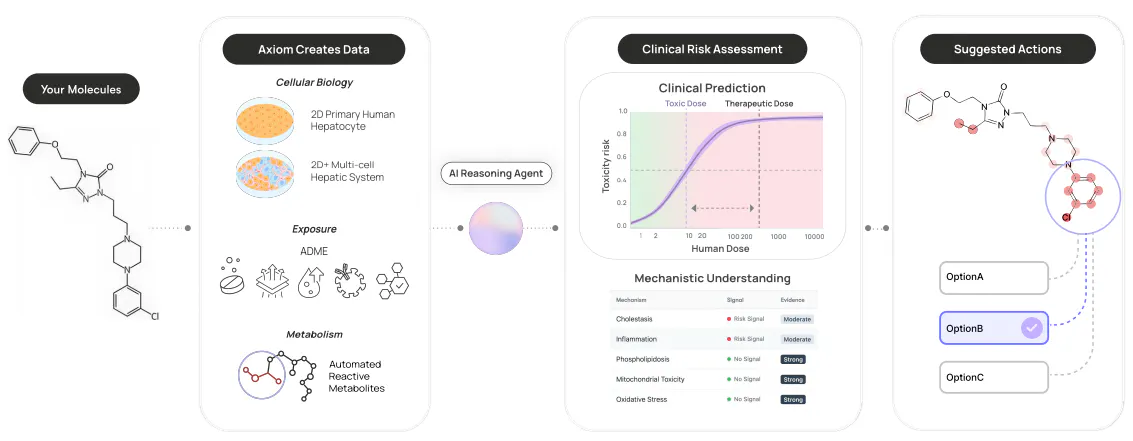
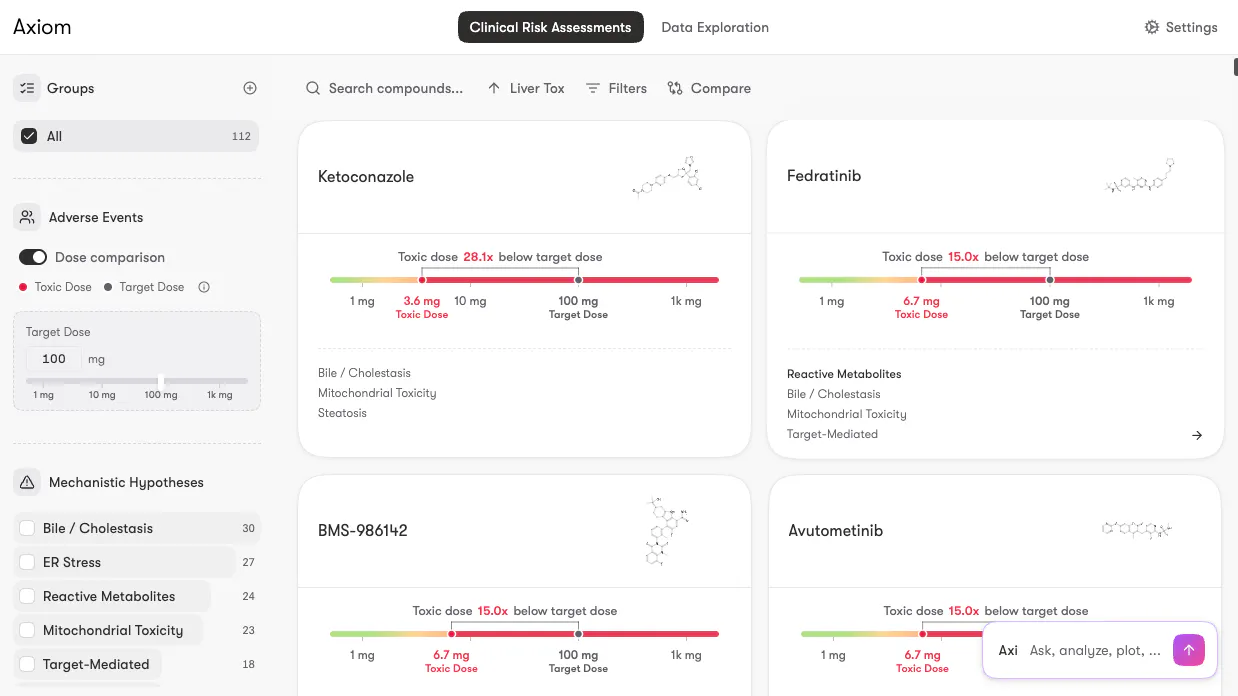
Axiom's core offering is Translate, which the company describes as "an end-to-end service, from data generation to clinical outcomes." A chemist submits a molecule, and Translate returns a clinical risk assessment for DILI across the doses a patient might receive. The output includes a predicted human toxic dose in milligrams per day, the gap between that dose and the intended therapeutic dose, and a breakdown of the biological mechanisms driving the risk. For each mechanism, Translate reports whether it sees a risk signal and how strong the supporting evidence is, so the model surfaces its own uncertainty rather than forcing a yes-or-no call.
Customers can run their own molecules through Translate at any point in discovery. Early on, a chemist can submit just a structure, written as a SMILES string, a text notation for chemical structure, and get a fully computational prediction before the compound is ever made. Later, they can send a physical compound through Axiom's wet-lab assays for a higher-fidelity readout from real cells. Both paths return the same clinical risk assessment, so a team can screen its own molecules in silico early and confirm the most promising ones experimentally later. Axiom pitches Translate at three stages of discovery. In lead generation, it flags which chemical series carry intrinsic toxicity risk. In lead optimization, it shows how structural changes move the safety profile across analogs. At candidate selection, it runs a full mechanistic assessment on a single molecule, with a follow-up assay plan where the model is uncertain.
Data

Source: Axiom
Axiom generates its own experimental data on each molecule in three layers, covering cell biology, exposure, and metabolism. Cell biology is the largest input. Axiom's assays are built on hepatocytes, the liver cells that do most of the body's drug processing, because liver toxicity is the most common cause of drug-trial discontinuation and market withdrawal. Many high-throughput liver assays use immortalized cell lines such as HepG2, which are inexpensive and reproducible but lack the metabolic capacity of a real liver. Axiom instead uses primary human hepatocytes, donor-derived liver cells that are harder to keep alive but retain the cytochrome P450 enzymes a human liver uses to metabolize drugs. That matters for compounds where the parent molecule is harmless and one of its metabolites is toxic.
The platform runs two assay systems. The first is a 2D primary human hepatocyte assay, a three-day culture with a two-day exposure, built as a fast screen for acute injury. The second is a multicellular hepatic system called TruVivo, which Axiom sources from LifeNet Health and has adapted to a 384-well format for throughput. It layers primary hepatocytes onto supporting stromal and endothelial cells, with Kupffer cells, the liver's resident immune cells, added when immune-mediated injury is in question, and its 7-14 day culture supports repeat dosing, which lets it pick up slower injury, including immune-mediated damage, that short assays miss.
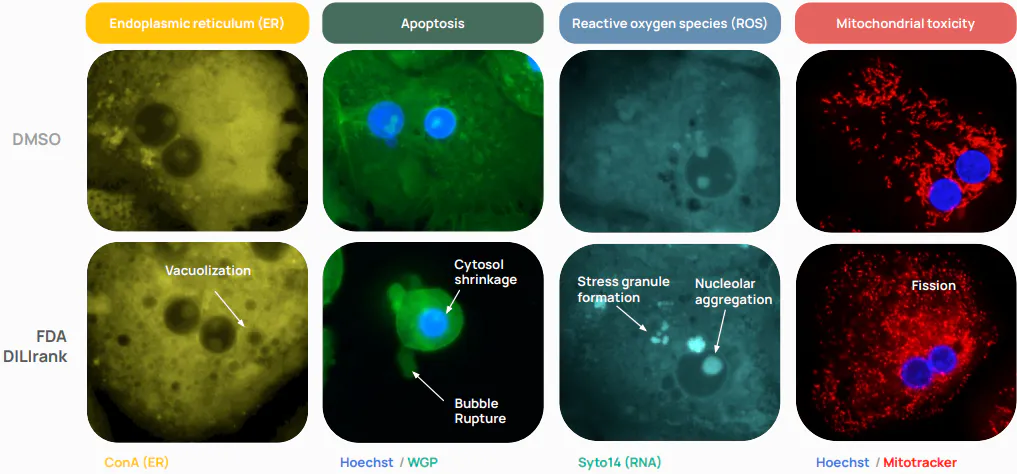
Both systems image cells at single-cell resolution using cell painting, in which fluorescent dyes mark different cell structures, so one run yields many separate markers of cellular stress rather than the single viability number a conventional assay returns. The assays have produced over 10 million images, which Axiom's annotators and segmentation models have turned into measurements on 394 million labeled cells.
Source: Axiom
Across these readouts, Translate resolves liver injury into eight mechanisms, covering mitochondrial toxicity, reactive metabolites, bile disruption, immune-mediated injury, lysosomal and phospholipidosis effects, sinusoidal vascular injury, steatosis, and endoplasmic reticulum stress. Each is supported by its own combination of imaging, transcriptomic, and biochemical evidence, which lets the platform tie a risk score to a specific biological cause rather than a single pass-or-fail number.
The second layer is exposure: the absorption, distribution, metabolism, and excretion (ADME) properties that determine how much of a drug reaches the liver and how long it stays there. A compound that is toxic to cells at a given concentration only becomes a clinical problem if it actually reaches that concentration in the body. The third layer is metabolism. Liver enzymes convert some drugs into short-lived, reactive intermediates that bind to cellular proteins, a frequent cause of unpredictable liver injury that standard cell assays tend to miss because the damage clears before the assay reads out. Axiom characterizes these with a trapping assay that captures the intermediates as stable adducts it can measure by mass spectrometry.
All of this runs against a screening library of over 115K small molecules and a clinical reference set of about 2.2K molecules that carry both lab readouts and documented patient outcomes. Axiom curates those clinical labels itself, using LLM agents to gather the evidence for each drug and human experts to review it, rather than relying on the FDA's DILIrank set, which it argues tracks how much data exists for a drug more than how dangerous it is. Atorvastatin is graded most-DILI-concern even though clinically apparent injury shows up in roughly 1 in 10K patients, while dapsone, which can cause severe or fatal injury, is graded less-concern.
AI Reasoning
Source: Axiom
Translate's analysis runs through Axi, an AI agent included with every subscription. Axi reasons across a molecule's experimental data and Axiom's clinical reference set to compare candidates, propose mechanistic hypotheses, and pinpoint the structural features driving risk. In the March 2026 technical report, it traced the liver risk in Bristol Myers Squibb's BMS-986020 to its structure and cleared its successor, BMS-986278, which went on to a successful trial.
In a webinar first held in March 2025, Axiom's team demonstrated the structure-analysis workflow, which runs structural variants of a molecule through the models, compares their predicted toxicity to isolate the substructure driving the risk, and ranks modifications that should lower that risk while keeping the molecule drug-like. For nefazodone, an antidepressant withdrawn for liver toxicity, it pointed to the chlorophenol group, the group the literature later tied to a toxic metabolite.
Underneath, a structure model built on graph neural networks predicts a molecule's cellular response from its structure alone, which lets Axiom score compounds before they are synthesized. A downstream generalized additive model turns those features into a risk score, chosen so each input's contribution stays interpretable.
Clinical Prediction

Source: Axiom
Axiom's primary clinical-risk model, which it calls the Bioactivity Margin of Safety (MOS), runs on the TruVivo system in a fast configuration: a seven-day culture with a 48-hour exposure. An AI model scores the bioactivity of each well by learning to separate images of treated cells from untreated controls, a readout Axiom describes as a bioactivity point of departure. Because it works on image embeddings rather than a single viability number, it catches earlier morphological change than a conventional cytotoxicity assay. The MOS then extrapolates from the concentration at which bioactivity reaches 20% of its maximum observed effect (the EC20) to the human oral dose at which liver injury becomes likely, producing a toxicity risk curve and a toxic-dose threshold.
Axiom's documents report results for several model versions and test sets, so the figures below are not interchangeable with each other or with competitors' published results. Axiom reports that a single TruVivo readout matched or beat each of six published liver-toxicity benchmarks, from groups including the FDA, AstraZeneca, Cellarity, GSK, and Cyprotex, on the compounds both had tested, by margins in area under the curve (AUC) ranging from 0.073 on the FDA and InSphero set to 0.001 on Cyprotex's. AUC summarizes how well a test separates toxic drugs from safe ones, where 0.5 means it cannot tell them apart, and 1.0 means it ranks every toxic drug above every safe one. Most of those benchmarks use older drugs, with average first-in-human dates in the 1970s, so Axiom also tests on its own clinical molecules split by era.
On held-out drugs first tested in humans after 2000, Axiom's model card reports that it catches 74% of drugs that caused liver injury (sensitivity) while correctly clearing 89% of safe ones (specificity), for an AUC of 0.91, compared with 42% sensitivity, 94% specificity, and 0.79 AUC on pre-2000 drugs. Before 2000, dose and lipophilicity, what Axiom calls the rule of two, carried most of the predictive signal while cell cytotoxicity added little. For modern compounds, shaped by ADME optimization and monitored more tightly in trials, that reverses, which is why Axiom's cell-based readouts matter more in modern chemistry. Across 1.8K compounds of all eras, dose alone scores an AUC of 0.64, adding hepatocyte viability lifts that to 0.72, and Axiom's production model reaches 0.79.
Sensitivity also depends on how common and how fast the injury is, running around 70% for injury seen in over 1% of patients within 12 weeks and falling to 20-40% for rare, slow-onset, or out-of-domain cases, with specificity near or above 90% throughout. As a reference point, AstraZeneca's own published primary-hepatocyte method reported 41% sensitivity at 86% specificity. Axiom defines the chemical space its data covers well as modern drug-like molecules with a molecular weight above 250, a therapeutic dose under one gram per day, and a logP, a measure of how fat-soluble a molecule is, between one and five. Outside that range, on small, water-soluble, or very high-dose drugs, the assay was not designed to detect the relevant effects.
Market
Customer
Axiom sells to the preclinical side of drug development, mainly the discovery toxicology, drug metabolism, and medicinal chemistry groups that decide whether a candidate moves forward before it enters the studies required for an investigational new drug application. These teams commission animal and in vitro toxicology work, and they bear the cost when a molecule fails late for a reason that was visible early. Axiom's go-to-market starts with investigative toxicology, solving liver-safety problems already found in a program, then moves into early screening and wider use across the enterprise.
In April 2025, Axiom reported pilots underway or being finalized with six of the top 20 pharmaceutical companies, a major agrochemical company, several biotechs, and multiple hedge funds. Axiom has not disclosed the names of those companies. In January 2026, the company expected to complete blinded studies with several of the world's largest pharmaceutical companies early that year.
Market Size
Axiom's most direct market is ADME and toxicology testing, which one estimate put at $6.6 billion in 2025 and projected to reach $10.7 billion by 2030, a 10.1% CAGR. A separate estimate starts at $6.4 billion in 2024 and reaches $11.4 billion by 2030. In silico methods are the fastest-growing segment of that market, at 11.5% a year, and the broader in silico drug discovery market was $4.2 billion in 2025, projected to grow at an 11% CAGR through 2035.
Pharma's willingness to pay for toxicity prediction is a subset of its overall R&D spend. Drug R&D spending ran to $288 billion in 2024, with members of the Pharmaceutical Research and Manufacturers of America alone accounting for $104 billion. Outsourced safety testing is itself a large business. Charles River's Discovery and Safety Assessment segment, which runs preclinical safety studies for drug developers, reported $606.5 million in revenue in the second quarter of 2026 alone.
The testing market is also fragmented. One market report estimates that the top 10 ADMET testing players hold only about 12% of revenue between them, and large contract research organizations (CROs), including Thermo Fisher's PPD, IQVIA, Charles River, Labcorp, Eurofins, and WuXi AppTec, each sit near 1%.
Competition
Competitive Landscape
Axiom's competition sorts into four classes, divided by whether the testing is physical or computational and how early it can run. On the physical side are legacy CROs such as Charles River, Labcorp, WuXi AppTec, and Eurofins, which run animal and in vitro assays to order at thousands of dollars per compound and hold most of the toxicology budget Axiom is trying to convert into software. Alongside them sit in vitro model specialists like Emulate, with its organ-on-a-chip systems, and 3D-spheroid providers such as InSphero and Cyprotex, a subsidiary of Evotec. These sell more physiologically faithful wet-lab assays rather than predictions, which makes them as much a complement as a competitor, since Axiom can triage in silico and a physical assay can confirm the survivors.
On the computational side, Simulations Plus and its DILIsym franchise represent the physics- and mechanism-based software approach, hand-encoding biological models rather than learning them from data, which makes it the software alternative to Axiom's learned models. The AI-native platforms, including Recursion, Insilico Medicine, Cellarity, and Inductive Bio, are the most direct competition on method, learning toxicity from biological and chemical data. Most of that group runs broad discovery platforms where toxicity is one module among many, while Cellarity and Inductive Bio sit closest to Axiom's DILI-prediction wedge. A newer entrant, Absentia Labs, founded in 2024, announced in July 2026 that its digital liver model for predicting DILI had become the first AI drug development tool accepted into the FDA's Innovative Science and Technology Approaches for New Drugs (ISTAND) qualification program, at the Letter of Intent stage, the first of three.
Axiom owns the full pipeline of wet lab, image analysis, models, and product, and it treats toxicity prediction as the entry point rather than discovery. Its cell-painting and clinical-outcomes dataset is a byproduct of that integration, and in April 2025 its quoted cost per compound was about an order of magnitude below physical assays.
Competitors
AI-Native Platforms
Cellarity: Founded in 2019 out of Flagship Pioneering, Cellarity is Axiom's closest technical competitor on DILI prediction. Its DILImap dataset profiles 300 compounds at multiple doses in primary human hepatocytes using transcriptomics, and its ToxPredictor model reported 88% sensitivity at 100% specificity in blinded validation. As of September 2026, it has raised $274 million in total funding. In October 2022, it raised a $121 million Series C with participation from Flagship Pioneering, Kyowa Kirin, and Hanwha Impact, and it has not disclosed a valuation. The contrast with Axiom is that it reads cellular state through transcriptomics rather than imaging, and runs its own clinical pipeline rather than selling tooling alone.
Recursion Pharmaceuticals: Founded in 2013 and now public, Recursion is one of the largest AI-native drug discovery platforms, running cellular imaging at industrial scale across discovery, repurposing, and toxicity. Its market cap was $2 billion as of September 2026. Recursion acquired Exscientia in November 2024, adding partnered and internal drug programs, and its pharma partners include Roche and its Genentech unit, Sanofi, and Bayer. Recursion's scope is far wider than Axiom's, with toxicity as only one workstream, and it increasingly runs its own clinical programs, putting it in competition with the pharma customers it sells to.
Insilico Medicine: Founded in 2014 by Alex Zhavoronkov, Insilico runs Pharma.AI, which pairs generative chemistry with downstream ADMET prediction, and it counts 13 of the top 20 pharma companies as collaborators. It reported $85.8 million in 2024 revenue, which fell to $56.2 million in 2025. The company completed its Hong Kong IPO in December 2025, and its market cap was HK$32.4 billion as of September 2026. As with Recursion, toxicity is one module inside a generative-design and clinical-stage company, and that dual identity creates the same tension with its pharma customers.
Inductive Bio: Founded in 2022 in New York and led by Josh Haimson, Inductive Bio sells an AI ADMET prediction platform built on its Beacon models, which won the Polaris ADMET challenge in 2025 and took first place in OpenADMET's blind competition in 2026. As of September 2026, it has raised $29.3 million in total funding, including a $25 million Series A in May 2025 led by Obvious Ventures with a16z Bio + Health and Lux Capital, and it has not disclosed a valuation. In December 2025, it won an award of up to $21 million from the Advanced Research Projects Agency for Health (ARPA-H) to build toxicity models, starting with DILI and cardiotoxicity. Unlike Axiom, it operates no proprietary wet lab, sourcing data instead through a pre-competitive industry consortium of anonymized ADMET measurements.
Mechanism-Based Software
Simulations Plus: Founded in 1996 and based in Research Triangle Park, North Carolina, Simulations Plus is a computational ADMET software company whose DILIsym franchise competes directly with Axiom's clinical-risk product. Its market cap was $370 million as of September 2026, after it agreed in June 2026 to be acquired by private equity firm Altaris for about $375 million. DILIsym models liver injury mechanistically from existing biological knowledge, while Axiom's models are trained on data it generates itself.
In Vitro Model Specialists
Emulate: Founded in 2013 as a Wyss Institute spinout, Emulate sells organ-on-a-chip systems, including microfluidic Liver-Chips. A December 2022 study found its Liver-Chips caught 87% of the drugs that cause liver injury with no false positives, on a blinded set of 27 drugs, a smaller set than the holdouts Axiom reports. As of September 2026, it has raised $271 million in total funding, including an $82 million Series E in 2021 co-led by Northpond Ventures and Perceptive Advisors, and it has not disclosed a valuation. Because it sells physical hardware and consumables run per compound, it is as much a complement as a competitor.
Legacy CROs
Charles River Laboratories: Founded in 1947 and based in Wilmington, Massachusetts, Charles River runs preclinical safety and animal toxicology studies for drug developers. Its market cap was $13.4 billion as of September 2026, on $4 billion in trailing revenue. Its Discovery and Safety Assessment segment reported a 1.4% organic revenue decline in the first quarter of 2026 and 0.2% organic growth in the second, and the company completed the sale of several non-core units in May 2026. Its safety-assessment revenue depends on the volume of regulated studies drug developers order, the spend Axiom is trying to convert into software.
Business Model
Axiom sells Translate on annual contracts. Its August 2026 technical summary lays out three arrangements. The base tier is an annual fee for organization-wide access to Translate and the “Axi agent”, along with Axiom's clinical and proprietary reference data covering 2K to 10K compounds, data ingestion, and training. An enterprise tier adds an annual data program with volume-based per-compound pricing for new experiments, forward-deployed engineers and scientists, and customized in silico models. A third arrangement covers licensing Axiom's data or co-developing new datasets for other tissues and modalities.
In April 2025, Axiom quoted a price of $100 to $450 per compound at scale for its predictions, against $3K to $15K for the in vitro assays the same test would otherwise replace. Enterprise contract terms have not been disclosed. Axiom also operates its own wet lab, running primary human hepatocyte assays, the TruVivo multicellular system, ADME measurements, and reactive-metabolite trapping by mass spectrometry, all of which carry per-experiment reagent, consumable, and labor costs that a software-only business would not.
Traction
In terms of research traction, Axiom's liver model debuted at the Society of Toxicology conference in March 2025, and the X-Axiom dataset exploration tool went public in June 2025. The company has since published a March 2026 technical report, a June 2026 model card, and an August 2026 technical summary. Its scientists co-authored a May 2026 Cell Systems paper with a Health and Environmental Sciences Institute consortium showing that cell painting of primary human hepatocytes detected bioactivity at lower concentrations than standard cytotoxicity assays, and Axiom researchers also co-authored a February 2026 Nature Communications paper on predicting small-molecule bioactivity.
Axiom's published results line up with several clinical outcomes, though most of the calls were published after the outcome was known. It flagged hepatotoxicity risk for Pfizer's danuglipron and lotiglipron, which Pfizer had discontinued over liver concerns in April 2025 and June 2023, respectively. Its call on Eli Lilly's orforglipron came first. Axiom cleared the drug in April 2025, and the FDA approved it for obesity in 2026. Its model card also flags Merck KGaA's gartisertib, a cancer drug whose development stopped in Phase I over liver toxicity.
The company has, however, not disclosed revenue, and as of September 2026 it had not announced a named customer or the outcome of the blinded pharma studies it expected to complete in early 2026. As of September 2026, Axiom's website listed 17 team members, and the company had eight open roles, all at its San Francisco headquarters. In April 2025, the company said it planned to expand the platform from liver toxicity into brain, heart, and immunogenicity, with kidney and broader tissues to follow. As of September 2026, its product page described liver models only.
Valuation
As of September 2026, Axiom has raised at least $15 million in disclosed funding. Amplify Partners led a $7 million initial round in 2023 and invested again alongside Dimension Capital in an $8 million round in late 2024, and the company announced the combined total, with Zetta Venture Partners also participating, in April 2025. Neither round came with a disclosed valuation. CRV and Abstract VC are also listed as investors on Axiom's website, and CRV's portfolio page dates its partnership with Axiom to July 2025, but no round, amount, or valuation tied to that investment has been disclosed.
The list of angel investors includes Jeff Dean (Chief Scientist, Google), Ari Morcos (founder and CEO, DatologyAI), Stef van Grieken (co-founder, Cradle), Laksh Aithani (CEO, CHARM Therapeutics), Alec Nielsen (co-founder and CEO, Asimov), Barry McCardel (co-founder and CEO, Hex), and Elliot Hershberg (The Century of Biology).
Key Opportunities
Regulatory Acceptance of Non-Animal Safety Data
Between March and September 2026, the FDA wrote much of the rulebook for how non-animal methods get accepted. In March 2026, it issued draft guidance on validating new approach methodologies, setting out criteria including context of use and human biological relevance. Its September 2026 rule change came with a public database of 25 examples of non-animal methods already used in past reviews. In between, the agency accepted the first in silico drug development tool into ISTAND, at the Letter of Intent stage, for a model that predicts DILI. In December 2025, Health and Human Services Secretary Robert F. Kennedy Jr. argued that AI and computer models are more accurate than animal testing. Axiom has not announced an ISTAND submission of its own. Filing one would let its clinical risk assessments move from internal go-or-no-go decisions toward evidence that sponsors can put in front of the FDA.
Extending the Platform to Other Organs
Axiom started with liver toxicity, but the platform underneath is built around imaging, ADME, and labeled clinical outcomes, none of which are liver-specific. In April 2025, Axiom named brain, heart, and immunogenicity as the next organ systems, with kidney and broader tissues to follow. Amplify's investment memo frames Axiom as building a whole-body human toxicity model, letting pharma profile 100 to 1K times more compounds than physical testing allows. No second organ model had launched as of September 2026, but Axiom's August 2026 technical summary offers customers data licensing and the co-development of datasets for new tissues and modalities, a way to share the cost of building each organ's reference data with partners.
Screening AI-Generated Molecules Before Synthesis
AI drug discovery companies, including Insilico Medicine, Genesis Molecular AI, and Isomorphic Labs, are built to design new molecules, and AI can already generate vast numbers of candidates. As that volume goes up, the bottleneck shifts from designing molecules to filtering and prioritizing them. Toxicity is the most expensive filter to fail because the failures show up late and clinically. Axiom's structure model predicts toxicity for compounds before they are synthesized, which puts it in the same design loop as the generative tools, screening candidates before any chemistry is committed.
Key Risks
Pharma Adoption Cycles
Preclinical toxicology is conservative. Even with strong predictive performance, displacing established assays inside an FDA-regulated workflow takes years, and updating carcinogenicity guidelines historically took over 15 years, with little change to practice afterward. The FDA's roadmap starts with monoclonal antibodies rather than small molecules, which are Axiom's core market, and sets a three-to-five-year horizon. One CRO's analysis found that the FDA's announcement did not appear to reflect substantive engagement with the agency's own toxicology assessors, who continue to request additional animal studies. Pilots may not convert to enterprise contracts as quickly as the public messaging implies, and $15 million in disclosed funding is a modest runway for a wet-lab-heavy business with a long sales cycle.
Model Generalization to Novel Modalities
Axiom's published sensitivity varies by document and test set. Its model card reports 74% of liver-injuring drugs caught on post-2000 holdouts, while its March 2026 technical report shows 51% on post-2010 holdouts, 67% on post-2005 holdouts, and 49% on its full dataset, at 87% specificity or higher throughout. The company has not explained how the two sets of figures relate. All of those results come from small molecules with documented clinical outcomes. Pharma R&D dollars are shifting toward newer modalities, including proteolysis-targeting chimeras (PROTACs), molecular glues, peptides, oligonucleotides, and antibody-drug conjugates, which behave differently from the training distribution. Axiom's library includes some coverage, with about 3.4K macrocycles and 4K PROTACs and molecular glues, but clinical labels for these modalities are sparse, since few have reached the clinic. Biologics, including the monoclonal antibodies the FDA's roadmap covers first, are a separate question, since the hepatocyte-imaging assay was not built for them and extending into biologics would require new assays and new datasets.
Competition from Larger AI-Bio Platforms
If a foundation-model lab or a well-capitalized AI-bio company such as Recursion, Insitro, Isomorphic Labs, or Insilico decides toxicity prediction is in scope, it would bring data, compute, and pharma relationships. Recursion's platform already generates ADMET-adjacent cellular morphology data; Cellarity's November 2025 release of ToxPredictor and DILImap put more public modeling work into the DILI category; and Inductive Bio's ARPA-H award funds DILI and cardiotoxicity models at a company that already sells ADMET predictions to pharma. Axiom's defensibility sits in the proprietary primary-human-hepatocyte dataset more than in the modeling itself, so if a competitor either replicates the assay infrastructure, which is expensive but feasible, or trains a model that generalizes well from public datasets like Tox21 and DILIrank, the moat narrows.
Key-Person Risk
Katherine Titterton, who joined Axiom as its founding biologist and led the wet-lab platform build, departed in May 2026 after about two and a half years, and she no longer appears on the company's team page as of June 2026. Already-built infrastructure and trained models are not affected, but the company's moat sits in a proprietary wet-lab dataset, and in April 2025 Axiom said it planned to move from liver into new organs, each of which needs a new assay system built from scratch.
Summary
Drug development fails nine times out of ten in the clinic, and about 30% of those failures come from unmanageable toxicity. Preclinical toxicity testing has historically depended on animal models that are weak proxies for human biology. Since April 2025, the FDA has begun phasing out parts of the animal-testing requirement, primary human cell assays have matured, and machine learning on imaging data has gotten good enough to make structure-to-outcome prediction usable on small molecules.
In April 2025, Axiom reported pilots with six of the top 20 pharma companies, several biotechs, and multiple hedge funds. Open questions remain. The first is whether the pilot cohort converts to enterprise contracts before larger AI-bio platforms move into toxicity prediction. Beyond commercialization, Axiom still has to prove its liver models can extend into other systems like the heart, brain, and kidney. Its timing also depends on regulation, since the FDA's three-to-five-year shift away from animal testing will matter only if it translates into actual changes in how pharma runs preclinical workflows.