

Thesis
Generative AI is powering a major shift in how content is created and consumed. The global generative AI market is projected to grow from $103.6 billion in 2025 to $1.3 trillion by 2034, with generative AI in gaming alone expected to reach over $5.1 billion by 2030 from $1.8 billion in 2025. This growth reflects broader demand: the global video game industry generated $189 billion in 2025 and served more than 3.6 billion players. Meanwhile, social and streaming platforms like TikTok and Twitch see billions of hours of user engagement each month. Consumers are spending increasing time in interactive, media-rich environments and are looking for tools that let them co-create in real time.
Yet the technical infrastructure to enable that growing demand is lacking Most AI-generated content is static, built for one-shot output rather than live, continuous interaction. Generating video or immersive experiences remains too expensive and too slow. Diffusion models typically require many seconds of computation to produce a single second of video, while interactive applications demand generation in under 16 miliseconds per frame. Inefficiencies in how hardware is used mean real-time generation remains largely out of reach.
Decart is targeting this gap directly. Its core innovation is an inference engine that drastically improves GPU utilization for generative media models. That engine powers products like Mirage, which enables live video-to-video transformation, and Oasis, a real-time AI-rendered game world that runs without a traditional game engine. These systems show that high-fidelity, responsive AI experiences are possible when software and hardware are optimized together. As the generative AI market moves beyond static tools toward live environments, Decart is building the infrastructure needed to support that transition at scale.
Founding Story
Decart was founded in September 2023 by Dean Leitersdorf (CEO), Moshe Shalev (CPO), and Orian Leitersdorf (Chief Scientist). Dean Leitersdorf is a Technion-trained computer scientist: by age 23 he had completed his BSc, MSc, and PhD in computer science, earning an ACM dissertation award and later doing postdoctoral research in Singapore. His family background is notable, as his older brother founded the YL Ventures fund, and his younger brother Orian completed a Technion doctorate at 22, breaking the record Dean had set.
Shalev’s path was very different. Raised in a Haredi household in Bnei Brak, he studied accounting while working as a butcher’s assistant and then volunteered for the IDF through the Bina Beyarok program at age 23. Shalev spent 13 years in Unit 8200, Israel’s elite tech-intelligence corps, where he built and led large AI infrastructure projects. He even co-founded a nonprofit (StartAch) serving Israeli charities during his military career. In short, Decart’s founders brought together technical credentials on the Leitersdorf side and operational, systems-building experience on Shalev’s side.
Dean Leitersdorf and Shalev first crossed paths in Israel’s intelligence community. Both were serving in Unit 8200 in mid-2021 shortly after the Gaza conflict known as Operation Guardian of the Walls, when a chance “hallway conversation” sparked their partnership. As Shalev later recalled, meeting Leitersdorf was “pivotal”: Leitersdorf combined academic AI expertise with a product-minded vision, and Shalev saw an unusual match with his own strengths. Very quickly they agreed to build a company together. The timing coincided with the arrival of ChatGPT and a wave of interest in generative AI; convinced they “couldn’t wait,” they began recruiting AI researchers even while Leitersdorf was abroad and formally registered Decart in September 2023.
From the beginning, Dean Leitersdorf and Shalev set an unusually ambitious vision for Decart. They explicitly decided to “solve a truly massive problem,” aiming to create an AI company that would be as transformative as Google or Facebook. In December 2024, Leitersdorf said he wanted to build a “kilocorn” (a trillion-dollar company) rather than chasing a quick acquisition — an opinion that seems to have changed given the $6 billion acquisition talks with Anthropic reported in August 2026.
The founders have commented on their complementary skillsets. “We’re both strong executors, but we dream differently,” Shalev said of their dynamic. In his words, Decart is “the meeting point between Dean’s ability to imagine technology on a broad scale and [my] ability to bring it into an organization and operationalize it”. Their initial startup plan was only a broad sketch of doing “something revolutionary in generative AI,” but over 2023 and 2024 they iterated quickly on that vision, developing GPU-optimization tools to support real-time AI and an experimental AI game world.
The founders, however, met early challenges. When Decart raised its seed round in mid-2024, about half the investors they spoke with were excited and ready to invest, while the other half praised the technology but said they didn’t understand the end product. Only one, an anonymous female investor nicknamed “Sarah”, openly doubted the venture, saying Israelis “don’t know how to train models” and have missed the generative AI wave.
Instead of being discouraged, Dean Leitersdorf and Shalev took this as fuel, hanging a photo of “Sarah” on their office wall as a constant reminder to prove her wrong. The startup emerged from stealth with both an enterprise product (GPU-optimization software) and a consumer demo (the AI-generated game world Oasis), and it began generating revenue immediately. The founders later summed up their mindset by saying they could have built something to sell off quickly, but instead they were determined to “build an app for a billion users,” underscoring their long-term, ambitious outlook.
Throughout Decart’s early days, Dean Leitersdorf and Shalev’s contrasting personalities shaped the company’s culture. Leitersdorf, in his mid-20s, has high technological ambitions while Shalev, in his late 30s and with more leadership experience, brings in a business perspective. Leitersdorf “charges ahead with vision,” while Shalev’s “more grounded business mindset” keeps him tethered to what can be executed immediately. Despite their age gap and very different backgrounds, the two found in each other a mutual trust and a shared hunger to make Israel a leader in AI.
As the company scaled, it built a second research base outside Israel. Kfir Aberman, a founding member who previously worked as a senior research scientist at Google and a principal research scientist at Snap, leads Decart’s San Francisco R&D center and its US hiring. As of 2026, Decart operates from Tel Aviv, San Francisco, and New York.
Product
Decart is an AI lab focused on real-time generative video and world models. The company claims to build the fastest visual AI systems ever made, with models that “transform video live” at sub-frame latencies. In practice, Decart’s stack is engineered for live-stream, interactive use cases rather than batch processing. Its stated mission is to make AI “fast, responsive and affordable enough to power dynamic, interactive experiences for millions of concurrent users”.
As of August 2026, that stack has three layers: DOS, an inference-optimization layer sold to enterprises; Oasis, a world model that generates interactive environments; and Lucy, a live video model that edits streams as they run. The layers share the same engineering premise, which is that custom low-level work on how models run yields order-of-magnitude efficiency gains. Decart claims its world models run 10x more efficiently than alternatives, and says the stack cuts the cost of GPU-based video generation from hundreds of dollars per hour to cents.
Across all products, Decart’s core differentiators are real-time performance, cost-efficiency, and interactivity. At the same time Decart’s stack drives GPU costs down by orders of magnitude: its founders report cutting compute charges from hundreds of dollars per hour to cents. By focusing on always-on, streaming-first AI rather than static, batch renders, Decart is building an “AI-native” layer for media. As one investor noted, Decart’s innovations “remove barriers to entry and significantly reduce costs,” which “empowers a new wave of creativity and practical applications”.
DOS (Inference Optimization Layer)
Decart’s first product is an enterprise-grade software stack that optimizes GPU usage for AI training and inference, named DOS. This tool aggressively squeezes out performance from standard hardware (e.g. NVIDIA GPUs) by integrating at the system level, improving throughput for video data pipelines. In stealth mode Decart’s founders used it as a financial engine, licensing the optimizer to cloud providers and labs. In concrete terms, the toolkit dramatically cuts costs: Decart engineers claim to reduce the expense of generating video via diffusion models from hundreds or even thousands of dollars per hour down to well under $0.25 per hour.
Because it turns GPU-heavy workloads from cripplingly expensive into essentially commodity tasks, DOS addresses an “aspirin”-level pain point for enterprises running AI: high compute cost. It also underwrites Decart’s R&D, since the enterprise contracts arrived before the consumer products did. DOS 2.0, released alongside the May 2026 funding round, targets inference throughput of 1.6K tokens per second and world models running above 100 frames per second. It is the layer that makes the rest of the product line economically possible, and the capability that acquirers were reported to be pricing in August 2026.
Oasis (Real-Time World Model)

Source: Decart
Oasis is Decart’s real-time “open-world” video model designed for interactive environments. Released in late 2024, Oasis powered a live Minecraft-like demo that it generated on the fly in response to player input. Oasis found an audience immediately. The free demo drew one million users within days, drawing its appeal from the fact that it allows gamers to experience new worlds without hand-building them.
Under the hood, Oasis is an AI “world model” built with transformer and diffusion neural networks. It was trained on video footage of actual Minecraft gameplay and, in real time, takes a user’s keystrokes and mouse movements and synthesizes each frame of the game simulating terrain, physics and entities on the fly. Players can explore auto-generated 3D landscapes or even upload an image to seed a custom environment. In September 2025, Decart released Oasis 2.0, which restyles entire Minecraft worlds in real time at 1080p and 30 frames per second, swapping a desert scene into the Swiss Alps or Burning Man live.
In June 2026 Decart extended its offering with Oasis 3, which generates photorealistic multi-camera driving environments and is sold through an API to autonomous-vehicle developers who need to simulate rare scenarios at scale. Decart intends to extend the model to robotics and other physical AI applications. The commercial logic is that a simulator is worth more than a toy: an AV team that cannot collect a dangerous edge case on public roads can generate it instead. In testing, environmental consistency degraded over extended use, a prompted New York street gradually drifted into a generic Western city, controls lagged, and cars passed through objects rather than colliding with them.
Lucy (Live Video Model)

Source: Decart
Lucy is Decart’s video-to-video model for live-stream transformation, and the successor to the model Decart launched in mid-2025 as Mirage, or MirageLSD. It allows users to apply text- or style-based filters to a live video stream in real time. For example, a streamer can point a camera at a scene or play a video clip and have the model warp it on the fly into themes like cyberpunk, underwater, anime or fantasy, all with no pauses or manual editing.
In June 2026, Wired demonstrated the model running on a Zoom call, noting that it “transforms live footage” into mind-bending scenes in real time. The company describes Lucy as follows as of August 2026:
“Lucy is a realtime video and world editing model that turns video into a programmable medium. It can transform people, products, environments, and visual effects live as content is being created, streamed, or consumed.”
Lucy 2.5, released in July 2026, edits live video at 1080p and 30 frames per second and adds persistent edits, so a change applied to a stream survives as the scene moves. Its stated technical mechanism is self-anchoring: a few seconds into a stream the model captures its own output as a reference frame and constrains later edits to that anchor, which is Decart’s answer to the drift problem that Oasis 3 still exhibits.
Unlike offline video models, Lucy is differentiated in its ability to enable real-time video interactivity. It was showcased at industry events, including a live demo at TwitchCon in October 2025, where streamers used it to generate novel visuals on the fly and even monetize the experience. Observers noted that Decart’s system was “running AI video generation at 100x cheaper than competitors,” allowing streamers to morph themselves or their gameplay for a few dollars of compute per hour. In one account, Twitch creators were charging viewers $3 per hour for the effect and making “thousands of dollars per hour” in tips. Whether for gaming, social media, or XR, the ability to manipulate video in real time represents a significant shift from offline post-production to interactive content. The product lets users tweak prompts live and see instant visual feedback, opening up applications from live-event stage effects and stream overlays to in-game dynamic styles.
Market
Customer
Decart’s early revenue came from selling its GPU-acceleration stack to large-scale compute customers. In practice, that means unnamed major cloud providers and top AI research labs have licensed Decart’s low-level optimization software under multi-million-dollar contracts. For example, Decart inked multimillion-dollar deals to integrate its software with hyperscale cloud GPU fleets. This helped obtain early revenue and build the company’s foundation. In turn, cloud vendors like AWS have spotlighted Decart as an early partner, and AWS lists Decart among early adopters of its Trainium AI chips. Decart says these enterprise customers use its stack to dramatically speed up and cut the cost of running video-generative AI models, slashing per-video inference costs from hundreds of dollars to cents.
Decart’s May 2026 funding round made several of those relationships clearer. Amazon joined the round as a strategic customer, and Adobe, Toyota, and eBay invested through their venture arms, a pattern Decart described as technology leaders backing the company as both customers and investors. Use cases include real-time graphics for gaming or AR/VR, accelerated content pipelines for media and marketing, and infrastructure services for high-throughput video processing.
With Oasis 3’s launch in June 2026, Decart acquired another customer segment: autonomous-vehicle developers buying simulation coverage. This segment differs from streamers or cloud providers in that AV programs are regulated, capital-intensive, and chronically short of rare-scenario data. Decart has also focused on end consumers with Oasis and Lucy, stating that its goal is to build a product that appeals to billions of users and is something everyone needs to install on their phone. Lastly, Decart has also developed a significant developer base. As of June 2026, over 100K developers had built on Decart’s models, many of them on ecommerce and live-streaming products.
Market Size
Decart operates across a number of relevant markets including generative AI, AI video, gaming, AI infrastructure, and physical AI. Together, these segments create a convergent opportunity for Decart. AI, video, and gaming are interrelated, as billions of gamers and content consumers generate enormous demand for video content, while enterprises and cloud providers are pumping billions into scalable AI infrastructure. Decart addresses all of these markets, with DOS targeting infrastructure spend and Oasis and Lucy targeting creators, gamers, and AV developers.
Estimates of the generative AI market vary. One forecast pegs global generative AI at $22.2 billion in 2025 growing 40.8% per year to $324.7 billion by 2033; a broader definition that includes infrastructure and services puts 2025 at $103.6 billion. Both imply roughly a 14x expansion over the following decade. The driver behind that curve is enterprise deployment moving from pilots into production, which shifts spend from one-off training runs to continuous inference.
AI video in particular is projected to reach tens of billions of dollars in value by 2030. Focusing on entertainment, a market report projects media and entertainment generative AI revenues of $2.5 billion in 2025, rising to $8.1 billion by 2030, representing a 26% CAGR. This encompasses tools for advertising, film and TV production, gaming, and VR/AR.
Meanwhile, AI gaming is forecast to grow from $4.5 billion in 2025 to $81.2 billion by 2035, growing at a 33.6% CAGR, driven by generated game assets, live in-game content creation, and NPC and environment generation. Meanwhile, the core gaming market itself is large: Newzoo projected global games revenue of $188.8 billion in 2025, with roughly 3.6 billion players worldwide. Even modest penetration of this user base by generative AI-enhanced experiences could represent tens of millions of users.
The foundational market for AI hardware and software, meaning GPUs, chips, and cloud AI services, is also growing. Analysts valued the AI infrastructure market at $58.8 billion in 2025, expanding to nearly $498 billion by 2034, a 26.6% CAGR. The growth driver is the shift from training to inference: training spend is lumpy and concentrated in a handful of labs, while inference spend scales with usage and never stops. That is the segment DOS sells into.
Finally, autonomous-vehicle and robotics developers buy simulated miles because collecting rare real-world scenarios is slow, dangerous, and expensive, and because regulators increasingly expect coverage of scenarios that cannot be staged on public roads. The global simulation market was valued at $72.4 billion in 2024 and is expected to reach $172.3 billion by 2033, growing at an 11.4% CAGR.
Competition
Competitive Landscape
The market for real-time generative AI in interactive experiences is on the rise. Generative video was projected to “cross the chasm” in 2026, with advances in model quality and latency making live video generation and editing commercially viable. Generative video, long the most expensive medium, has gained traction in entertainment, marketing, education, social media, and virtual events. At the same time, related markets like AI-driven gaming, covering procedural content for virtual worlds, NPCs, and in-game cinematics, and infrastructure, covering GPU and cloud platforms optimized for low-latency AI, have grown. Industry observers note a proliferation of startups and tools addressing specific use cases like cinematic storytelling, real-time streaming, and virtual avatars.
The landscape as of August 2026 is fragmented between tech incumbents and venture-backed challengers, and it consolidated visibly during 2026. Large AI labs and tech giants, including Google, OpenAI, and Meta, run research teams and high-performance hardware aimed at generative video, and Google DeepMind opened its Genie world generator to consumer subscribers in 2026. Venture funding has poured into specialists: Runway raised at a $5.3 billion valuation in February 2026 and shipped its own world models, and World Labs shipped Marble, a model that generates persistent, downloadable 3D scenes.
Decart’s position in that landscape is as a real-time specialist that sells the inference layer as well as the models. As of August 2026 its flagship Lucy 2.5 edits live 1080p video at 30 frames per second, and Decart describes its systems as the “fastest visual AI systems ever made,” built with custom engineering for efficiency. Decart’s focus on real-time interactivity, rather than offline batch processing, separates it from the video-generation field, and its DOS layer separates it from the world-model field.
Competitors
Generative Video and World Models
Runway: Founded in 2018, Runway lets creators generate and edit videos from text prompts or example images. In February 2026 it raised a $315 million Series E led by General Atlantic at a $5.3 billion valuation, bringing total funding to $860 million as of August 2026 from investors including NVIDIA, Adobe Ventures, AMD Ventures, SoftBank, and Google Ventures. Runway’s Gen-4.5 model produces high-definition video with native audio and multi-shot generation, and it integrates with editing workflows through partnerships with companies like Lionsgate. The competitive relationship changed in 2026, as Runway’s GWM-1 family covers environment simulation, robot training, and digital humans, which puts it in Decart’s world-model market rather than adjacent to it. The two companies also differ in their business models. Runway’s cloud-first model serves creators and enterprise studios on a render-and-wait basis, whereas Decart sells continuous generation and the inference layer under it.
Synthesia: Founded in 2017, Synthesia is a UK-based AI video platform focused on corporate and educational video content. It lets companies create videos with AI avatars from text or slides, with no cameras needed. In January 2026, Synthesia closed a $200 million Series E at a $4 billion valuation, up from $2.1 billion a year earlier, bringing total funding to $536.6 million as of August 2026. Key backers include Google Ventures, Accel, Kleiner Perkins, NVIDIA’s venture arm, FirstMark, and NEA. Synthesia reached $150 million in ARR as of 2026 by serving Fortune 100 customers. Its product differs from Decart’s in being focused on polished, multilingual training or marketing videos with lip-synced avatars rather than on live interaction. Synthesia videos are rendered offline and used for knowledge sharing or social content, whereas Decart’s strength is editing and generating video streams on the fly. Both address the cost and scalability of video production through AI, and Synthesia’s relevance is that it has proven large-scale enterprise adoption in a segment Decart has not entered.
World Labs: Co-founded in 2023 by Fei-Fei Li and Justin Johnson, World Labs builds spatial intelligence systems and shipped its first commercial product, Marble, in November 2025. In February 2026 it raised $1 billion, including $200 million from Autodesk and participation from Andreessen Horowitz, NVIDIA, and AMD, taking total funding to $1.23 billion as of August 2026 at a valuation reported around $5 billion. Marble generates persistent, downloadable 3D environments from text, images, sketches, or video, exportable as meshes or video. The two companies differ in that World Labs builds a world once and hands it over, while Decart generates each frame as the user moves through it. The two approaches suit different buyers. A game studio that wants an asset it can edit and ship prefers Marble; a streamer or an AV simulator that needs an environment to respond to input in real time needs Decart’s approach. World Labs is the closest competitor on the world-model axis where Decart’s real-time constraint is not required.
AI Infrastructure and Platforms
Modular: Founded in 2022, Modular built an AI unified compute layer, a cross-platform infrastructure and orchestration stack designed to abstract hardware differences and optimize large-model inference across GPUs, CPUs, and accelerators. It raised a $250 million round in September 2025 at a $1.6 billion valuation, taking total funding to $380 million prior to its acquisition, before Qualcomm agreed to acquire it for $4 billion in June 2026. Modular never produced media content; it was a runtime that accelerated model serving for enterprises and cloud providers. Decart addresses the same cost problem through custom optimizations at the model level rather than a separate runtime.
NVIDIA: Founded in 1993, NVIDIA is the dominant provider of GPUs and AI computing platforms and, as of 17 August 2026, traded at a market capitalization of $5.5 trillion. Its high-end GPUs, including the A100, H100, and Blackwell lines, and systems like DGX and Omniverse power most generative AI training and inference. In April 2024 NVIDIA acquired Run:ai, and its Cosmos platform targets world-model generation for physical AI directly. NVIDIA’s relationship with Decart is unusually layered: it is a supplier, an investor through the May 2026 round, a competitor through Cosmos and Omniverse, and, per August 2026 reporting, an unsuccessful bidder for the company at a price above Anthropic’s.
Game Engines and Interactive Platforms
Unity Technologies: Announced in 2005 and founded in Denmark in 2004, Unity provides one of the world’s most popular real-time 3D engines, used by millions of developers to build games, VR/AR, and simulations across more than 25 platforms. Unity is publicly traded and, as of August 2026, traded at a market capitalization of $20.6 billion. In May 2026 Unity moved its own AI toolset, an in-editor assistant, into open beta to automate asset creation and workflows. For Decart, Unity is a key incumbent, since most interactive experiences run on Unity’s engine, and Decart’s technology could integrate as a plugin to add instant background replacement or character animation. The two differ in focus, as Unity is a general-purpose engine and tools platform, whereas Decart is a content-AI provider. Unity is relevant because it is the platform most creators use, and because its simulation business competes for the same AV budgets Oasis 3 now targets.
Epic Games: Founded in 1991, Epic Games is the creator of Unreal Engine and games including Fortnite, and one of the largest private game companies. Secondary-market data valued it at $18 billion as of August 2026, down from the $31.5 billion mark set in 2022, after CEO Tim Sweeney tied layoffs in March 2026 to a Fortnite engagement decline. Unreal Engine is widely used for games, virtual production, and architectural visualization, and Epic has announced AI initiatives including MetaHuman digital avatars. For Decart, Epic is another platform incumbent: any interactive video or game content likely involves Unreal, and Decart’s video models could be embedded into Unreal workflows for real-time background synthesis or on-the-fly effects. Epic and Decart do not directly compete, since Epic does not sell AI models, but both aim to enhance real-time 3D creation, and Epic’s continued investment through MegaGrants makes it an ecosystem player.
Business Model
Decart pursues a hybrid business model that balances enterprise revenue in the short term with a long-term consumer platform play. The company has built both enterprise and consumer products in parallel. Its first enterprise offering, the GPU optimization software stack renamed DOS, began generating “millions of dollars” from large customers soon after launch. At the same time, Decart’s first customer-oriented product, the Oasis AI open world experience, was released for free and quickly attracted millions of players. This two-pronged approach, enterprise contracts to fund the business and a viral consumer app to capture users, underpins Decart’s business model.
In the near term, enterprise contracts are Decart’s primary revenue driver. The company licenses its AI infrastructure technology to organizations under multi-year and annual agreements. Decart’s value proposition for enterprises is cost reduction in AI workloads, which the company says cuts cloud computing costs from $100 per hour to $0.25 per hour for certain AI tasks.
Beyond direct enterprise sales, Decart also sells through a developer platform. Its world models are offered via API on usage-based pricing, and since December 2025 they are also available through Amazon Bedrock, which puts Decart in front of AWS’s enterprise customer base without Decart carrying the distribution cost. This strategy mirrors other AI platforms that charge for compute and API calls, and it generates ongoing developer revenue as the ecosystem grows.
On the consumer side, Decart has so far prioritized user growth and engagement over immediate revenue. Its flagship app Oasis, a real time AI-generated game world, was released free of charge and went viral, passing ChatGPT’s launch record and drawing public praise from Elon Musk. The decision to keep Oasis free was deliberate in order to build a large community and gather feedback. In 2024, Leitersdorf said he wanted to get as many people interested in Decart’s product as possible, and later turn that activity into revenue.
Source: Decart
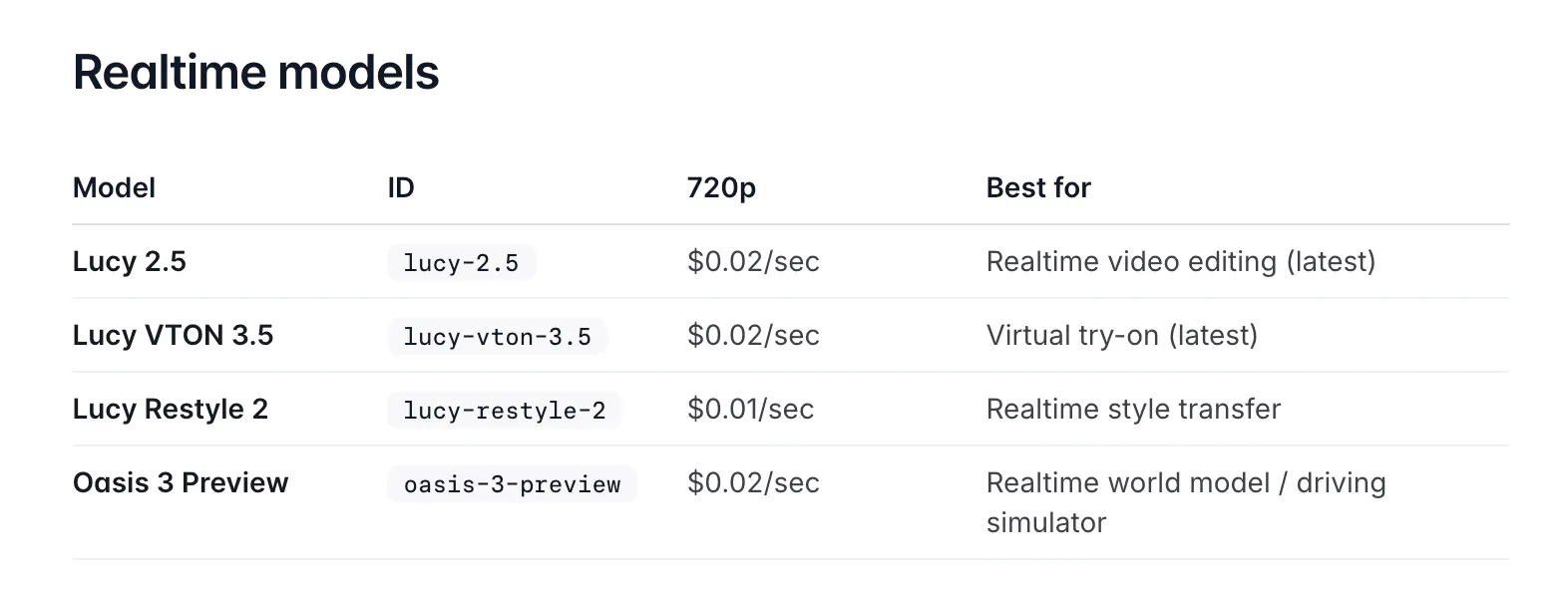
Realtime models are priced per second, at $0.02 for Lucy 2.5 Realtime and $0.01 for the rest of the realtime line, making continuous, live usage economically viable. This pricing structure favors high-frequency, session-based applications where users stay engaged over time rather than one-off outputs.
Source: Decart
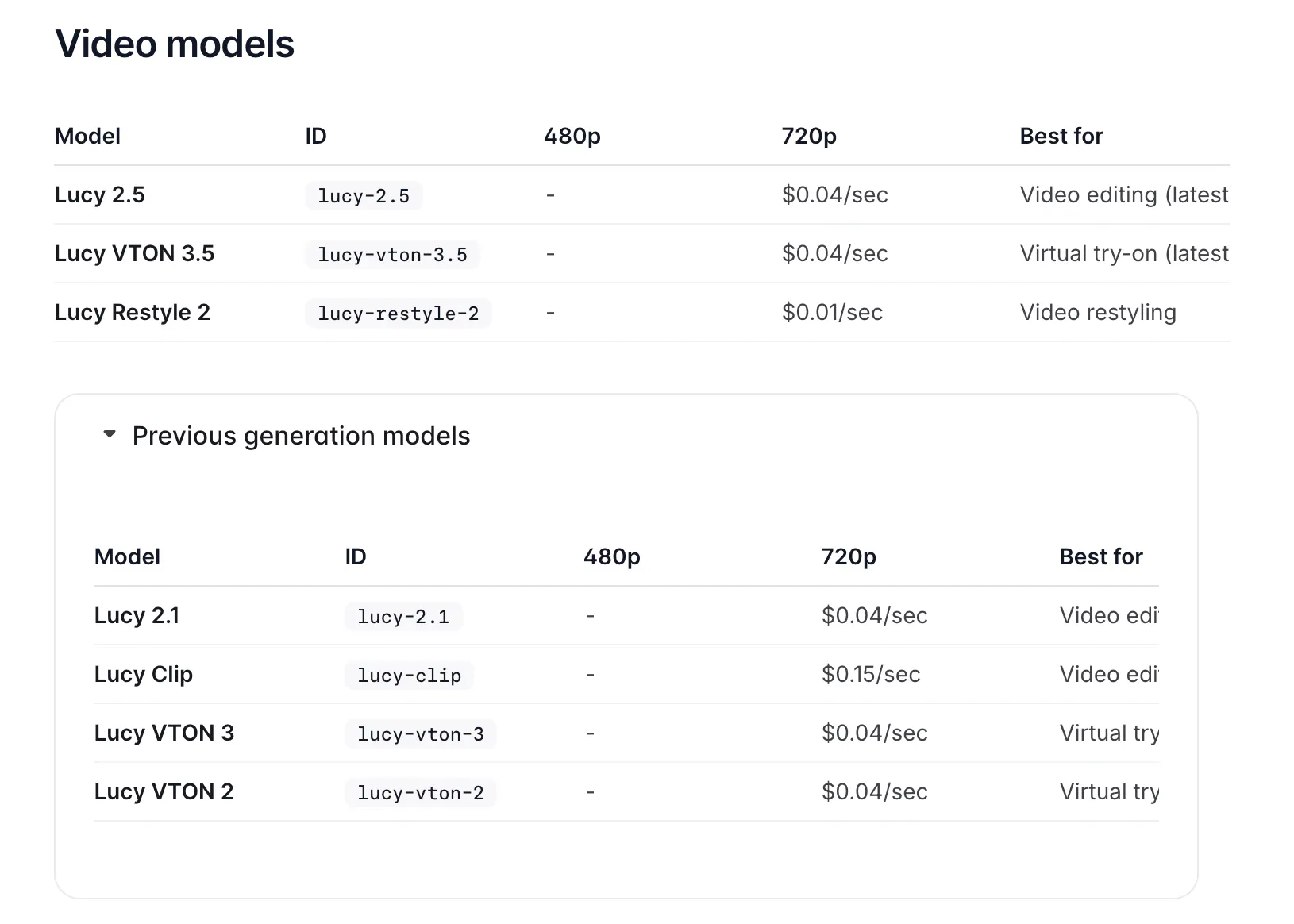
Batch video pricing scales with quality, ranging from $0.01 per second for restyling to $0.15 per second for premium editing, reflecting a clear quality-cost gradient. This allows users to trade off cost versus fidelity depending on whether they are iterating quickly or producing final, high-quality outputs.
Source: Decart
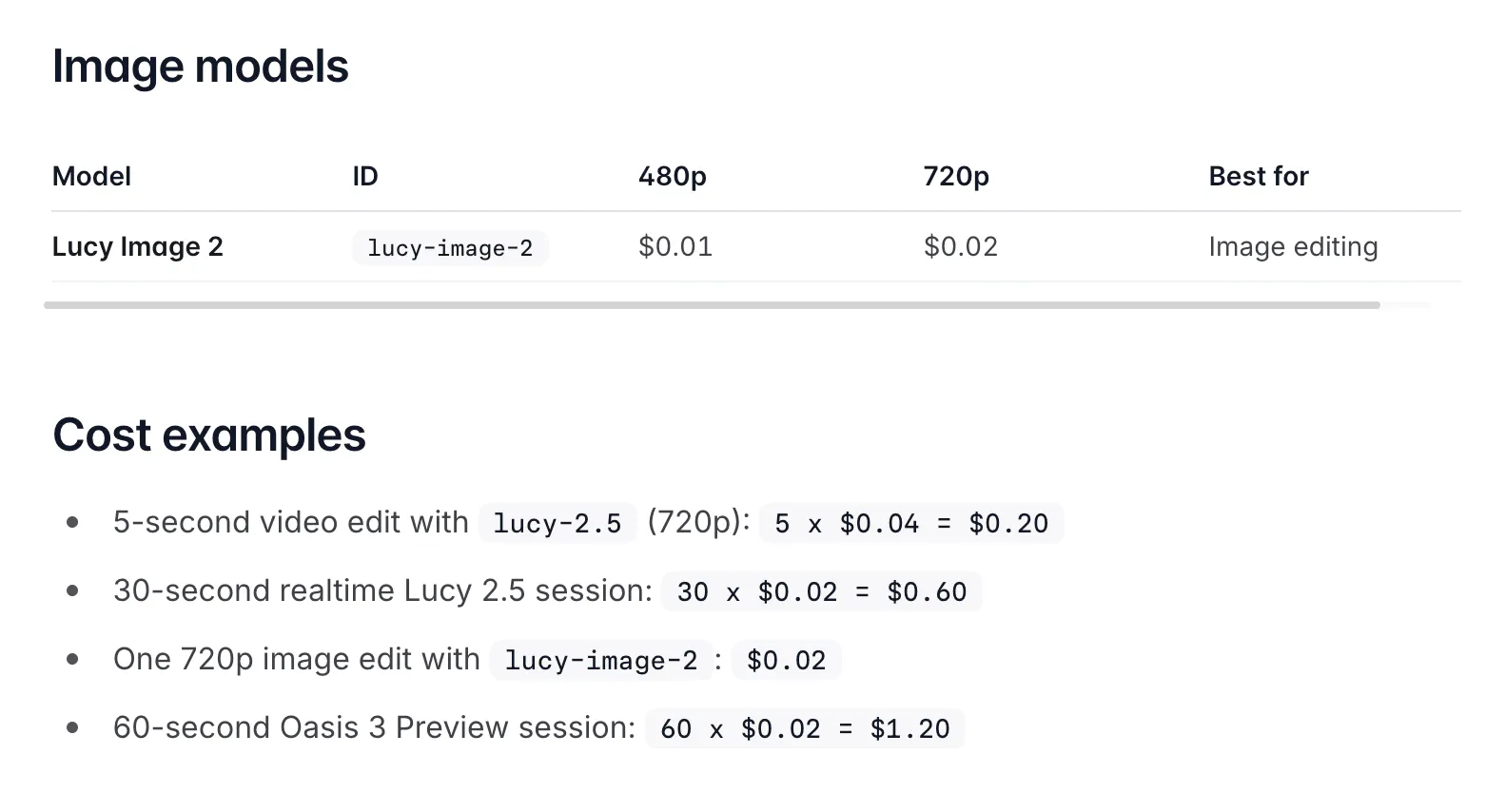
Image models are priced per generation, at $0.01 at 480p and $0.02 at 720p, making them the most accessible entry point in the stack. Their low cost supports high-volume usage, particularly for generating or refining assets that feed into more expensive video workflows.
A key strength of Decart’s business model is its capital efficiency. The company is relatively asset-light, since it doesn’t manufacture proprietary hardware, instead running on existing cloud GPUs or customers’ infrastructure. This means Decart’s cost of goods is mostly cloud compute expense, not fixed capital cost. Decart’s own innovations are focused on minimizing those cloud costs, so it can serve customers at lower operational expense than competitors running on unoptimized infrastructure. That efficiency shows up in the burn figures. By mid-2025, Decart had spent less than $10 million of the $153 million it had raised at that point, which implies enterprise contract revenue was covering most of its operating cost rather than investor capital.
Traction
Decart’s consumer demos garnered significant interest early on. Its Oasis platform hit over one million unique users in roughly three days after its launch. On the enterprise side, Decart’s initial product, a GPU-optimization infrastructure for AI training, was already generating “millions of dollars in revenue” soon after launch. Decart quickly converted early sales of its systems software into stable cash flow, enabling continued R&D even before rolling out its consumer features. Individual customers are not named publicly, though Decart has said its optimization software is licensed by major cloud providers and AI research labs.
Decart has also built an active developer and creator community around its tools. The company has released APIs and apps for real-time video effects, including a Delulu Stream plugin for Twitch and OBS and live XR filters for Quest 3 and mobile. Demos at events like TwitchCon drew the attention of streamers, and early adopters shared DecartStream clips that spread on X and TikTok, which suggests strong interest among content creators in using Decart’s sub-40ms video generation models in live environments. That community has since scaled, and as of June 2026, over 100K developers had built on Decart’s models.
Finally, Decart has secured strategic integrations with its hardware and cloud partners. Its models run on top-tier accelerators, and the Oasis demo used NVIDIA H100 GPUs. In December 2025, Decart announced a collaboration with AWS to optimize Lucy for Amazon’s custom Trainium3 chips and to distribute its generative video models through Amazon Bedrock. Decart obtained early access to Trainium3 and reported outputs up to 100 frames per second, generating frames up to 4x faster at half the cost of GPUs. By aligning with both NVIDIA’s GPU stack and AWS’s silicon and cloud ecosystem, Decart avoids single-vendor dependence on the hardware its economics rest on.
The 2026 product cadence is another clear sign of traction. Decart shipped DOS 2.0 and Lucy 2.0 in May 2026, Oasis 3 in June 2026, and Lucy 2.5 in July 2026, a release every month across two model families and the inference layer beneath them.
Valuation
As of August 2026, Decart has raised a total of $456 million in venture funding across five disclosed rounds. The most recent is a $300 million round in May 2026 at a valuation of roughly $4 billion, led by Radical Ventures. NVIDIA, Adobe Ventures, Toyota Ventures, eBay Ventures, Atreides Management, and Valor Equity Partners joined alongside existing backers Sequoia Capital, Zeev Ventures, and Benchmark, and Amazon came in as a strategic customer. Angel investors in the round included Andrej Karpathy and Michael Eisner.
Before that, in August 2025, Decart raised a $100 million Series B at a $3.1 billion post-money valuation, led by returning backers Sequoia Capital, Benchmark, and Zeev Ventures and joined by Aleph. In December 2024, the company raised a $32 million Series A at a $500 million valuation, led by Benchmark. Two months prior, in October 2024, it closed a $21 million seed round at a valuation just over $100 million, led by Sequoia Capital and Zeev Ventures. A $3 million round preceded the official seed in December 2023, shortly after founding.
The trajectory of valuation growth has been rapid. Decart went from a valuation just over $100 million in October 2024 to $4 billion in May 2026, a 40x increase in nineteen months, across four priced rounds as of August 2026. The August 2025 round made it Israel’s first AI startup to pass a $1 billion valuation. However, publicly disclosed revenue details remain sparse. At the time of its Series B, Decart was generating estimated revenue of $1 million to $10 million, and it has not disclosed a revenue figure since.
Decart has also generated significant acquisition interest. In August 2026, Anthropic was reported to be in talks to acquire Decart for $6 billion, a figure later reported at close to $7 billion, paid mostly in Anthropic shares. It would be Anthropic’s largest acquisition and would give it a development center in Israel. NVIDIA reportedly bid higher, at an estimated $7 billion to $8 billion, and lost. Google and SpaceX have been named as alternative bidders. The founders hold 64% of Decart’s shares between them. However, as of mid-August 2026, no deal had yet been signed.
Key Opportunities
Inference Efficiency as the Scarce Asset
The generative AI market is projected to approach $1 trillion by 2035 and is growing at a 35% CAGR and the next phase of that expansion is likely to be defined by real-time, continuously updating systems embedded inside live environments rather than by static content generation. As generative models move from offline creation tools into streaming platforms, gaming engines, and immersive media, latency and cost per generated second become the binding constraints.
That shift is already indicated by Anthropic’s willingness to pay $6 billion or more to acquire Decart, and NVIDIA’s reported counter-bid above it, were, as of August 2026, two of the largest buyers of compute in the world bidding against each other for an efficiency layer. Decart’s opportunity is that DOS is desirable to all of them. The optimization work that makes Lucy economically viable would make any frontier lab’s inference bill smaller, and unlike a model, an efficiency layer does not have to be the best in the world to be worth buying, it only has to beat the cost per token the customer already pays.
Physical AI and Simulation Demand
Simulation is the part of autonomous systems development that cannot be solved by collecting more real-world data, because the scenarios that matter most are the ones too rare or too dangerous to stage. Decart entered that market in June 2026 with Oasis 3, which generates photorealistic multi-camera driving environments through an API, and has said it will extend the model to robotics. The strategic value of this segment is that it converts Decart’s core capability from a “vitamin” into an “aspirin”. A streamer restyling a webcam feed will stop paying when the novelty fades; an AV program that has built simulated-mile coverage into its validation process will not, because dropping the vendor means redoing the safety case.
Distribution Through Cloud Platforms
Selling inference software to enterprises usually means a long direct sales motion, and Decart has largely avoided one. Its models became available through Amazon Bedrock in December 2025, which puts them in front of AWS’s enterprise customer base through AWS’s own procurement path. The same partnership optimized Lucy for Trainium3, where Decart reported frames generated up to 4x faster at half the cost of GPUs, an arrangement that benefits both sides. Amazon has a commercial reason to promote models that make its own silicon look better than NVIDIA’s, and Decart gets distribution plus a hardware hedge it did not have when Oasis ran exclusively on H100s. Over 100K developers had built on Decart’s models as of June 2026, and the platform path is how that number grows without a proportional increase in sales headcount.
Israel’s AI Ecosystem and Talent
There is intense competition for AI researchers and engineers, and companies that tap into under-utilized talent pools or foster new talent stand to gain a long-term edge. Israel in particular has emerged as an untapped wellspring of AI expertise which Decart is positioned to take advantage of. The company’s leadership and many early team members come from the Technion and Unit 8200, and it deepened the link by forming a partnership with the Technion: Decart pledged funding to the university’s elite honors program, since renamed the Technion-Decart Excellence Program, and agreed to launch a joint AI research center on campus. This asset is partially responsible for Anthropic’s interest in Decart, which is reported to be partly about establishing an Israeli development center.
Key Risks
Product and Market Focus
Decart’s founders have a stated ambition of building an app that serves a billion users, and as of August 2026 the company is selling into four distinct markets at once: cloud and lab infrastructure, consumer entertainment, creator tooling, and autonomous-vehicle simulation. Those buyers have little in common. The skepticism the founders met early on was specific about this: in raising the seed round, Dean Leitersdorf reported that half of potential investors told the team they could “succeed technically, but we don’t understand what the final product is, so we’ll pass”. One prominent investor, referred to as “Sarah” in press accounts, said she did not know what Decart was trying to build. The company has since answered that criticism with revenue and a developer base rather than a single flagship product, but the underlying tension has not resolved: a company selling an inference layer to hyperscalers, a restyling filter to streamers, and simulated miles to AV programs is running three go-to-market motions on one engineering team, and the consumer products have never been monetized at all.
Execution Risk and Technical Uncertainty
Decart is attempting real-time, high-fidelity generative video and world simulation at consumer scale, which remains largely uncharted. The company has hit impressive technical milestones. Lucy 2.5 edits live video at 1080p and 30 frames per second as of July 2026, which no mainstream competitor matched at that latency. But the newest product shows how far the frontier still is. In testing, Oasis 3’s environmental consistency degraded over extended sessions, a prompted New York street drifted into a generic Western city, controls lagged, and cars passed through objects instead of colliding with them.
Those issues matter more in the AV market than they did in gaming, because a simulator whose physics are wrong produces validation data that is worse than none. Decart also runs a far smaller engineering team than the labs it competes with. It employed fewer than 150 people at the time of its Series B in August 2025 and has grown since, against headcounts in the thousands at Google DeepMind and OpenAI, and it is chasing a frontier where Genie 3, Marble, and GWM-1 all shipped within nine months of each other.
Capital Intensity Ahead
Decart has been capital-efficient so far, having spent less than $10 million of the $153 million it had raised by mid-2025. That will not hold as the company scales. Training frontier generative video models and building real-time inference infrastructure are costly, and the talent is priced accordingly: one report found an “AI premium” for LLM and related specialists averaging over NIS 43K per month, or $14K. To build what Dean Leitersdorf describes as one of the deepest AI labs in the world, Decart has to match compensation offers from companies with far larger balance sheets, including NVIDIA, which carried a $5.5 trillion market capitalization as of August 2026. Payroll and infrastructure costs will rise faster than the historical burn figures suggest.
Geopolitical and Operational Risks
Decart’s base in Israel offers access to a deep engineering talent pool, but also carries geopolitical and operational uncertainty. Since late 2023, Israel has been engaged in multi-front conflicts, and in February 2026 the United States and Israel began a war with Iran that included the assassination of Supreme Leader Ali Khamenei. A significant portion of Israeli tech workers are reservists, and news reports emphasize that military duty “is an established risk factor” for startups. Israeli high-tech companies have had to absorb call-ups affecting 15% to 20% of their workforces and sometimes more, and 30% of Israeli tech firms cited reserve call-ups as their biggest challenge.
Decart’s core R&D team in Tel Aviv, which accounts for the large majority of its headcount, could be affected if employees are drafted or otherwise diverted, causing development slowdowns. Its Israel-centric presence may also create practical challenges in serving US enterprise customers who often favor vendors in their own region, and time-zone differences and travel restrictions during periods of regional instability could complicate sales and partnerships. The San Francisco and New York offices led by Aberman are a partial hedge against exactly this exposure.
Summary
Decart builds real-time world models and the inference layer that makes running them affordable. The company generated its first revenue from DOS, a GPU-optimization stack licensed to AI labs and cloud providers, then built two model families on top of it. The first is Oasis, which generates interactive environments and since June 2026 sells driving simulation to autonomous-vehicle developers. The second is Lucy, which edits live video streams at 1080p and 30 frames per second. As of August 2026 it has raised $456 million across five rounds, including a $300 million Series C in May 2026 at a $4 billion valuation. Anthropic was reported in August 2026 to be in talks to acquire the company for $6 billion to $7 billion, ahead of a reportedly higher NVIDIA bid.