Thesis
By 2022, video had become the largest format of content on the internet, accounting for 65% of all internet traffic. Demand for generated rather than recorded media climbed alongside it, enabled by the release of DALL·E 2 and open-source text-to-image models like Stable Diffusion. When OpenAI released Sora as a standalone app in September 2025, it reached one million downloads in under five days, faster than ChatGPT. OpenAI then reversed course, deprecating the Sora 2 models and its Videos API in March 2026 and scheduling their shutdown for September 2026 with no named replacement. The appetite those launches exposed did not retreat with them, and Google's Nano Banana brought in 10 million first-time Gemini users and 200 million image edits within five days of its September 2025 launch.
The advent of generative video coincided with the growth of advertising revenues worldwide, which grew to over $1.1 trillion in 2025, and 30% of digital video ads that year were enhanced or built from scratch by generative AI, a shift enabled by the ability to hold a brand's visual identity constant through Low-Rank Adaptation (LoRA) fine-tuning. Meanwhile, generating AI video is costly. Inference represents roughly 80-90% of a model's total lifetime cost, and accounted for about one third of AI compute in 2023, half in 2025, and an estimated two-thirds in 2026. Hyperscalers are expected to spend over $500 billion on AI infrastructure in 2026, yet benchmarked GPU utilization often hovers at 30-50% of available capacity. For a single mid-sized cluster of 64 H100 GPUs, 40% utilization can mean wasting $1.1 million per year.
Fal is a generative media platform for developers. It hosts image, video, and audio models behind a single API and runs them on an inference engine built for the mathematics of diffusion models rather than for language models. Rather than managing multiple vendor relationships or integrating dozens of APIs, developers can access everything from FLUX.1 to Kling to the latest Veo models through one integration. Fal offered over 1K models as of September 2026 and trains LoRAs inside the same interface. Its position rests on the idea that generative media inference differs from language-model inference, that customers buy latency, and that a platform tuned for every media model beats a generalist running all of them adequately.
Founding Story

Source: First Round
Fal AI, formerly known as Features and Labels, was founded in 2021 by Burkay Gur (CEO) and Gorkem Yurtseven (CTO).
Gur graduated from MIT in 2012 with an undergraduate degree in electrical engineering and a master's in electrical engineering and computer science. His graduation came just after the release of Siri, as chatbots were first becoming popular, and out of college he joined Oracle to work on them. In 2016, he moved to Coinbase, where he became the company's first machine learning hire, focused on fraud. He left Coinbase at the end of 2020 to co-found fal, and remains its CEO.
Yurtseven, meanwhile, graduated from the University of Pennsylvania in 2013 with an undergraduate degree in computer systems engineering. After college, he joined Amazon as a software development engineer, where he worked on SageMaker and other developer tools. Batuhan Taskaya joined as head of engineering in 2022, having previously been one of the core maintainers of Python, and was the youngest during his tenure.
The two founders met in San Francisco and formed a bond over their shared background as Turkish immigrants. During the COVID-19 pandemic, the pair moved to Palm Springs together, rented a house, and worked through venture ideas. Their initial thesis grew out of the observation that many of the most valuable companies of the prior five years, such as Snowflake and Databricks, were compute and infrastructure platforms. They believed the next breakout company would be built the same way, but for machine learning workloads, and set out to build developer-first Python infrastructure for enterprises running machine learning systems rather than developing models.
The release of DALL·E 2, Stable Diffusion, ChatGPT, and LLaMA made high-quality foundation models widely available and lowered the barrier to building AI applications. Most teams could start from a pre-trained model and adapt it rather than train from scratch. Fal began working with image generation models as an extension of its compute thesis, and at the time the team counted only a handful of image models but expected the number to grow quickly. Rather than optimize for a single model and risk being invalidated by the next architectural shift, fal built its infrastructure to be model-agnostic.
Working with early customers surfaced two things. Demand from users building image-based applications was growing quickly and expanding into video, and the models themselves were slow and inefficient to run. The team turned to optimizing them, building a reputation for performance before it had consciously decided to specialize in generative media.
Product
Fal is a generative media infrastructure platform that serves as the backend layer powering AI-generated images, videos, audio, and 3D content. Developers build on the platform, and their end users never interact with fal directly, engaging instead through applications built on its APIs. A photo editing app that creates AI backgrounds, or a marketing platform that produces product videos on demand, may run on fal without the end user ever knowing. What would otherwise be a months-long infrastructure project, procuring GPU servers, hosting models, building autoscaling systems, and tracking new model releases, collapses into a few lines of code.
The platform has three core offerings. Model APIs is a developer-facing interface to the model catalog, Serverless is execution infrastructure that runs requests, and Compute is dedicated GPU capacity for enterprise and training workloads. In addition to these three, there is fal Agent, which is a conversational layer that orchestrates models on a user's behalf. Fal also offers a set of platform endpoints that expose model metadata, pricing, usage, logs, and metrics programmatically, allowing customers running fal at scale to reconcile spend and audit calls without going through a dashboard.
Model APIs

Source: fal
Model APIs is fal's primary product, the interface through which developers reach over 1K production-ready models spanning image, video, audio, and 3D generation as of September 2026. Every model in the catalog is reachable through one standardized interface, with the same authentication, request format, and software development kit (SDK). Switching from one image model to another means changing a single identifier, with no new integration, SDK, or documentation. Fal also makes newly released models available on the day they launch, so developers building on the platform reach the latest models without additional work.
Different kinds of generation have different performance characteristics. Generating a video, which is many temporally dependent frames, is more compute-intensive than generating a single-frame image. Fal therefore supports three ways of calling a model, plus a fourth pattern for chaining several together.

Source: fal
The queue is the default and recommended method, designed for requests that take longer than a few seconds, such as video generation. A developer submits a request naming a namespace and model, optionally with a subpath for a specific capability, and immediately receives a tracking ID. That ID is used to check status, stream log output, and retrieve the result when ready. Separating submission from retrieval is what makes fal viable for video generation and model training at production scale, because the application never holds an open connection for the length of a job. Developers use this asynchronous flow to submit requests in parallel and keep serving users while generations run.

Source: fal
Synchronous requests are simpler and are the lowest-latency option, suited to requests that finish quickly. The tradeoff is that they require an unbroken connection, which removes the flexibility to batch requests and makes them sensitive to dropped connections. WebSockets suit interactive applications where a user iterates quickly and needs near-instant feedback, maintaining a persistent connection and streaming outputs back rather than running a request-response loop. That enables live image-editing interfaces, where adjusting a prompt updates the result in place.

Source: fal
Workflows chain multiple models into one pipeline. Rather than calling models individually and stitching results together in custom code, a developer creates a single endpoint that passes an input through several models in sequence. One workflow could generate a product image with FLUX, upscale it, apply a brand-specific style, and return several format variants from one API call. Fal's workflow engine emits four events, covering step submission, step completion, final output, and errors. Because these pipelines are built on fal rather than in a developer's own code, they raise switching costs considerably.
Serverless
Source: fal
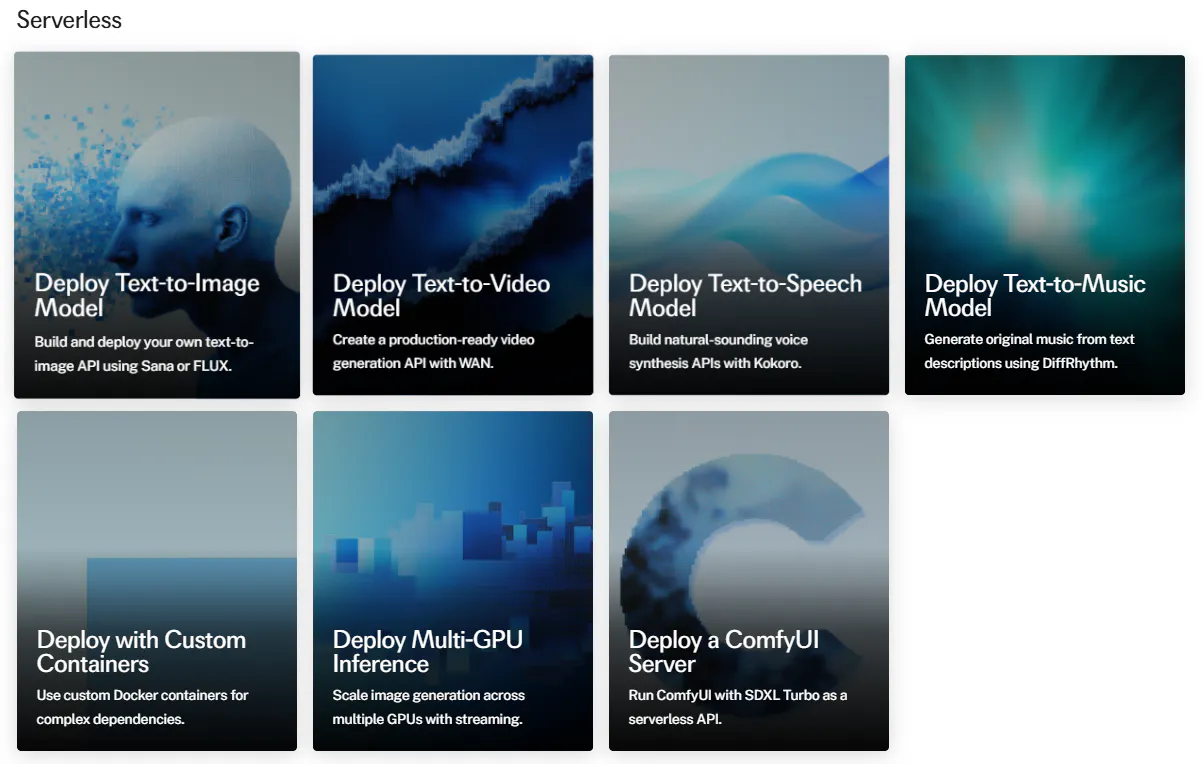
Serverless provides on-demand GPUs that scale to thousands of units instantly. When a developer calls a fal endpoint, fal allocates GPU resources, loads the model, runs the generation, streams the result back, and deallocates, with no infrastructure management on the developer's side. Developers can also host their own models, apps, and workflows on the same infrastructure, and as of September 2026, can publish them to a marketplace for other customers to call.
Fal's differentiation in Serverless comes from the fal Inference Engine, which it built to optimize how models run on GPU hardware. A kernel is a specialized function written in CUDA, the basic building block that tells a GPU what to do, comparable to a procedure in ordinary CPU code. Fal has a dedicated team writing templated kernels that cover roughly 95% of the work a fully specialized kernel would do, while staying flexible. The team traces model execution, finds patterns that those semi-generic kernels can cover, and swaps in specialized kernels at runtime.

Source: fal
A traditional issue among inference providers is the time a model takes to load into GPU memory on first use, known as a cold start. Fal addresses it with scaling parameters and with FlashPack. The parameters trade off differently, so keep_alive keeps a runner warm between requests while startup_timeout caps how long a cold start may run before failing. FlashPack is a file format and loading mechanism for PyTorch that fal claimed made model loading three to six times faster than existing methods when it launched in October 2025. Serverless also lets developers pick specific hardware, trading cost against performance.
Compute

Source: fal
Compute is fal's dedicated GPU cloud, built for workloads that need guaranteed persistent capacity rather than on-demand bursting. Unlike Serverless, which allocates and releases GPUs per request, Compute gives customers reserved clusters with full control. As of September 2026, fal lists B300, B200, H200, H100, and RTX PRO 6000 GPUs on its fleet. Customers get enterprise-grade security and compliance features, custom-optimized infrastructure, low-latency, high-bandwidth interconnect for distributed computing, and scalable architecture.
The ideal use cases are large language model training, custom fine-tuning, distributed training, and large-scale workloads whose volume is predictable enough that reserved capacity beats Serverless on cost. Compute also supports fal's enterprise compliance requirements, including SOC 2 certification, single sign-on, private model hosting, and dedicated support for custom fine-tuning.
fal Agent
fal Agent, launched in early access in August 2026, is a conversational interface that selects and chains models on a user's behalf. It picks a model per task, carries characters, references, and visual style across generations, and keeps project memory so work can resume weeks later without rebuilding prompts. Fal has listed programmatic access through an API, a command-line tool, and an MCP server integration as coming soon rather than available.
The product moves fal up the stack from infrastructure toward the creative teams operating it. Where Model APIs and Serverless are sold to engineers, fal Agent is aimed at the designers and producers those engineers build for, which widens the buying center inside an existing enterprise account rather than requiring a new one.
Market
Customer
Fal serves two related customer segments that lie on a spectrum, from individual developers calling models self-serve to enterprises on negotiated contracts, and it reported over 2.5 million developers on the platform as of August 2026.
Self-serve developers and AI startups. Fal's developer-first approach, combined with the early stage of generative media adoption, meant most of its initial customer base was independent developers. At the time of its Series A in September 2024, fal had 500K developers. In August 2024, Black Forest Labs' FLUX models were, on release, the first generative media models to reach commercially usable, enterprise-grade quality. Google's Veo 3, launched in May 2025, represented the arrival of a properly usable text-to-video component. Those improvements let application startups scale, and they turned to fal to run inference.
Layer, an artist-first platform where studios generate and refine 2D, 3D, video, and audio assets while keeping creative control, saw inference speeds twice as fast as its in-house clusters and cut infrastructure costs by 30% against self-managed GPUs. Pimento, which powers ad creation and editing workflows for marketers and agencies by training custom models on their own visual references, cut generation times by 80% and integrates new models into production within 24 hours. Kay Zhu, CTO of AI agent platform Genspark, said that "Fal's seamless integration of generative media capabilities has empowered our AI agent ecosystem to deliver visually rich, dynamic results."
Enterprise clients. Enterprise client count grew from 50 in February 2025 to over 300 as of July 2025. These are typically engineering organizations that have prioritized API integration for programmatic control and workflow automation. Named enterprise customers include Quora, Adobe, Canva, Shopify, Perplexity, and, as of May 2026, Amazon MGM Studios. Advertising and entertainment lead adoption of generative media models on an industry basis.

Source: fal
Poe, Quora's consumer AI platform, is the most instrumented of these relationships. As of January 2025, fal powered 50% of Poe's video and image generation messages, with response times down 36% against the Flux-dev endpoint it was compared with, and its bots received positive user feedback up 18% against other multimedia bots on the platform. Adam D'Angelo, CEO of Quora, said that "The fal team is one of the fastest-moving organizations we work with and consistently goes the extra mile to optimize inference and ensure great user experience."
Market Size
The AI inference market was valued at $106 billion in 2025 and is projected to reach $255 billion by 2030, a 19.2% CAGR over 2025 to 2030. Fal's domain within that market is generative media, which, as of 2026, is smaller than language model inference but growing faster. It also has different unit economics, because a five-second AI-generated video clip consumes more compute than thousands of text completions, making each API call worth more.
The end markets that fal operates in reflect that growth. The generative AI music market was valued at $569.7 million in 2024 and is projected to reach $2.8 billion by 2030, a 30.5% CAGR. The generative art and design market was valued at $298.3 million in 2023 and is expected to reach $8.6 billion by 2033, a 40% CAGR. Media companies using generative models in pre-visualization and VFX work are projected to raise spending from $2.6 billion in 2024 to $12.5 billion by 2029. Marketing and advertising lead, with 55% of surveyed organizations already using video models for campaign creation and spending projected to rise from $27 billion in 2025 to $82 billion by 2030.
Following Jevons paradox, total infrastructure spend has continued to grow even as per-unit inference costs have fallen, because declining prices expanded usage volume faster than they compressed revenue. Taken together, design, music, media, and advertising represent a generative media infrastructure opportunity in the tens of billions of dollars by the early 2030s. The total generative AI market is projected to reach $1.3 trillion by 2032 at a 42% CAGR, with infrastructure-as-a-service the single largest component.
Competition
Competitive Landscape
Fal competes in a market that is young and crowded. Startup activity in 2025 clustered around inference and compute without any single player locking up the market, and a group of well-funded startups has converged on the same two surfaces, performance and developer experience, from different angles. The landscape can be divided into AI inference platforms such as Together AI, Fireworks AI, Baseten, Modal, and Replicate, which are fal's most direct rivals, and the cloud hyperscalers every startup must navigate around.
Artificial Analysis' 2025 media survey put fal second in both categories it competes in. Google AI Studio led image endpoint adoption with fal second, ahead of OpenAI and Replicate. Splitting that by user type is more useful. Google led among individuals while fal led among organizations for image APIs, the segment that generates sustained inference volume. The same survey placed fal second in video endpoints behind Google AI Studio and ahead of Replicate, Kling, and MiniMax. It was conducted before OpenAI announced it would retire its Videos API, which removes one of the image-endpoint alternatives the survey measured.
Direct Competitors
Together AI: Founded in 2022 and headquartered in San Francisco, Together AI provides a platform connecting users to a network of high-end GPUs, letting them run open-source models without relying on traditional cloud services. In July 2026, it raised an $800 million Series C led by Aramco Ventures at an $8.3 billion valuation, and reported annual bookings above $1.1 billion. As of September 2026, it has $1.3 billion in total funding. It shares fal's developer-first approach and usage-based pricing, but where fal built around generative media, Together AI spans text, media, code, and embedding models.
Fireworks AI: Founded in 2022 by former members of Meta's PyTorch team, Fireworks AI runs a platform for deploying and optimizing model APIs with a focus on fast, cost-effective inference. In July 2026, it raised a $1.5 billion Series D led by Atreides Management, Index Ventures, and TCV at a $17.5 billion valuation, having surpassed $1 billion in annualized revenue, with total funding above $1.8 billion as of September 2026. Like Together AI, it serves generative media models, but its weight remains in language models. Genspark is a client of both companies, using fal for generative media and Fireworks AI for language workloads.
Baseten: Headquartered in San Francisco, Baseten sells infrastructure for deploying and serving models in production, with an emphasis on dedicated deployments and custom performance work. In June 2026, it raised a $1.5 billion Series F led by Altimeter Capital, Conviction Partners, and Spark Capital at a $13 billion valuation, its fourth round in 18 months, and reported revenue up 20 times year over year. It has raised a total of $2.1 billion in funding as of September 2026. Its customer base skews toward language and agent workloads rather than media, which is the clearest line between the two companies.
Modal Labs: Founded in 2021, Modal sells serverless compute that turns a Python function into an autoscaling GPU workload, which overlaps directly with fal's Serverless product. In May 2026, it raised a $355 million Series C led by General Catalyst and Redpoint Ventures at a $4.7 billion valuation, up from the $1.1 billion it was valued at in September 2025. It has raised a total of $465.5 million in funding as of September 2026. It is the closest comparable to fal on both valuation and revenue, and it competes on general-purpose developer ergonomics rather than on media-specific model optimization.
Replicate: Founded in 2019 in San Francisco, Replicate runs an API-first platform for machine learning models spanning video generation to object detection. Cloudflare announced in November 2025 that it would acquire the company and fold its model catalog into Cloudflare Workers, with Replicate continuing to operate under its own brand. Replicate had raised roughly $58 million before the acquisition, including a $40 million Series B led by Andreessen Horowitz in December 2023. Like fal, it started in generative media before moving toward open-source language models. One customer of fal at a major ecommerce company described the strength and support of fal's engineering team as what made it the better enterprise partner, rather than feeling like a model warehouse.
Large Cloud Providers
Google AI Studio and Google Vertex: Google AI Studio is a web-based development environment for the Gemini family, used for quick prototyping. It was released alongside the Gemini API in December 2023 and serves as a gateway into Google's wider AI ecosystem. Vertex, launched in May 2021 as Google's enterprise AI developer platform, has since been rebranded as the Gemini Enterprise Agent Platform. Alphabet's market cap stood at $4.2 trillion as of September 2026. Both provide serverless inference without fal's degree of media-specific optimization.
AWS Bedrock: Bedrock, launched in September 2023, offers a choice of foundation models from companies including Anthropic, Cohere, and Stability AI. Like fal it provides a unified API so developers can swap models without rewriting applications, and it is fully managed. Amazon's market cap stood at $2.7 trillion as of September 2026. The relationship is no longer purely adversarial: in May 2026, fal and AWS announced a partnership to move parts of fal's serverless infrastructure onto AWS over the course of 2026, with Gorkem Yurtseven describing AWS as the "global scale and reliability layer" beneath fal's optimization work.
Business Model
Fal operates an infrastructure-as-a-service model, pricing its Serverless and Compute products differently from its Model APIs. It also offers enterprise contracts with volume commitments, covering custom fine-tunes, private model hosting, bespoke kernels, and enhanced security, and provides research grants to people advancing AI through open-source projects. In August 2026, it added a fourth motion, subscription tiers for fal Agent, which is the first part of the business that bills on a recurring basis rather than on consumption.
Serverless and Compute Pricing

Source: fal
Fal charges for Serverless and Compute by GPU time on its own fleet, quoting both a list rate and a discounted rate per chip. As of September 2026, H100 capacity starts at $1.9 per hour against a list rate of $4.5, while B300, the newest chip on the fleet, starts at $4.5 against a list rate of $8.5. The spread between list and discounted pricing is where volume commitments are negotiated.
Model APIs Pricing, Video Models

Source: fal
Within Model APIs, fal bills video model calls by output unit, either per second of video or per video generated. The prices pictured assume a five-second clip at 720p resolution.
Model APIs Pricing, Image Models

Source: fal
For image models, fal bills by either image count or output size in megapixels, with the pictured prices normalized to a one-megapixel basis and higher resolutions priced proportionally. Some image models use GPU-based pricing instead, depending on their architecture.
fal Agent Pricing
fal Agent is sold in four tiers as of September 2026. Starter costs $50 per month, Pro $200 per month with a discount of 5% off interface usage rates, and Max $1K per month with a discount of 10% off those same rates, with custom enterprise pricing above that. Each tier includes monthly credits usable across the whole platform. Unused credits roll over month to month, and a customer spends them down before standard usage rates apply. The structure keeps consumption billing intact while adding a committed monthly floor, which is a different revenue quality than the usage-based business beneath it.
Cost Drivers
Fal's dominant cost is GPU capacity, and it carries that cost in two forms. It rents from cloud providers, and it operates its own colocated fleet across 35 data centers as of December 2025, which means paying for headroom that sits idle between demand spikes. The second cost is the research team writing kernels, which is the work the inference engine depends on and a fixed cost that does not scale down with usage. Fal has not disclosed gross margin, so how much of the optimization advantage reaches the income statement is not publicly checkable.
Traction
Fal's revenue has grown steeply over the past two years as of 2026. In September 2024, the company reportedly generated $10 million in annual recurring revenue, a 10x increase from January 2024, having reached 500K developers and 50 million images, videos, or audio streams per day. As of January 2025, it generated $3.6 million in monthly revenue, a $40 million run rate, with no sales team. By February 2025, it had over 1 million developers and more than 50 enterprise customers, including Quora, Canva, and Perplexity, and had formed partnerships with Black Forest Labs and PlayAI.
Between May and July 2025, annual recurring revenue rose by more than half, to $95 million. By then, fal had over 2 million developers and 300 enterprise customers, had added Moonvalley and Foster + Partners as clients, and had formed partnerships with Google Gemini, Stability AI, ByteDance, Kling, and MiniMax.

Source: Notable Capital
Fal reached $200 million in annualized revenue as of October 2025 and grew its team from 30 to 70 people over the year to October 2025. Reporting in March 2026 put annualized revenue near $400 million, a 40x increase over 18 months. Headcount reached 80 as of September 2026, and developer count passed 2.5 million by August 2026.
Valuation
In December 2025, fal raised a $140 million Series D led by Sequoia at a $4.5 billion valuation, bringing its total funding to $337.5 million as of September 2026. That Series D was part of a broader deal including a $110 million secondary share sale in October 2025, which valued the company above $4 billion.
Fal raised its Series C five months earlier, in July 2025, a $125 million round led by Meritech Capital at a $1.5 billion valuation. It raised a $49 million Series B in February 2025, led by Notable Capital and Andreessen Horowitz. Its first financing came in September 2024 as a two-part deal, a $14 million Series A at an $80 million valuation led by Kindred Ventures, alongside a $9 million seed round led by Andreessen Horowitz.
The trajectory is unusually steep even by 2025 and 2026 standards. The Series A valued fal at $80 million in September 2024 and the Series D at $4.5 billion 15 months later, a 56x step-up, with the Series C to Series D leg alone tripling the valuation in five months. Reporting in March 2026 described fal as in talks over a new round at roughly $8 billion, which would be another near-doubling. No such round had been announced as of September 2026, so $4.5 billion remains the last priced valuation.
Companies in fal’s market have received high revenue multiples. Fireworks AI was valued at $17.5 billion in July 2026 on over $1 billion of annualized revenue, a revenue multiple near 17 times. Modal was valued at $4.7 billion in May 2026 on annualized revenue of $300 million, near 15 times. Fal's $4.5 billion valuation in December 2025 against the $400 million of annualized revenue reported in March 2026 works out near 11 times.
Key Opportunities
AI Inference Demand
The tailwind underlying fal's entire business is the shift of AI compute spending from training to inference. Inference made up roughly one third of AI compute in 2023 and half in 2025, and is projected to drive two-thirds in 2026. Most of it will keep running in data centers on AI chips worth over $200 billion rather than on inexpensive edge silicon, so general movement toward the edge does not threaten a company running large, compute-intensive models. Each application built on fal generates inference volume that compounds with its own user base, which is a large part of why revenue grew from $10 million in September 2024 to a reported $400 million by March 2026. Despite falling unit costs of inference, rising volume has lifted net spend on generative AI thanks to its usage-based revenue model.
Multimodal Advancements
Models such as Claude, Gemini, and ChatGPT have reached broad capability through scaling compute and techniques including reinforcement learning, but they learn from statistical patterns in text and lack a representation of physical reality. Under training and evaluation systems as of March 2026, language models were rewarded for producing plausible but incorrect answers. Researchers, including Yann LeCun, argue that language models will not scale to general intelligence, and that the path runs instead through world models, which represent cause and effect in a physical environment.
In December 2025, LeCun left Meta to found AMI Labs, seeking to raise $586 million at a $3.5 billion valuation, with a focus on cause-and-effect understanding, persistent memory, and task planning. In January 2024, Fei-Fei Li founded World Labs to build 3D environment generation with real-time simulation; it released Marble in September 2025 and raised $200 million in February 2026 at a reported $5 billion valuation. Google DeepMind released Genie 3, the first real-time interactive general-purpose world model, in August 2025.

Source: Introl
These models reach across gaming and entertainment environments, simulated training grounds for robotics and autonomous vehicles, scientific simulation, and applications in fields sensitive to language model hallucination. Like video models, world models are trained on video data that raises memory and compute requirements sharply, and they add a further layer of physics simulation on top. That combination is the kind of workload fal's optimization work targets, and it would extend the company's addressable market beyond image and video into simulation.
Moving Up the Stack into Orchestration
Generative media models were expected to converge on a single omni-model handling every task. Enterprise production deployments instead use a median of 14 different models, because task-specific optimization keeps outperforming general-purpose approaches for specialized applications. That fragmentation is what makes an orchestration layer valuable. With orchestration, a developer calling a single model API faces low switching costs, while one who has built a custom pipeline, for instance, an image passed through Seedream v4 Edit and then Seedance 1.0 Pro, is entrenched and faces high ones. More complex pipelines also call more models per session, multiplying inference revenue per unit of customer effort.
Fal has moved on this twice. It acquired YC-backed Remade in November 2025, a builder of AI-native tools for creative and design teams, then launched fal Agent in August 2026 with subscription pricing attached. The company has also begun post-training models under its own name, releasing H3 Max in August 2026, a version of MiniMax's open-weights H3 model that fal claimed runs at about 35 times the throughput of MiniMax's own endpoint. Each step widens the buyer inside an account from the engineer integrating an API to the creative team producing the work.
Key Risks
GPU Supply and Capital Constraints
Fal offers access to B300, B200, H200, H100, and RTX PRO 6000 chips across its Serverless and Compute platforms, both renting GPUs from cloud providers and operating its own collocated infrastructure. As of December 2025, it was running in 35 data centers. For fal's workloads H200 chips are considered "overkill", and the company has been moving from H100 directly to B200 and B300 for better performance per watt and per dollar. However, there have been supply limitations. Nvidia CEO Jensen Huang confirmed in December 2025 that Blackwell chips were sold out through mid-2026, against a backlog of 3.6 million units from the largest cloud providers alone. Fal's exclusive reliance on Nvidia silicon concentrates that exposure.
In this context, capital can become a competitive weapon by allowing capacity to be bought ahead of demand and allocated against a backlog the biggest committed buyers reach first. Fal's total funding of $337.5 million as of September 2026 is less than a quarter of what either Fireworks AI or Baseten raised in a single 2026 round. Fal's business rests on converting an optimization advantage into a price and performance advantage. If GPU costs rise faster than it can pass them through, or if a better-funded rival buys the same capacity cheaper and funds the same media-specific kernel work, the advantage compresses from both directions at once. Batuhan Taskaya has argued that fal's exclusive focus on generative media is what keeps that gap open while competitors stay oriented around language models.
Open-Source Model Commoditization and Inference Price Compression
Open-source models are those whose code and architecture are publicly accessible, free for developers and researchers to use, modify, or improve. Stable Diffusion and FLUX are the examples that matter most in generative media, and both are central to fal's catalog. Where those models are open-weight, developers can self-host them on cloud platforms such as AWS or CoreWeave, or on local GPUs, reducing reliance on a third-party inference platform. Fal partially answers this by selling the compute itself through its Compute product. The harder problem is open-source inference engines. Capable open alternatives put a ceiling on what any inference provider can charge, because the price of running a model in-house sets the maximum a customer will pay someone else to do it.
Copyright Exposure
Fal does not train the frontier models in its catalog, but it runs them, and the legal questions attached to generative media reach the companies serving those models as well as the ones building them. Disney, NBCUniversal, and DreamWorks sued Midjourney in June 2025 over image outputs reproducing their characters, and Warner Bros. Discovery brought its own suit in September 2025. Midjourney has argued fair use, and the case was still in discovery as of July 2026. Fal's catalog is made up of exactly the kind of image and video models those suits concern.
The exposure is different in kind from the supply and pricing risks. An adverse ruling on output liability, or a licensing regime that requires provenance tracking on every generation, would fall on the serving layer as much as on the model developer, and fal has not disclosed what indemnification it offers enterprise customers. Its largest accounts are the ones most sensitive to it: advertising and entertainment buyers are the industries furthest into adoption and also the ones with the most to lose from a rights dispute over work they shipped.
Summary
Fal is a generative media infrastructure platform providing developers and enterprises with API access to over 1K image, video, audio, and 3D models through a unified interface, run on an inference engine built for media workloads. It has raised $337.5 million across five rounds as of September 2026, reached $200 million in annualized revenue as of October 2025, with reporting putting that figure near $400 million by March 2026, and counts Adobe, Canva, Shopify, and Perplexity among its enterprise customers.
The company spent 2026 moving up the stack, adding a conversational orchestration layer in fal Agent, beginning to post-train and ship models under its own name, and converting part of its revenue from consumption to subscription. What the last year has not settled is whether a media specialist can hold a performance lead over rivals carrying three to four times its capital, at a point where the binding constraint on the whole category is who can buy GPU capacity first.