
Thesis
The AI model landscape has undergone a “Cambrian explosion” in optionality. When ChatGPT launched in November 2022, only a handful of useful models were available. As of March 2026, over 1.4 million models are ready for use on Hugging Face alone. This proliferation has created a compounding problem for AI engineers as it becomes increasingly difficult to keep up with newly released models, evaluate their performance across specific use cases, and maintain a multi-model API stack. Choosing the right models to use for a given task is an ever-changing balancing act.
The stakes of this balancing act are rising. Companies are no longer treating AI as something to evaluate cautiously. They are increasingly deploying it in production across an expanding range of domains, and the dominant use case is shifting from basic chatbots to agentic AI, systems that autonomously execute multi-step tasks and require five to 30 times more compute per task than a standard chatbot.
Meanwhile, the AI inference market is projected to grow from $106 billion in 2025 to $255 billion by 2030. As OpenRouter’s COO Chris Clark observed: “inference costs will eclipse salaries as the dominant operating expense for most knowledge-based companies over the next five to ten years.” The challenge is that applications don’t always need the best model. Instead, companies must balance cost, performance, and security, and the model that works in early 2026 may not be the best fit as token prices, latency, and uptime shift across providers. Companies are employing a multi-model inference strategy as of 2025, and they need a way to manage it.
This is where OpenRouter comes in. The platform serves two functions. First, it consolidates real-time data on how millions of developers use inference across 500+ models and 80+ providers as of August 2026, benchmarking each model on specific use cases, price, latency, and throughput. This gives engineers the visibility to make informed model selections without having to evaluate each independently. Second, OpenRouter provides a single API through which developers can route requests to any model, instantly switch between providers, and automatically fall back to alternatives should cost, performance, or uptime be compromised. Rather than managing a fragmented stack of individual model API integrations, engineers can optimize their entire inference strategy through a single interface.
By consolidating that real-time inference data and access to hundreds of models, OpenRouter has become a way to manage use of frontier models, allowing the company to ride the rising tide of interest in AI coding. In August 2026, Stripe reportedly agreed to acquire OpenRouter for over $7 billion, a deal that would place the layer metering AI inference inside a payments company.
Founding Story
OpenRouter was founded in 2023 by Alex Atallah (CEO) and Louis Vichy (CTO). Prior to starting OpenRouter, Atallah co-founded OpenSea, one of the world’s largest marketplaces for buying, selling, and discovering NFTs and other digital assets on the blockchain. Alongside co-founder Devin Finzer, Atallah was inspired to start OpenSea after a new Ethereum standard, ERC721, allowed for a wide variety of NFT projects to be created on the blockchain.
After numerous ERC721-based projects emerged, Finzer and Atallah found that users of these projects “didn’t have a way to trade their assets” and co-founded OpenSea in 2017 to fill that need. In 2021, it “quickly became the most well-known and well-funded NFT marketplaces in the world,” as the platform’s monthly transaction volume scaled to $3 billion by August 2021. However, in 2022, NFTs and crypto entered a bear market, leading to substantial drops in prices and trading volumes. Monthly NFT trading volumes on OpenSea dropped from a peak of $5 billion in January 2022 to $255 million by November 2022. With this rapid fall, Atallah left OpenSea in August 2022.
A few months later, in November 2022, ChatGPT launched to the public. Just five days after its release, it surpassed 1 million users. This was what initially drew Atallah to large language models. He commented on this newfound obsession:
“At the very end of 2022, we all saw the beginning of ChatGPT, and I got bitten by the AI bug. I decided to look into answering this question, ‘will this market be winner-take-all?’ Inference may be the largest market ever in software, and it seemed like a critical thing that everybody was just assuming the answer to be yes. OpenAI was just far and away the leading model.”
While ChatGPT dominated for the first few months, February 2023 saw users show the first signs of wanting other types of models. This led to the release of the first open-source LLMs, such as Facebook’s OPT 175B and Bloom. That month, Meta launched LLaMA 1, an open-source model that was comparably smaller than GPT-3 but, in Atallah’s account, outperformed it on “most benchmarks.” The model still wasn’t very useful. “It was very difficult to run locally, the infrastructure just wasn’t there, and people were struggling to figure out what to do with it.” Even so, it was a significant moment in LLMs, as it was the first time an open-source model outperformed a larger, server-only, compute-intensive model.
The release of LLaMA sparked a surge in new open-source models, including Alpaca in March 2023. A team of researchers at Stanford fine-tuned LLaMA 1 using synthetic outputs from GPT-3 and created Alpaca for under $600. This was the first time Atallah saw “the transference of both style and knowledge from a large model onto a small one.” It proved that training a custom model no longer required a large budget, and unique data could be made available as a service. This led Atallah to believe there would be hundreds of thousands of unique LLMs. In April 2023, he launched Window.ai, an open-source Google Chrome extension that let a user plug in any model they wanted to use with any web app.
To build Window.ai, Atallah used the Plasmo framework and formed a relationship with its founder, Louis Vichy. Atallah still felt there needed to be a platform that aggregated different models while removing the “black box” around each one, so developers could understand the use cases each was best suited for. This was similar to the problem Atallah wanted to solve with OpenSea, since the NFT ecosystem was extremely fragmented in 2017, with no consolidated marketplace for users to buy and sell them. With the early insight that users would also need a platform to discover an increasing array of LLMs and discern what each was best at, Atallah and Vichy co-founded OpenRouter in May 2023.
Product
The AI ecosystem has expanded rapidly in optionality since the launch of ChatGPT. What started as a few models developed by a small number of players has grown into a fragmented environment with hundreds of models available. While more models are available, it has become difficult to easily understand which use cases each model is best suited for, or how each fares on cost, performance, and security benchmarks.
For AI engineers, keeping up with newly released models and how they differentiate, while also maintaining the multi-model API stack for their product, is increasingly challenging and time-consuming. OpenRouter addresses this by offering public model rankings for major AI models, along with a unified API gateway that lets users access hundreds of models from major providers with a single API key.
Public Model Rankings
Source: OpenRouter
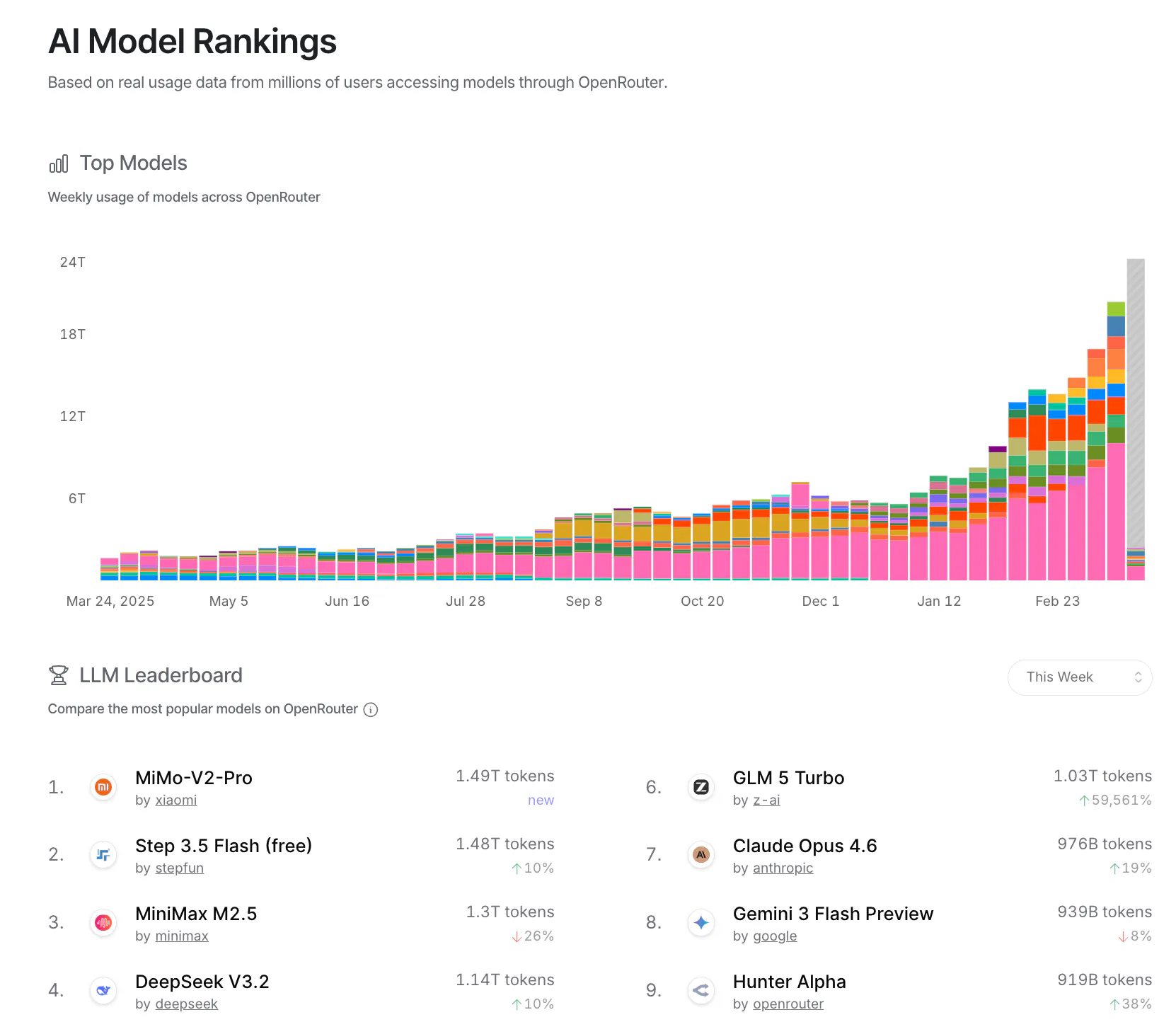
With OpenRouter’s public AI Model Rankings dashboard, developers can quickly discover consolidated real-time data on 500+ models and 80+ model providers as of August 2026. Users can see the most popular models on OpenRouter, ranked by token usage. Beyond total model usage, models are segmented by use cases, including finance, marketing, coding, and academia. For example, an investment firm building an application for a finance-related use case could filter the table for finance to quickly vet the best-fit models. Users can also view dashboards that benchmark multiple models across price, latency, throughput, context length, and more.
Source: OpenRouter
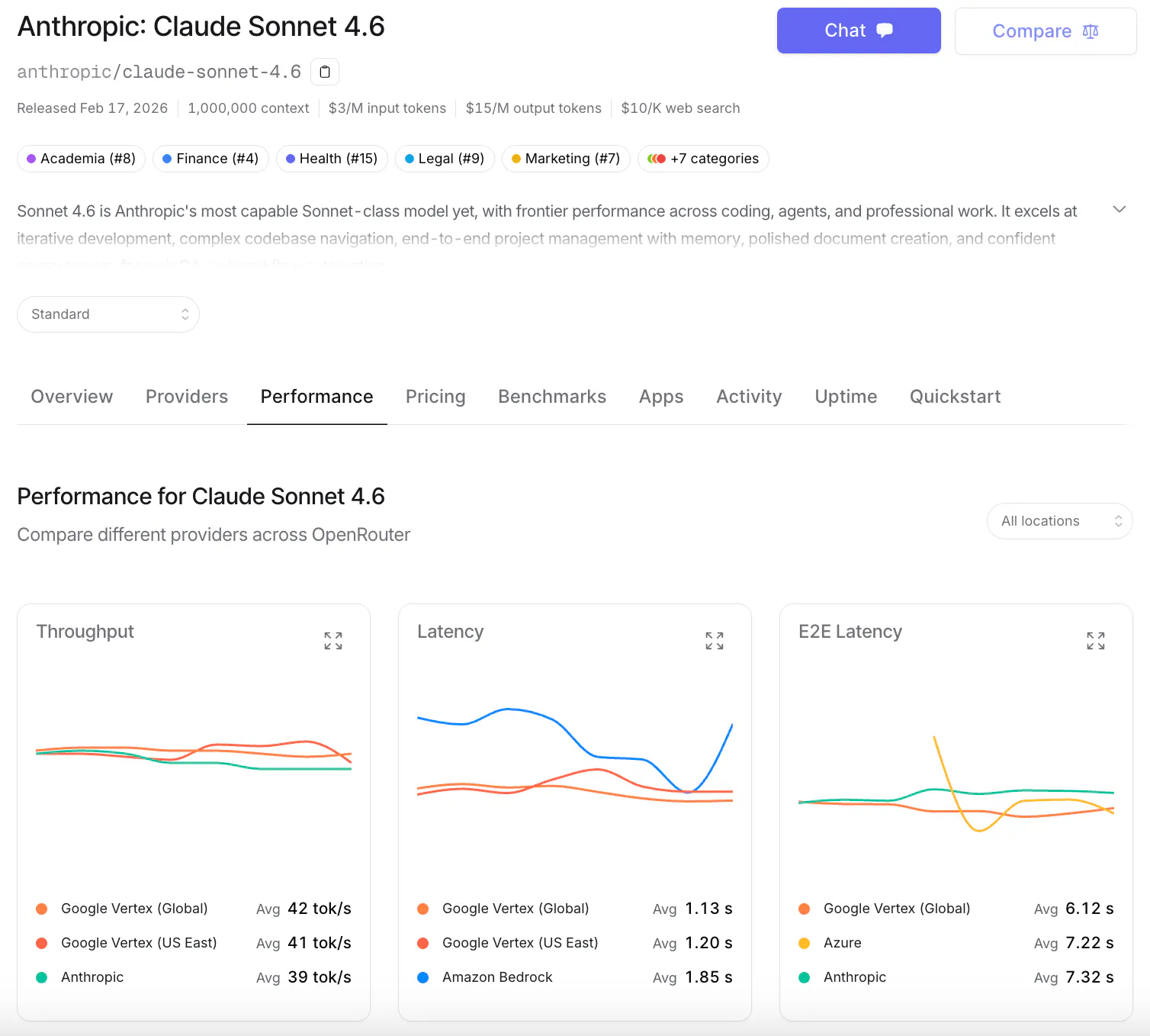
If a specific model is appealing, users can access its full profile to view granular metrics. Across numerous providers, users can see how a given model has been priced over time, as well as its throughput and latency.
Source: OpenRouter
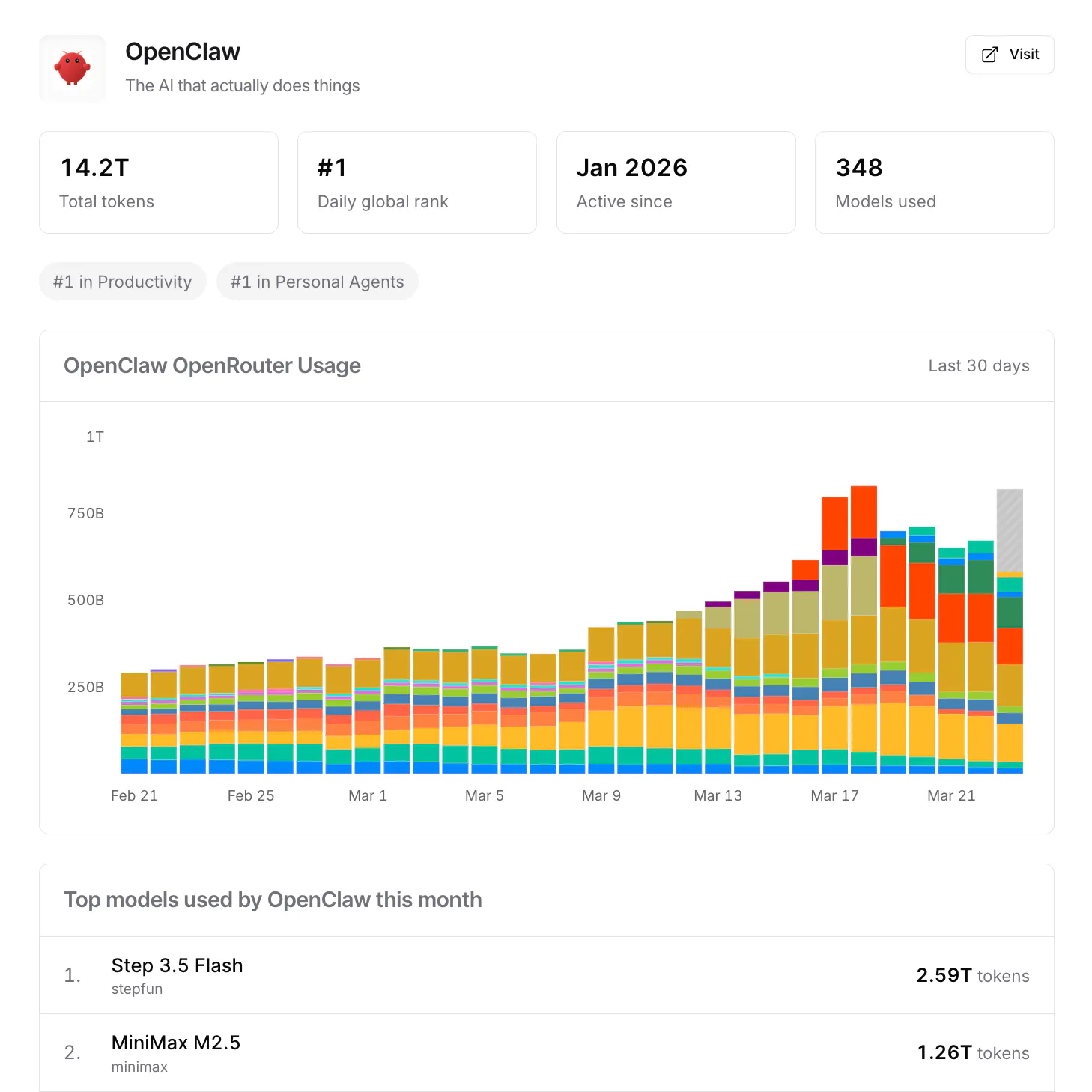
OpenRouter also measures which models top applications are using. For example, OpenClaw is the most active application overall on OpenRouter, having incurred 20.4 trillion tokens as of April 2026. On its page, users can see that OpenClaw’s most-used model is Step 3.5 Flash, as of April 2026. Having visibility into what power users are doing is “really valuable” for the long tail of developers, as they can quickly compare how inference is being used in similar products, which informs their own strategy. Holistically, the AI Model Rankings dashboard removes the “black box” around the AI model ecosystem, giving developers a granular, consolidated understanding of how hundreds of language models are used, their performance metrics over time, and which models inference power users favor.
OpenRouter doesn’t just help developers discover and evaluate AI models. It also addresses two growing problems with model integration. First, AI engineers manage an increasingly broad array of model API integrations in tandem, which becomes difficult to maintain. Andreessen Horowitz noted that “the experience of using LLMs in product development is like using electricity in the 1890s, before reliable power grids. Models flicker on and off, pricing changes overnight, and providers have different APIs.” Second, each model involves trade-offs among cost, performance, and security, which can fluctuate, meaning the model that works one day may not be the best fit should token cost, throughput, or latency change.
Unified Model API
Source: OpenRouter
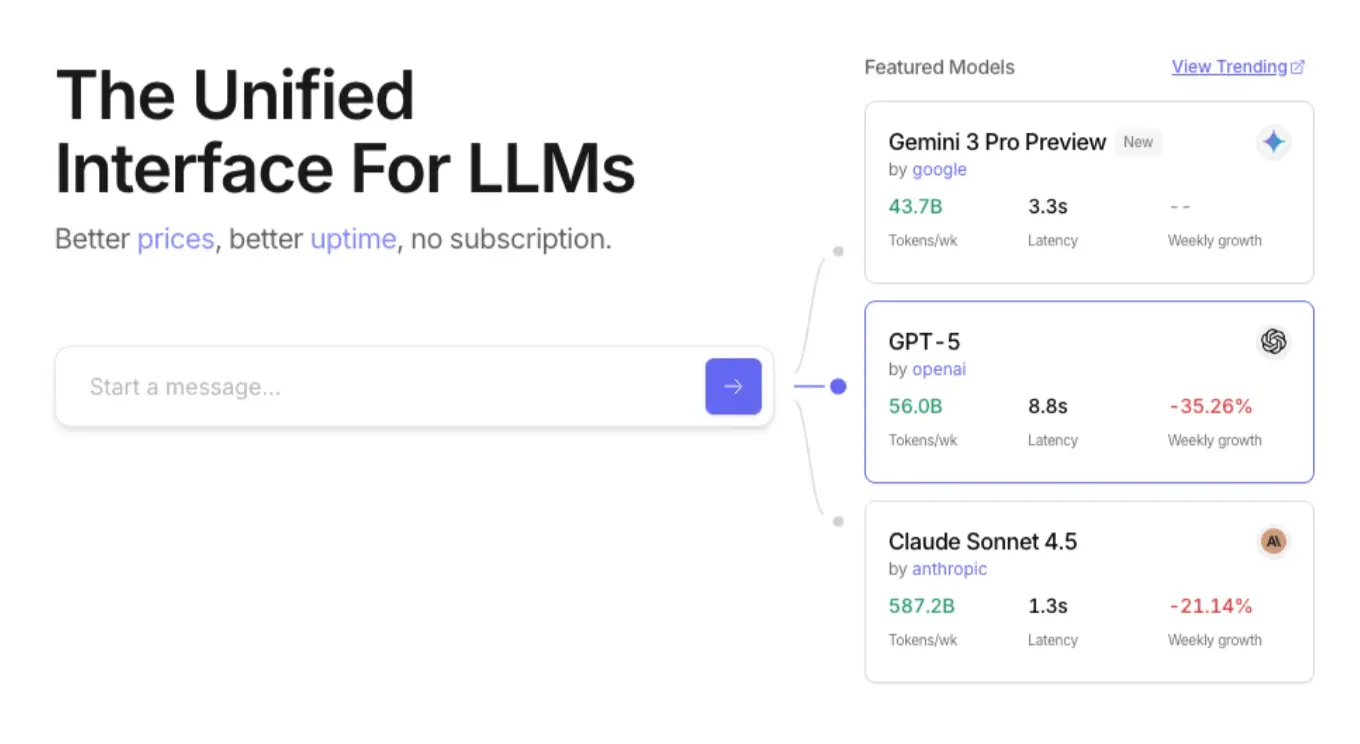
Before OpenRouter, there wasn’t an easy way to switch between hundreds of models while constantly optimizing for cost, performance, and uptime. The company solves this problem by serving as an “aggregator and marketplace for LLMs. It’s a single pane of glass where you can orchestrate, discover, and optimize all your intelligence needs in one place.” To make switching between models easier, the company’s unified model API gives developers the ability to toggle between 500+ models from top labs like OpenAI, Anthropic, Google, Meta, NVIDIA, and Mistral, while also switching between 80+ providers, including AWS Bedrock, Groq, and Google Vertex, as of August 2026.
Source: OpenRouter
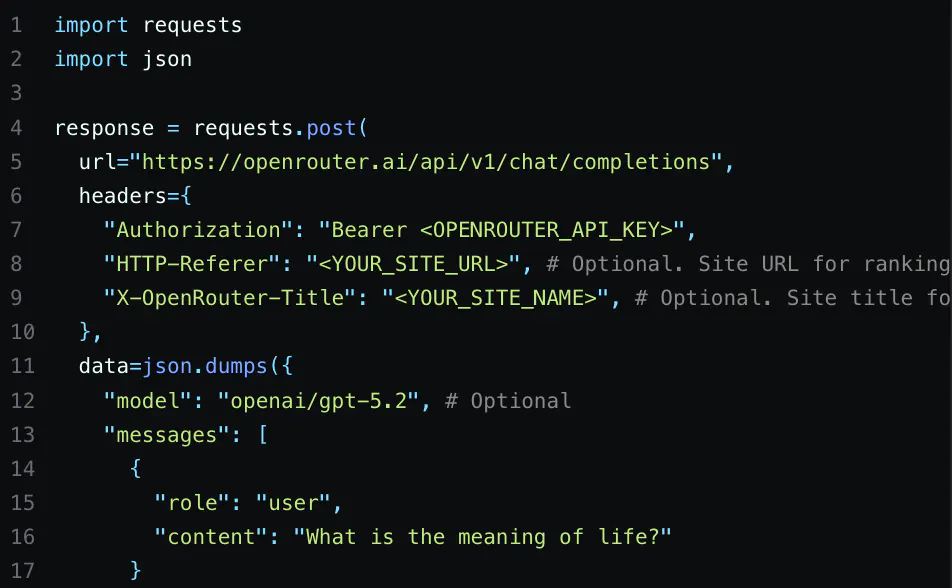
There are a few ways developers can use the API. First, to use a single model, such as GPT 5.2, a developer only needs to specify it in a single line of code in the API call. To switch the model, the developer only needs to swap out the model name, which takes seconds.
Auto-Routing
If a developer doesn’t have a specific model in mind but instead wants to optimize for cost, latency, or throughput, they can use OpenRouter’s auto-routing feature. Auto-routing allows developers to specify a general model attribute to optimize for. OpenRouter evaluates the user’s prompt and automatically pairs it with an appropriate model that meets the user’s needs. In August 2025, Atallah explained: “If you want performance, you get prioritized for the providers that have high performance. If you’re really cost-sensitive, you get prioritized for providers that are really low-cost today. There are innumerable ways you could get routed, but you’re in full control over the user experience that you’re aiming for.”
Load Balancing
Before OpenRouter, it was difficult for companies to redirect their API calls to different models or providers if cost, latency, or throughput were compromised. For example, if a company optimizes for cost but token rates for the model it's routed to increase sharply, quickly switching to a lower-cost model or provider would be ideal. Or, if a company optimizes for uptime but its provider is experiencing an outage in its service area, moving to a different provider that’s operational hedges against the outage.

Source: OpenRouter
Because models’ costs and performance attributes aren't constant, the same model or provider may not always be the best fit. OpenRouter solves this with fallback routing. Developers can configure fallback models that automatically reroute their API calls to a separate model or provider when an adverse event compromises token cost, latency, or throughput.
Inference Usage Observability
Source: The MAD Podcast with Matt Turck
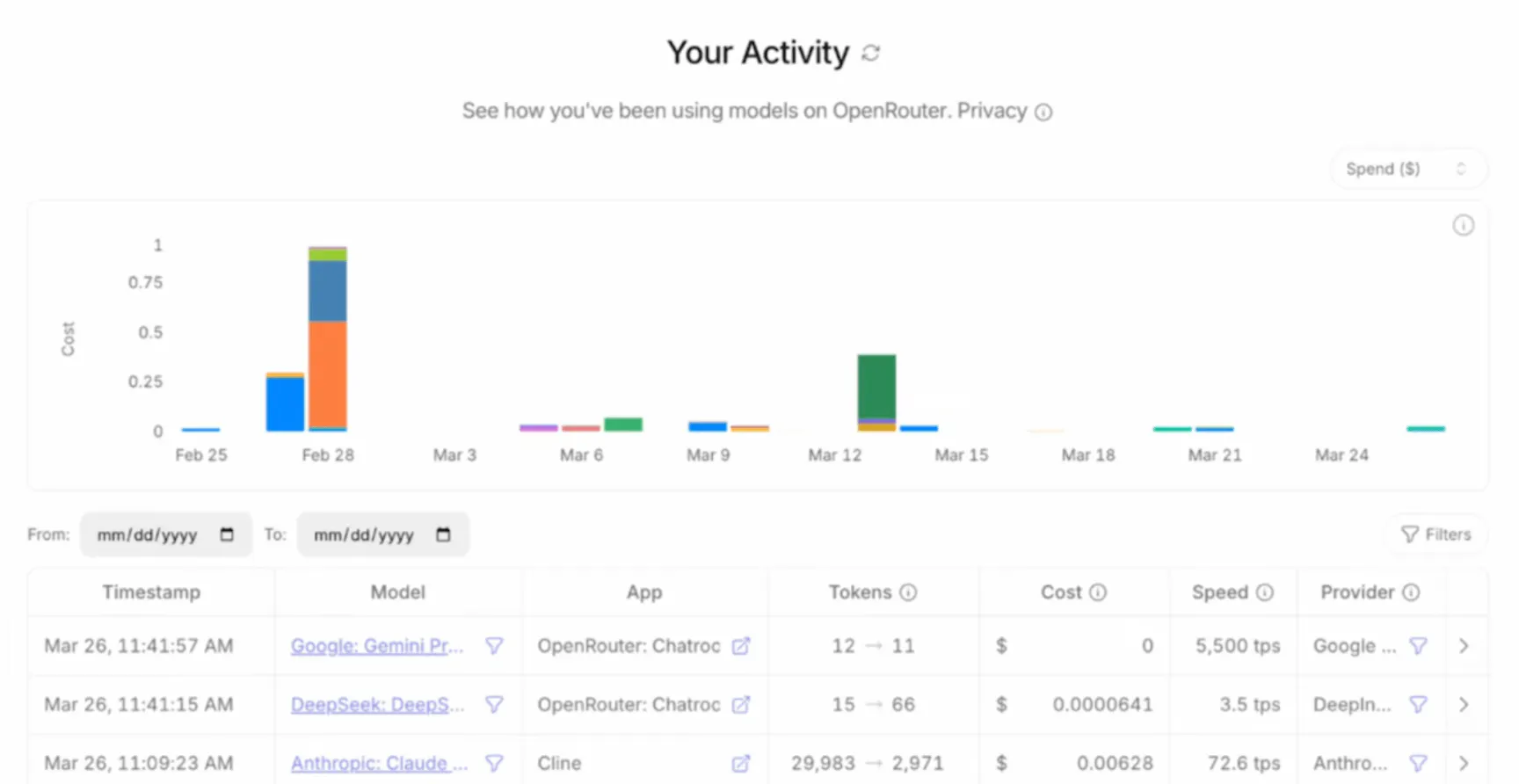
As inference becomes the “fastest-growing cost for forward-looking companies,” it is critical that companies have visibility into how much they spend on it and how their usage spreads across time periods and models. OpenRouter monitors every call users make through its API, giving teams a comprehensive breakdown of the models they use most and how much they spend on inference over time.
Overall, OpenRouter solves two critical challenges that engineering teams face. First, the Public Model Rankings dashboard helps engineers quickly discover and evaluate new models, so they can understand which use cases each model is best suited for. Second, the unified model API makes it easy to use any model while switching to an alternative optimized for cost, throughput, or latency. It also gives companies a clear view of their inference usage: which models are most favored and how much is spent on each.
In April 2025, Atallah described how OpenRouter helps companies source the right inference as follows:
“We’re trying to be the best place to source intelligence, where you can plug in your credentials and immediately get better prices, better performance, better uptime, and best model selection so you can build the best products without having to worry about sourcing the right intelligence.”
Instead of AI engineers spending hours discovering, evaluating, integrating, and switching among individual model APIs, OpenRouter streamlines the process and has “quickly become the control plane for observability, monitoring, and usage management of frontier models.”
Customer
For AI engineers, staying informed on new model releases, evaluating how they work, and maintaining a multi-model API stack has become increasingly cumbersome. As of August 2026, over 8 million developers rely on OpenRouter’s dashboards, AI model marketplace, and unified API to streamline discovery, evaluation, and integration of models across 80+ providers. Instead of maintaining complex in-house infrastructure with numerous model APIs, developers can quickly evaluate a broad selection of models, see what inference industry leaders are using, and switch the model their product uses almost instantly.
Because companies aren’t just optimizing for the best-performing model but instead making trade-offs among price, performance, and security, developers can use the platform to interact with hundreds of AI models in a single interface while ensuring their inference is continually optimized for the criteria that matter most to them. OpenRouter has “become a seminal tool in every AI engineer’s arsenal,” according to one of its investors, as it allows engineers to focus on building their core product rather than managing a patched-together in-house model infrastructure. The platform is used by developers at enterprise-scale companies such as Zoom, hyper-growth startups such as Lovable, Replit*, and Descript, and popular open-source tools such as OpenClaw.
Market Size
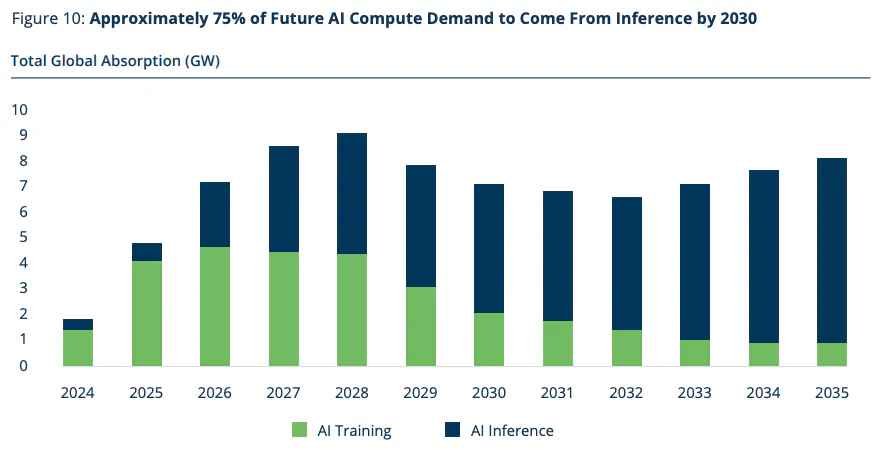
The AI inference market is expected to grow from $106 billion in 2025 to $255 billion by 2030, at a 19.2% CAGR. From 2022 onward, model training had been the predominant driver of compute demand. However, as organizations deploy AI at increasing rates, compute needs for model training are declining relative to inference. By 2030, it is estimated that inference will account for 75% of all compute needs. This is driven by economics. Training a model is largely a one-time cost, whereas inference is needed every time a user prompts the model. As Jensen Huang noted in March 2026, “the inflection point for AI inference has arrived.”
Source: Brookfield
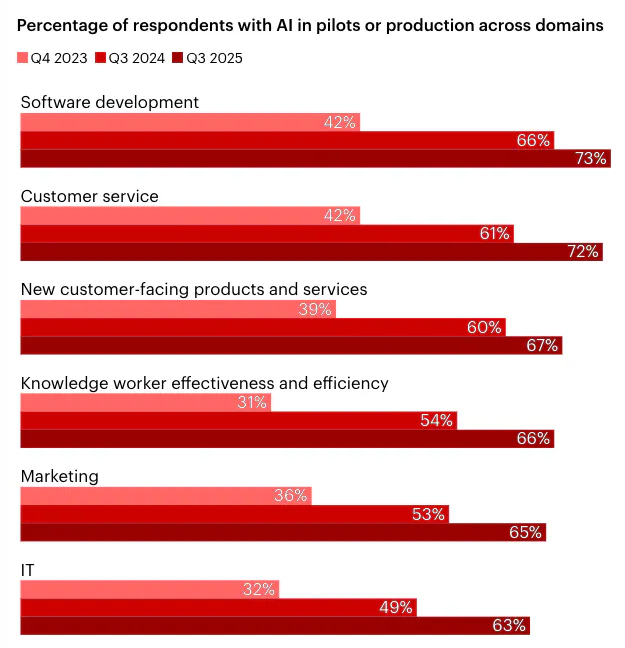
There are a few reasons compute is increasingly being allocated to inference. NVIDIA noted that “companies are moving from AI pilots and assessment to scaled deployment,” with most use case categories seeing a growing share of pilots advance to production. One study published in November 2025 found that between Q4 2023 and Q3 2025, the share of companies with AI in pilot or production roughly doubled across nearly every business function. For example, marketing scaled from 36% to 65% of respondents, while IT went from 32% to 63%. AI is spreading across the organization rather than being concentrated in a few experimental pockets.
Source: Bain & Company
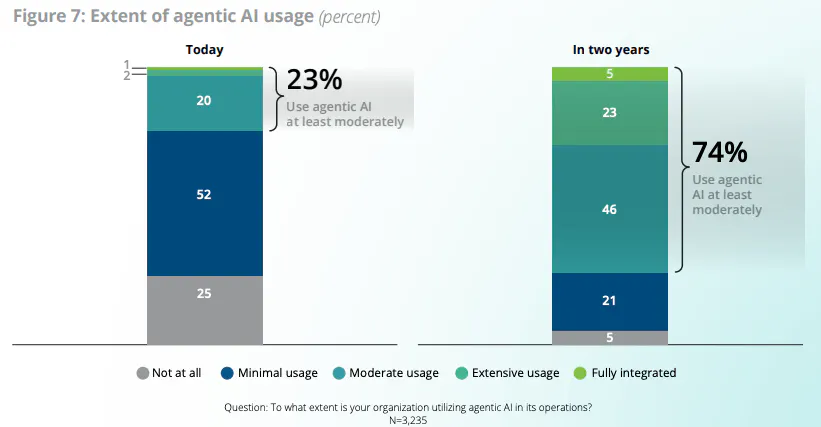
The second reason compute allocation is shifting from training to inference is use case complexity. While “chatbots have dominated public attention over the past several years,” the industry is pivoting toward agents, systems that execute complex, multi-step tasks autonomously rather than simply retrieving information. As of 2026, only 23% of companies have fully integrated agentic AI or use it extensively. Within two years, 74% of companies expect to use agentic AI to at least a moderate extent.
Source: Deloitte
This matters enormously for inference: agentic AI requires between five and 30 times more compute per task than a standard chatbot. Where a chatbot processes a single prompt and returns a response, an agent plans, selects tools, executes steps, evaluates outputs, and iterates, with each stage generating its own token consumption. This is a central reason inference is projected to account for 75% of all AI compute utilization by 2030.
Overall, companies are using AI across a broader range of applications, deploying it to production at healthy rates, and shifting toward agentic AI, a more token-intensive form of intelligence. As each of these trends accelerates, overall inference spend will continue to climb. Chris Clark, OpenRouter’s COO, commented on the impact this will have on modern companies: “Inference costs will eclipse salaries as the dominant operating expense for most knowledge-based companies over the next five to ten years.” Every major technology transition has had a critical layer that made large-scale adoption possible: “processors for card networks, cloud computing for software. For generative AI, inference infrastructure is emerging as that layer.”
Competition
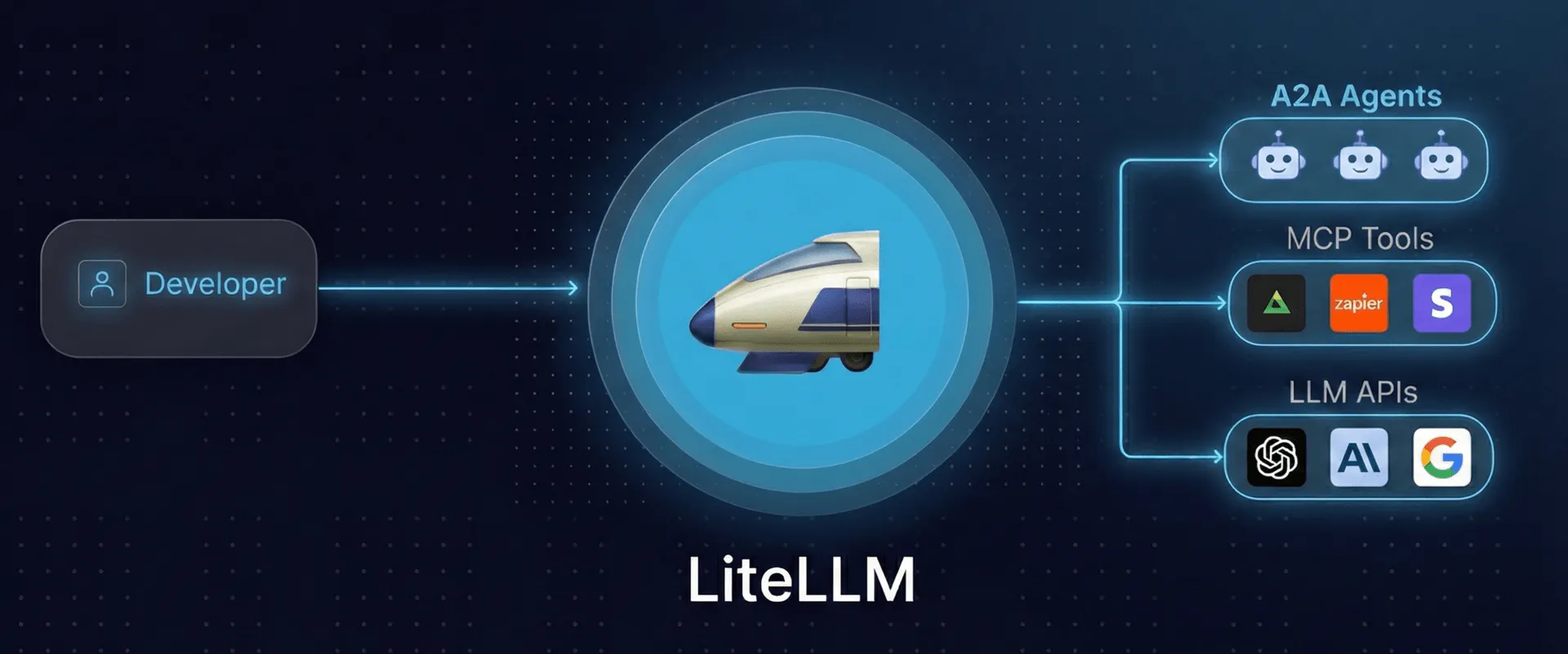
LiteLLM: Founded in 2023 out of Y Combinator’s Winter 2023 batch, LiteLLM has raised $1.6 million in total funding as of August 2026. It provides an open-source Python SDK and a self-hosted proxy server that normalizes requests and responses across 100+ model APIs into the OpenAI format, letting engineering teams call any model API without worrying about each model's different syntax. Beyond normalization, teams can define their own routing logic to determine how calls are distributed across different models.
OpenRouter takes a fundamentally different approach. It is a cloud-hosted API that developers call externally. A single API call goes to OpenRouter’s endpoint, and its routing intelligence directs the request to the best-fit model across hundreds of models and 80+ providers based on price, performance, and availability. There is no configuration, no infrastructure to manage, and no proxy to run.
Source: LiteLLM
This distinction drives every other difference between them. Because teams fully own and operate the LiteLLM infrastructure, they gain precise control over routing logic and configuration, but also inherit the operational overhead of deploying, scaling, and maintaining it. OpenRouter offloads all of that. The tradeoff is routing flexibility. LiteLLM lets teams define fully custom routing criteria tailored to their system requirements. OpenRouter’s routing preferences are set at the model or provider level, meaning teams can either specify the model or model family they want to use, or optimize at the provider level based on price, performance, or security. This is simpler to set up but offers less precision than LiteLLM’s self-hosted configuration.
The full customizability that LiteLLM offers may be one reason large enterprises have gravitated toward it. Companies like Stripe, Netflix, Adobe, SAP, and Twilio use LiteLLM as of April 2026, drawn to the ability to precisely configure routing logic and keep data entirely within their own environment. OpenRouter offers enterprise-grade features, but data flows through its cloud infrastructure, which some buyers cannot accommodate. Overall, OpenRouter may suit fast-moving product and engineering teams that want broad, immediate access to the widest range of models without the overhead of managing infrastructure, while LiteLLM may be more suitable for enterprises that need precise control over their routing logic and prefer to keep data within their own environment.
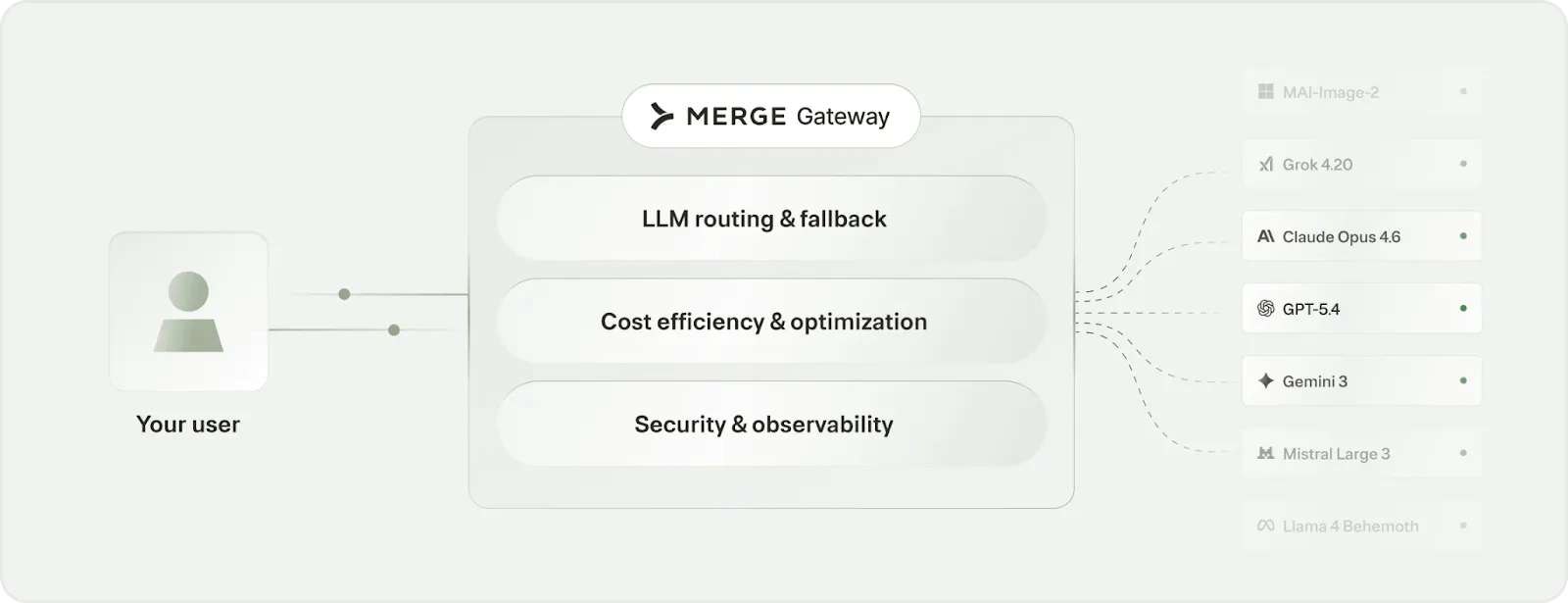
Merge: Founded in June 2020, Merge built its core product as a unified API that helps product and engineering teams connect to hundreds of applications, including CRMs, file storage platforms, HR systems, codebases, and accounting software. The company’s product solves the complex problem product and engineering teams face: building and managing dozens of integrations individually. However, in March 2026, the company released Merge Gateway, a directly competitive product to OpenRouter’s. As of April 2026, companies like OpenAI, Mistral, Dropbox, and Perplexity use the new offering.
Source: Merge
Through a single API, developers can access a wide variety of top AI models from labs including OpenAI, Anthropic, Mistral, Google, and Meta. Much like OpenRouter, Merge Gateway also handles request routing and automatic fallback: “Every request is routed to the optimal model based on latency, quality, and cost. If a provider degrades or goes down, traffic automatically reroutes to a healthy model.” Also comparable to OpenRouter is Merge Gateway’s usage and spend observability. Users can “track where every dollar goes by model, provider, project, and tag” to identify areas to improve inference spend and model allocation. Merge serves thousands of customers, including Ramp*, Bill.com, Dropbox, and Thomson Reuters. Expanding its product portfolio to include a unified API for AI models is consistent with its existing focus on unifying software integrations, and it presents an opportunity for Merge to scale adoption of its Gateway product by upselling its existing customer base.
While OpenRouter focuses exclusively on a unified API for AI models, Merge now covers a broader range of software integrations. Customers could use Merge’s API to connect to platforms like Salesforce, Google Drive, and Workday while also using Merge Gateway to optimize inference. This broader horizontal array of integrations could be an advantage for Merge, though OpenRouter has a few critical advantages. First, OpenRouter’s live dashboard is an established resource that helps attract new users and retain existing ones; Merge lacks a comparable asset. Second, OpenRouter has greater optionality of models and providers, where Merge works with a select few. OpenRouter offers 500+ models and 80+ providers as of August 2026 and has been scaling its portfolio since its founding in 2023. Third, OpenRouter benefits from a large volume of routing data, which improves model routing effectiveness.
OpenRouter has over 8 million developers using its platform and processes over 100 trillion tokens monthly as of August 2026. This scale generates a large volume of routing data that is continually used to enhance its routing algorithms, which Merge lacks. While OpenRouter benefits from being early to its category and holds a competitive advantage in its live model dashboard and increasingly optimized routing algorithms, Merge’s product is similar to OpenRouter’s. Merge Gateway is five months old as of August 2026 and does not yet match OpenRouter’s model and provider breadth or its developer scale.
Portkey: Founded in 2023, Portkey built its core product as an open-source AI gateway that helps AI teams route API requests to over 1.6K AI models. The company’s API gateway is similar in functionality to OpenRouter’s and is used by over 3K engineering teams at companies such as Palo Alto Networks, Snorkel AI, and Cyera. As of February 2026, Portkey routed $500K in daily inference spend to model labs, processing over 500 billion tokens across 120 million API requests.
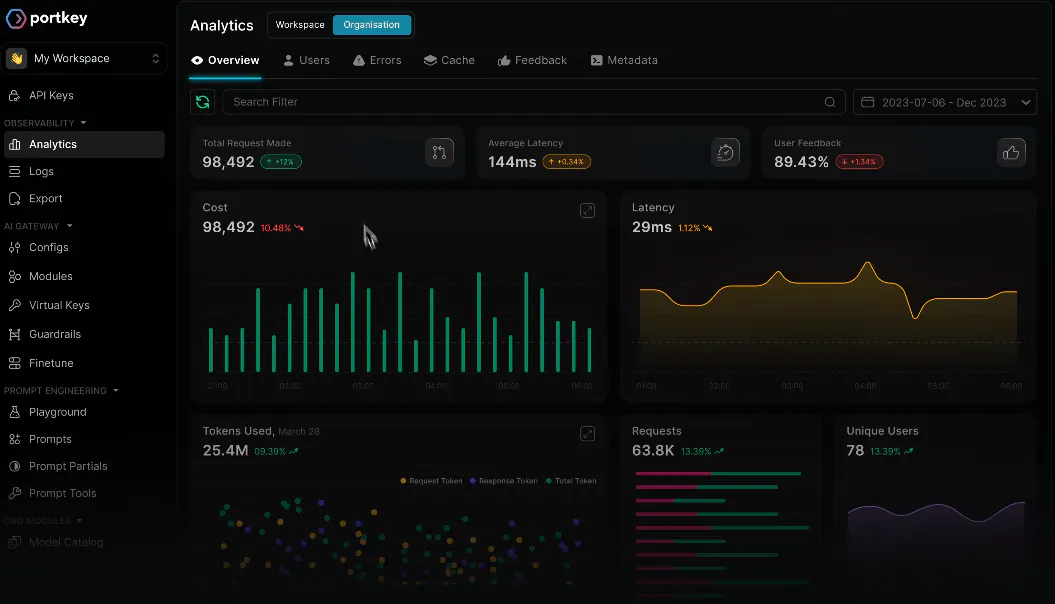
Like OpenRouter, Portkey’s gateway dynamically routes prompts to the best-fit models, distributes workloads across models and providers, and handles failover using user-created instructions. What differentiates the company from OpenRouter is its guardrails and observability suite. In addition to routing API requests to over 1.6K models, users can see, in a single view, their costs, tokens used, and number of calls, with user-specific logs for each API request.
Source: Portkey
While this is mostly available on OpenRouter, Portkey has more robust guardrail checks that users can apply to ensure API inputs and outputs meet specified criteria. For example, users can set guardrails to check for personally identifiable information (PII), word or character counts, and specific words or phrases in returned LLM responses. OpenRouter provides much less granular governance control over API requests and responses; with only a few guardrails available as of April 2026, users can only get as granular as the providers and models they permit routing to. Portkey also separates itself from OpenRouter in two other ways. First, it provides model integration and observability for users’ agents in production. By integrating Portkey’s API gateway and observability suite, users can monitor exactly how agents perform on each call using 40+ metrics. This is broader than OpenRouter’s platform, which focuses only on LLM routing.
Source: Portkey
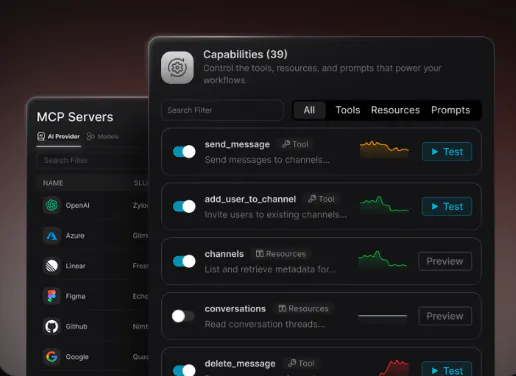
Second, beyond model integration and tooling for agents, Portkey released its Model Context Protocol (MCP) Gateway in January 2026. Users can view available MCP servers in one place and integrate with any of them in minutes. The MCP Gateway ensures users can control the context their agents have access to, and provides visibility into how often agents call specific tools, how they are called, and how they take action. Overall, OpenRouter and Portkey have comparable AI model routing capabilities. However, Portkey has the edge in granular observability and call logging: Portkey users can monitor API calls, apply a wide variety of guardrails, and observe how agents take action using the LLMs to which requests are routed.
Business Model
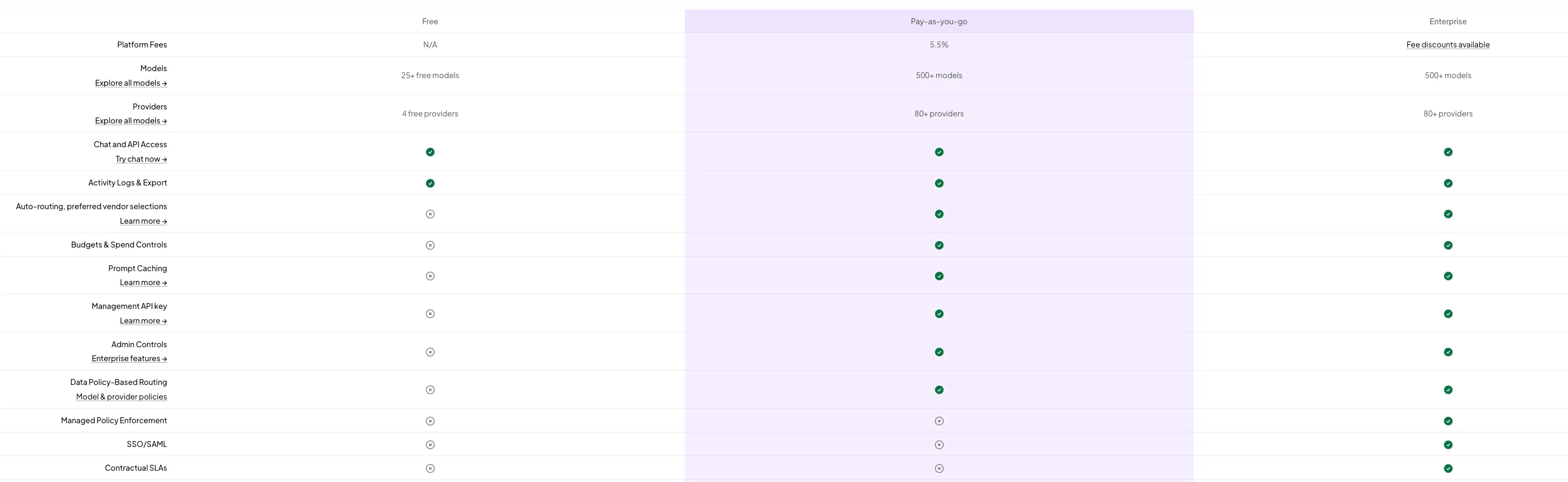
OpenRouter offers a free plan, a usage-based plan, and an enterprise plan. The free plan carries no platform fees, but access is limited to 25 models and four providers. It also excludes auto-routing, preferred vendor selections, budget and spend controls, prompt caching, and admin controls. The usage-based plan charges a 5.5% platform fee on all inference spend and unlocks the full platform: the full model catalog, all providers, auto-routing, preferred vendor selections, budget and spend controls, prompt caching, and admin controls. The enterprise plan includes everything in usage-based, layering on enterprise security and governance features, including managed policy enforcement, Provider Data Explorer, single sign-on (SSO), and contractual service-level agreements (SLAs).
Source: OpenRouter
The free plan may serve as a natural acquisition channel, giving developers hands-on access to the platform before converting to usage-based as their inference needs grow. The usage-based plan is where OpenRouter monetizes. The 5.5% fee on inference spend means revenue scales directly with the volume of tokens processed through the platform, aligning OpenRouter’s incentives with its users. The platform earns more only if developers route more calls through it, so OpenRouter has an incentive to consistently offer the broadest model selection, the most reliable uptime, and the most intelligent routing.
Because revenue is tied to inference spend on the platform rather than seat count or subscription tiers, sustaining revenue growth depends on token volume scaling faster than token unit prices decline. While inference costs dropped 1,000-fold between 2022 and 2024 and are projected to fall another 90% in per-token cost from 2025 to 2030, OpenRouter has scaled token consumption on the platform from 10 trillion tokens per year in June 2025 to over 100 trillion tokens per month as of August 2026. That volume growth is what positions OpenRouter for continued revenue growth despite falling per-token costs. Atallah has described inference as potentially “the largest market ever in software,” and OpenRouter’s take-rate model scales its revenue directly with that market’s growth.
Traction
Achieving Critical Mass
OpenRouter’s launch timing proved to be a significant advantage. Atallah noted that toward the end of 2022, “OpenAI was just vastly ahead of everybody else. There was basically no usable language model apart from DaVinci-3 API and ChatGPT itself.” Many of the other models at the time were “barely usable,” but when LLaMA was built and released by a group at Stanford for under $600, Atallah recognized what was coming: “There’s going to be hundreds of thousands of these. They seem incredibly important.” The problem was that there was no clear way for anyone to distinguish among different models or to understand what each was best at.
To address this, OpenRouter built a consolidated dashboard of real-time market data that removed the “black box” around which use cases people were using different models for, and which model categories were gaining traction among power users. As the number of LLMs surged, developers began treating OpenRouter’s dashboard as a single source of truth for model discovery and evaluation. “When we put up a new model,” Atallah said, “the power users instantly discover it. Power users figure out which workloads are interesting, and you can see from the data what they’re doing. Everybody can benefit.” Because developers value optionality and the ability to choose models independently, this live dashboard provides the real-time insights needed to make informed model selections at scale. This was how OpenRouter got started and built its initial critical mass of developers.
API Usage Growth
Alongside its dashboard, OpenRouter’s model routing API drove significant growth in its user base. As of June 2025, 2.5 million developers were using the platform. By December 2025, this had doubled to over 5 million developers, and it reached over 8 million by August 2026. The number of tokens processed scaled just as quickly. In June 2025, Menlo Ventures stated that “over the past year, we saw them go into hyper-growth, scaling 10x from processing 10 trillion tokens a year to over 100 trillion tokens a year.” That figure eclipsed 300 trillion tokens annually by December 2025, as the company processed “more than 1 trillion tokens every single day.” Token volumes have continued to scale since, surpassing 1 quadrillion tokens annually as of August 2026.
This growth in usage translates directly to revenue. OpenRouter retains a 5.5% fee on all inference spend processed through the platform. As of May 2025, one unverified estimate put the company’s monthly customer spend at $8 million, or about $400K in monthly revenue. OpenRouter has since scaled its annualized revenue 5x, from $10 million in October 2025 to $50 million by April 2026.
Model Proliferation
The proliferation of possible models available on OpenRouter contributed to its growing adoption. In 2022, only a handful of models were useful. In a few years, OpenRouter scaled its supply side to over 500 open and closed-source models and 80+ providers as of August 2026. Being listed on OpenRouter is valuable to model labs and providers because it gives direct access to a large, high-intent audience of developers.
Beyond distribution, model labs have used OpenRouter to beta-test new models and gather large-scale feedback before an official release. Before OpenAI launched GPT 4.1 to the public, the company first worked with OpenRouter to release the model under the alias “Quazar Alpha” to gauge user response. A subset of OpenRouter’s user base runs a series of open-source benchmarks on newly added models. From these tests, OpenAI received granular, real-time feedback, refined the model, and re-released it under the alias “Optimus Alpha” to compare feedback from OpenRouter’s community. Soon after, OpenAI officially launched GPT 4.1.
Two-Sided Network Effects
OpenRouter built its initial user base through its live dashboard, and as of August 2026, that real-time view of how models are being used continues to attract millions of developers to the platform. The company’s positioning as the “capitalist benchmark” for model performance makes the value proposition to the supply side clear: new models should be listed on OpenRouter to reach the market’s highest-concentration developer audience, a central reason the platform has scaled to 500+ models and 80+ providers. The flywheel reinforces itself. Greater model optionality attracts more developers to the platform, while continually improving routing intelligence retains existing users. By embedding these network effects into the platform's core, OpenRouter doubled its user base within six months, scaled tokens processed by 30x within 18 months, and grew revenue 5x within six months.
Valuation
In June 2025, OpenRouter announced it had raised a cumulative $40 million across a seed round and a Series A, at a $500 million Series A valuation, co-led by Andreessen Horowitz and Menlo Ventures, with Sequoia Capital and angel investors also participating. In May 2026, amid rapid growth in user count, token usage, and revenue, OpenRouter raised a $113 million Series B at a $1.3 billion valuation, led by Alphabet’s CapitalG. Its total funding reached roughly $154 million as of May 2026. Reporting placed the company’s ARR at $10 million in October 2025, rising to $50 million by April 2026. The valuation jump from Series A to Series B represented a 2.6x increase.
In August 2026, Stripe agreed to acquire OpenRouter for $7.5 billion. At that price, the reported deal values OpenRouter at more than 5x its Series B valuation from just three months earlier and reflects Stripe’s thesis that layer metering AI inference will sit at the center of how AI spend is billed and settled.
Key Opportunities
Rapid Growth of Inference Spend
The AI inference market is projected to grow from $106 billion in 2025 to $255 billion by 2030, at a 19.2% CAGR. This growth is being driven by enterprises deploying AI at increasing rates and shifting toward agentic workloads that are far more token-intensive than the chatbot applications that preceded them.
Source: Menlo Ventures
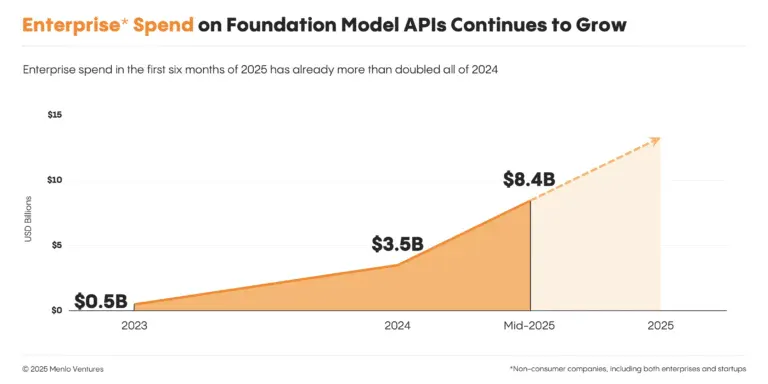
The pace of enterprise adoption reflects this. The share of companies with AI in pilot or production roughly doubled across most business functions between Q4 2023 and Q3 2025, and enterprise spending on foundation model APIs grew from $3.5 billion in all of 2024 to $8.4 billion in just the first six months of 2025. Because OpenRouter’s revenue scales directly with the volume of inference spend flowing through the platform, this market growth translates into a durable and compounding revenue opportunity.
Becoming the Default Routing Layer for AI Agents
Agentic AI adoption is projected to grow from 23% to 74% of companies between 2026 and 2028, and agentic workloads require five to 30 times more inference per task than standard chatbots. Unlike single-model chatbot interactions, agentic systems involve multi-step, multi-model pipelines, in which different models may be best suited to different tasks within a single workflow. This creates a more complex routing problem than simple chatbots require. OpenRouter’s auto-routing and fallback capabilities are already designed for this kind of dynamic, multi-model orchestration.
However, routing alone may not be sufficient as agents grow more complex in production. Portkey has already moved in this direction, offering agent observability across 40+ metrics per call and an MCP Gateway that lets developers connect to numerous MCP servers in seconds. As a significant and growing share of inference spend on OpenRouter’s platform may be agent-driven, building comparable capabilities, including agent observability, MCP integration, and agent-specific guardrails, would expand the platform’s total addressable market well beyond model routing.
Enterprise Up-Market Motion
Enterprise spending on foundation model APIs grew from $3.5 billion in all of 2024 to $8.4 billion in just the first six months of 2025, reflecting the pace at which enterprises are moving beyond experimentation and bringing AI into production at scale. As this spend compounds, OpenRouter may capture a meaningful share of it as the primary interface through which enterprises route and manage inference. OpenRouter’s user base skews heavily toward individual developers and growth-stage startups, leaving the enterprise segment as a significant and largely untapped expansion opportunity.
The company’s enterprise plan, which includes SSO, managed policy enforcement, contractual SLAs, and Provider Data Explorer, provides the compliance and governance features enterprise buyers require. However, OpenRouter predominantly relies on a product-led growth model to acquire customers, with only two active account executives as of April 2026. Building out a dedicated enterprise sales function would allow OpenRouter to actively pursue and close large enterprise logos rather than relying on inbound developer adoption to convert into enterprise accounts.
LiteLLM’s traction with companies like Stripe, Netflix, Adobe, SAP, and Twilio demonstrates that large enterprises see clear value in inference routing infrastructure and are willing to pay for it. LiteLLM’s self-hosted model may be a central reason these companies gravitated toward it, as data stays entirely within their own environment. OpenRouter’s cloud-hosted infrastructure might be a barrier for enterprises with strict on-premise data residency requirements. Supporting on-premise deployments could remove that barrier and open up a customer segment that has already demonstrated strong demand for competitive products. Stripe’s reach into enterprise finance and compliance functions could accelerate that motion if the reported acquisition closes.
Adding Multimodal Models
The AI model landscape is expanding beyond text to include image, video, and voice generation. The AI image generation market is projected to grow 7x, from $8.7 billion in 2024 to $60.8 billion by 2030. The global AI video market is projected to scale 10x, from $3.9 billion in 2024 to $42.3 billion by 2033. The AI voice generation market is projected to scale 8x, from $3.5 billion in 2023 to $21.8 billion by 2030.
As of April 2026, OpenRouter’s platform primarily focused on LLM routing, with 631 text models, 17 image models, five audio models, and four video models. The foundation is in place, but the multimodal catalog remains underdeveloped relative to the opportunity. As the shift toward multimodal AI continues and organizations increasingly integrate these applications across their operations, expanding OpenRouter’s multimodal model portfolio would increase the platform’s value to developers building them and help maintain OpenRouter’s position as a single interface for all AI inference.
Key Risks
Hyperscaler Commoditization
Hyperscalers like AWS Bedrock have distribution, enterprise relationships, and financial leverage that OpenRouter does not. Amazon Bedrock has seen significant usage growth: as of Q4 2025, which concluded in December 2025, it reached a “multi-billion annualized run rate,” with customer spend up 60% quarter over quarter. More broadly, Amazon Web Services reached an annual revenue run rate of $142 billion at the conclusion of Q4 2025, after securing new contracts with enterprises including Salesforce, Adobe, S&P Global, United Airlines, Perplexity, and DoorDash.
Given that AWS has already launched a native intelligent prompt routing feature that appears competitive with OpenRouter’s, hyperscalers act as both supply-side partners on OpenRouter and potential competitors in model routing. Hyperscalers have a built-in incentive to route traffic toward their own infrastructure. Enterprises with annual cloud contracts may default to their provider’s native model routing layer rather than adding a third-party dependency like OpenRouter, particularly if these capabilities are bundled into broader cloud contracts at comparable discounts.
Compressing Inference Costs
OpenRouter’s 5.5% take rate applies to the dollar value of inference spend flowing through the platform. As per-token costs fall, the dollar value of that spend compresses even if token volume continues to grow. Inference costs dropped by a factor of 1,000 between 2022 and 2024 and are projected to fall a further 90% by 2030. For instance, the cost to run GPT 4-caliber intelligence on a set of PhD-level questions has decreased by a factor of 40 each year from 2023 to 2025. OpenRouter’s revenue growth through 2026 has been driven by platform inference volume scaling faster than prices fall. That trend has to continue for the company to keep scaling revenue.
Disintermediation of the Routing Layer
OpenRouter’s value rests on being a neutral aggregation layer between developers and models. That position is also its central vulnerability. As the platform scales, its 5.5% take rate becomes a larger tax on inference that both model labs and high-volume buyers are incentivized to bypass by integrating directly with providers, and its highest-volume customers have the resources to build that integration in-house. One analysis framed the risk as OpenRouter “systematically eroding its own reason to exist,” as improving model interoperability and direct-provider tooling reduce the switching friction OpenRouter was built to solve. The reported acquisition by Stripe cuts both ways here: it pairs routing with billing and settlement in one company, but ownership by a payments provider could complicate OpenRouter’s standing as a neutral party among model labs that also compete with one another.
Summary
The AI ecosystem has undergone a “Cambrian explosion in model optionality.” When ChatGPT launched in November 2022, there were only a handful of useful models. As of March 2026, Hugging Face hosts over 1.4 million models. As companies implement AI in pilots and production at an increasing rate as of Q3 2025, an effective inference strategy that balances the trade-offs between price, performance, and security matters more than ever.
AI engineers face two challenges. The first is model discoverability and evaluation: it is difficult to discover new models, understand how they perform in specific use cases, and compare them with alternatives. OpenRouter solves this with a live dashboard that displays real-time metrics on how millions of developers and popular apps use different models, plus model-specific benchmarks. The second is how challenging it is to manage multiple model APIs simultaneously. OpenRouter provides AI engineers with a unified model API that lets them instantly switch between and make requests to hundreds of model APIs.
Strong network effects on both sides of its platform helped the company scale token volume from 100 trillion tokens annually in June 2025 to 300 trillion by December 2025, and past 1 quadrillion annually as of August 2026. That trajectory drew an acquirer: in August 2026, Stripe reportedly agreed to buy OpenRouter for over $7 billion. Because inference may be the “largest market ever in software,” OpenRouter intends to be the central “control plane” for how modern companies manage their inference. The open question is whether the inference-routing layer can hold its position and take rate as model routing becomes more competitive and its largest customers gain the scale to route around it.
* Contrary is an investor in Ramp and Replit through one or more affiliates.