Thesis
Global advertising spending surpassed $1 trillion for the first time in 2025, with digital channels accounting for more than 75% of the total. Within the digital bucket, 90% of display ad dollars were transacted programmatically as of 2025, meaning brands purchased inventory through automated, data-driven systems rather than manual negotiations. That programmatic infrastructure is what allowed Google, Meta, and Amazon to capture the majority of digital ad spend by giving marketers standardized tools for targeting, bidding, measurement, and optimization at scale.
Creator advertising has grown quickly even without such infrastructure. US creator economy ad spend more than doubled from $13.9 billion in 2021 to $29.5 billion in 2024, reached $37.1 billion in 2025, and was forecast to reach $43.9 billion in 2026, an 18% increase and roughly 4x faster than the media industry overall. Nearly half of ad spending decision-makers, 48% of those surveyed, considered creators a "must buy" as of 2025, ranking behind only social media and paid search.
The largest advertisers have begun moving budget accordingly. Unilever CEO Fernando Fernandez announced in March 2025 that the company would raise social media spend from 30% to 50% of its total media budget and work with 20 times more influencers, and by December 2025 reported working with close to 300K influencers globally. Publicis Groupe acquired creator platform Influential for $500 million in August 2024, then Captiv8 for a reported $150 million in May 2025.
Increased spend on creator advertising, however, has not reached creators at anything like the rate it has reached the platforms hosting them. This is because creator partnerships are difficult to scale. Executing a creator campaign takes weeks of manual work, from finding creators and negotiating individual deals through managing contracts, coordinating content approvals, and measuring performance across inconsistent data, and marketing teams that run campaigns on Meta or Google at scale have no equivalent way to run creator campaigns at scale.
Advertising platforms like Google sell reach rather than integrations, and media agencies buy impressions rather than broker partnerships. This is reflected in the fact that branded integrations on YouTube grew 54% year over year in the first half of 2025 across more than 65K creator videos, but the sponsorship leaderboard remained dominated by performance advertisers in tech, gaming, and fitness, compared to the mainstream consumer brands that dominate television. As the COO of the analytics firm that compiled that leaderboard put it, YouTube "has the attention, but not the participation."
Agentio is a two-sided marketplace where brands buy sponsored ad integrations inside creator content, and it automates the steps between them, from creator discovery and matching through bidding, contracting, brand safety review, content approval, performance tracking, and payment. The company launched on YouTube in October 2023 and opened the same workflow on Instagram and Facebook in July 2026. Agentio's estimate is that less than 2% of digital advertising spend reached creators as of November 2025. Its thesis is that creator advertising will remain a rounding error in digital budgets until the transaction layer that programmatic gave search and social is built.
Founding Story
Source: TechCrunch
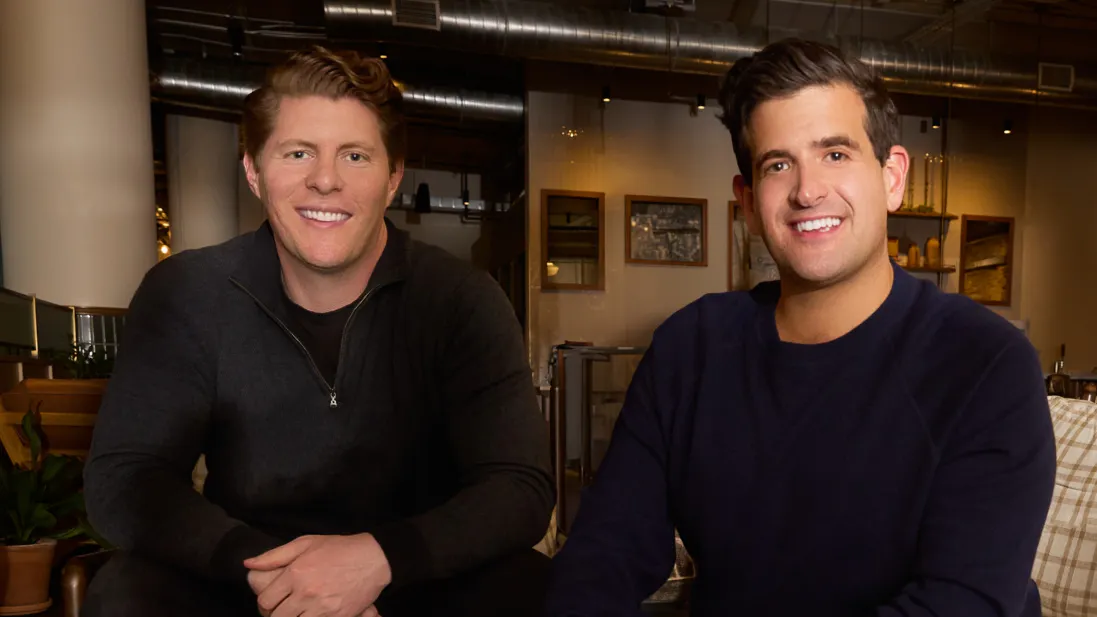
Agentio was founded in March 2023 by Arthur Leopold (CEO) and Jonathan Meyers (CTO), two former RBC Capital Markets colleagues who reunited a decade after meeting to build a programmatic ad platform for creator content. Both were in the same intern and analyst class at RBC's New York office in 2011.
Leopold and Meyers stayed in touch after this, occasionally catching up over beers and coffees in New York. In early 2023, after leaving Cameo, Leopold began searching for a technical co-founder and ran into Meyers by chance at a Brooklyn biergarten. Meyers was still at Spotify. They started talking about how fragmented, manual, and unscalable creator advertising had become, and the conversations continued. Over a lunch shortly afterward, they shook hands and incorporated the company, and in late 2023 raised a $4.3 million seed round co-led by Craft Ventures and AlleyCorp.
The idea came out of Leopold's time at Cameo, where he was the first employee and one of the first investors from August 2017. Over five and a half years, he rose from COO to Chief Business Officer in August 2020 to President in February 2022, onboarding over 50K celebrities and driving nearly $500 million in sales before stepping down in January 2023. Launching Cameo for Business was where the thesis formed. As he later explained in a December 2024 interview:
"I learned in conversations with folks at media agencies and CMOs that for there to be a real shift in the way that brands work with creators today, you needed to shift digital ad spend dollars, working media dollars, to creators."
In that same interview, Leopold put the mismatch at roughly $600 billion of digital ad spending against an influencer and talent budget of $15-20 billion. The infrastructure to bridge that gap did not exist.
Meyers brought the technical side to the team. He joined RBC Capital Markets as a summer analyst in 2011, graduated from Princeton University in 2012, and returned to RBC from July 2012 to August 2013. Earlier, he had interned at Columbia Records, where he designed a proposal for premium user-generated content on YouTube that was presented to Sony Music senior management. In 2015, he joined LiftMetrix as its first engineering hire and helped scale the social analytics platform from zero to $10 million in ARR. After Hootsuite acquired LiftMetrix, he stayed on as a senior software developer from February 2017 to December 2019.
He then joined Spotify as a backend engineer in December 2019 and was promoted to engineering manager for growth and innovation in May 2021, before leaving in March 2023, an important part of what led to Agentio. At Spotify, Meyers had observed that combining creator and listener data made advertising campaigns 30% more efficient than the same campaigns run without it. When large language models arrived, the two concluded they could read creators through the content they produce, the demographics of their audiences, and the data they share, and target them with the precision of a Meta or Google buy.
The company launched in October 2023 with a staff of six, including the two founders. The seed investor base included Cameo co-founder Steven Galanis, Academy Award-winning producer Michael Sugar, SoulCycle co-founder Elizabeth Cutler, YouTube creator Cody Ko, and former DoubleClick CEO Kevin P. Ryan through AlleyCorp.
Product
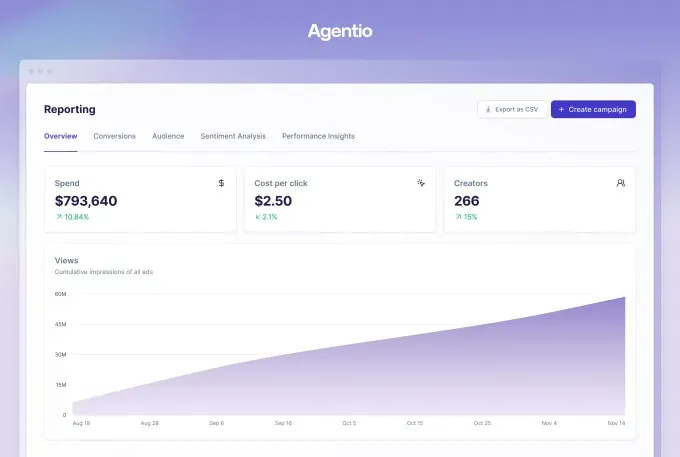
The product is organized around the two sides of the marketplace. Brands get a buying interface built to resemble a programmatic ad platform, with four capabilities covering performance prediction, creator access, campaign automation, and cross-channel delivery. Creators get a dashboard where brand offers arrive priced and pre-briefed. Agentio serves as both a demand-side platform and a supply-side platform, operating as a creator ad network for direct buys rather than plugging into outside demand or supply partners.
Source: Yahoo Finance
The company launched on YouTube in October 2023, targeting host-read ad integrations baked into video content. These differ from the pre-roll and mid-roll ads sold through Google AdSense. Host-read ads are a creator's most lucrative unit, but YouTube creators sold them on only 10-25% of available inventory, because doing so required working directly with a brand account manager who approves the final spot before publication. One of YouTube's top three advertisers told Leopold it saw 15x better return on ad spend from sponsored creator content than from traditional mid-roll ads. Demand existed on both sides; the infrastructure to transact at scale did not.
Performance Prediction
Agentio says it runs on first-party creator audience and performance data drawn from every campaign and every match made on the platform, and uses it to tell a brand which creators are most likely to perform before any money is committed. This is the company’s core capability, which is designed to compound. Each campaign feeds signals back into the matching and prediction models, so on the company's account, match quality and measurement improve with volume.
Because the models sit above the channel, Agentio claims that intelligence carries from YouTube to Meta rather than restarting on each platform. Its profiling ability also widens the candidate set. A health supplement brand would conventionally work with fitness and wellness creators, while Agentio's matching can surface creators whose audiences overlap for reasons a category filter would miss, such as creators who work outdoors.
Creator Supply and Matching
Source: TechCrunch
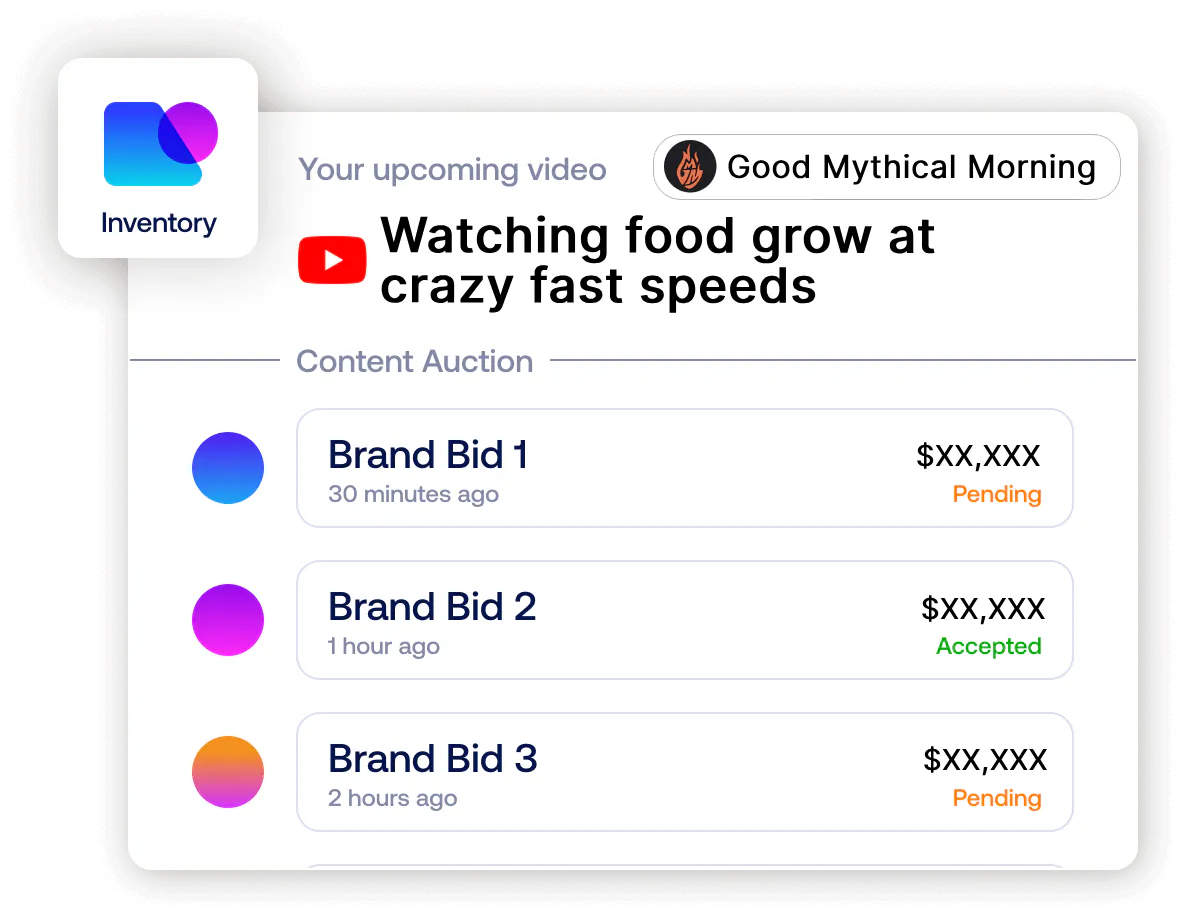
Agentio operates as a closed marketplace rather than a searchable database. Creators are onboarded only when there is an active brand opportunity, which Leopold has said lets the company verify that they are reliable, convert for other brands, and fit a brand's content. The company describes every creator on the platform as vetted, brand-safe, and transparently priced, with performance history attached.
Bidding is automated through a CPM formula. Brands send a bid calculated as CPM multiplied by a creator's historical median views, so a creator with a 100K-view median and a brand bidding a $40 CPM produces a $4K bid. Leopold has described creator pricing in December 2024 as "very much a finger-in-the-wind situation" in which managers, agents, creators, and brands alike do not know how to price creators, and the formula is meant to give both sides a standardized, data-driven number. On the supply side, Leopold has noted that creators sometimes receive four, five, or six bids from tier-one brands on a single piece of inventory, creating competition.
Campaign Automation and Brand Safety
Source: Forerunner
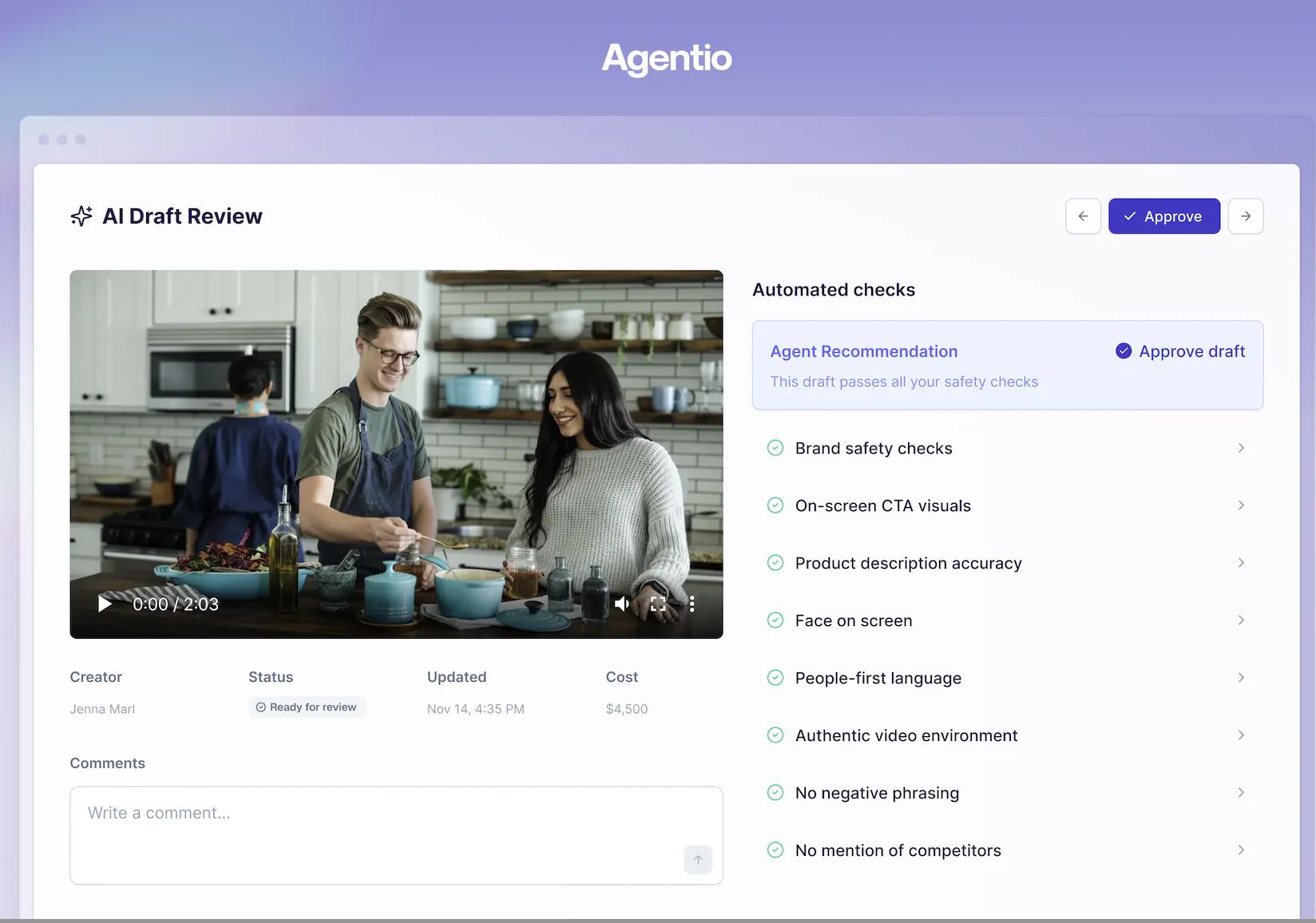
Once matches are confirmed, the platform automates contracting, brief creation, and brand safety checks, and marketers can train custom agents in natural language to turn campaign ideas into contracted creator programs. Agentio describes the target state as collapsing the manual steps into two that matter, defining the strategy and approving the content, with the system handling matching, briefing, measurement, and optimization in between.
Real-time analytics cover views, clicks, conversions, customer acquisition cost, return on ad spend, and lifetime value. The content review layer watches draft videos submitted by creators and judges whether they follow the campaign brief and meet brand safety standards. Meyers explained the change in November 2025:
"Previously, brands had to assign a person to watch every single creator video to make sure they were following the campaign brief. Now, our agent checks all these parameters that save time for brands and allows them to roll out and scale campaigns rapidly."
The company has also integrated reasoning models and multimodal understanding into its campaign manager, letting marketers build campaigns through conversational interfaces. Leopold has described the resulting speed in concrete terms. Brands have spent $500K on Agentio within 48 hours across more than 40 creators, work he estimated would take a conventional influencer team six months or more to negotiate.
Creator Workflow
The creator side is free and inverts the usual direction of effort. Brand offers arrive in a creator's dashboard with rates, requirements, and timelines already attached, and the creator accepts or declines. Agentio then handles contracts, approvals, revisions, and payment. As of September 2026, the company reported that 98% of its deliverables were approved on time, that brands approved content in as little as six minutes, and that better matching produced a 3x average lift in sell-through rate. Creators on the platform in September 2026 included Good Mythical Morning, Nick DiGiovanni, HopeScope, and MAZELEE.
Pricing is framed around repeat business rather than headline rate: Leopold has argued that a creator who prices at $7K instead of $10K converts more often and earns repeat deals worth more in total. Half (50%) of all Agentio accounts were managed by talent representatives and management firms as of November 2025.
Cross-Channel Delivery
Agentio spent its first two years on YouTube alone. It began beta testing Meta Partnership Ads in late 2025 and made the integration available to all brands on the platform in July 2026, covering Instagram and Facebook. During the beta, the company reported a return on ad spend 81% higher than that of competitor-sourced Partnership Ads, click-through rates 89% higher at the creative level, and cost per action 13% lower than the same benchmark.
Because many creators already had an Instagram presence, Agentio scaled its second channel on its existing supply base. The company frames the two channels differently, as YouTube integrations are operationally heavy and long-lived, while Meta Partnership Ads need continuous creative supply and return feedback in days. Agentio said in November 2025 that it planned to add TikTok and Snap in 2026; as of September 2026, neither was live, and the company's own site named YouTube and Meta as the supported channels.
Market
Customer
Over 100 enterprise brands had run campaigns on the platform as of November 2025. Named customers included Uber, DoorDash, Cash App, Bombas, Mint Mobile, Bilt Rewards, Vuori, David Protein, Coterie, The Farmer's Dog, and Olipop. As of September 2026, the company’s website also listed a number of notable customers including Eight Sleep, Chime, Warby Parker, Away, Turo, HelloFresh, WHOOP, and Maev*. Leopold has noted that Agentio attracts brands that "historically haven't touched the space," including Warby Parker, MasterClass, and Mejuri, and the company has begun seeing demand from business-to-business organizations.

Source: Agentio
The buyer is usually a small performance or influencer marketing team inside a consumer brand, and the pitch is that one person can run a program that would otherwise need an agency. Bombas is the most detailed public case. Using Agentio, it published over 450 creator videos, delivering 5.3x better return on ad spend than traditional video ads, 90% of acquired customers new to the brand, 10% higher lifetime revenue than paid social, a 94/100 sentiment score, and 2x lower customer acquisition cost as campaign spend grew 327%. Leopold has noted that a single performance marketer at Bombas ran the entire program alongside the company's Meta and Google spend.
Turo provides a similar case study at larger volume. Its senior integrated marketing manager, Talia Poblete, ran 435 creator partnerships in a single year, producing a 42-point lift in airport rental preference and 3-4x greater measured impact through media mix modeling than last-click attribution suggested. At the top end of adoption, the Unilever brand Grüns ran its entire social program through Agentio with more than a thousand ads live at once as of August 2026.
The supply side is the other half of the customer base. Talent managers place their rosters on the platform. The talent agency Outloud Talent reported a 3x increase in deals booked, under 20 hours to receive and accept a deal, and over 60 creators managed through Agentio. Creators joining Agentio have been able to more than double their brand partnership earnings within six months, a figure the company reported in November 2025.
Market Size
The market Agentio sells into is the portion of digital advertising that reaches audiences through creators. The IAB forecast US creator ad spend to be $43.9 billion in 2026, split into $13.2 billion of paid amplification of creator content on social, $11.1 billion of paid amplification beyond social, $11.6 billion of direct partnerships to produce and post content, and $7.9 billion of intentional ad adjacencies to creator content. Agentio’s various businesses touch several markets. Its YouTube business is a $11.6 billion pool, which grew 21% into 2026. YouTube sponsored video uploads grew 54% year over year in the first half of 2025, and views across those videos rose 28% to 19.1 billion, so the inventory itself is expanding. And the audience has moved. YouTube accounted for 12.4% of total US television viewing in April 2025, the largest share of any media distributor.
Meanwhile, its Meta business is paid amplification on social, a $13.2 billion market, which was growing 48% as of 2026. Agentio frames its broader addressable market as the $800 billion of digital ad spend it argues could move to creators once the infrastructure exists, on the basis that less than 2% of digital advertising spend reached creators as of November 2025. The broader creator economy, including commerce and subscription revenue that Agentio does not touch, was projected to approach $480 billion by 2027, roughly double its $250 billion size in 2023.
Competition
Competitive Landscape
Creator advertising infrastructure companies fall into several categories based on business model and position in the value chain. Agency holding companies have consolidated creator marketing through acquisitions. SaaS creator management platforms sell workflow software to brands. Affiliate and commerce platforms monetize creators through product recommendations and storefronts. YouTube, Meta, and TikTok operate native ad-buying tools that compete for the same brand budgets.
Agentio's shape differs from each. It is a closed, two-sided marketplace acting as both demand side and supply side, automating the transaction from discovery through payment, priced on CPM at a 20% take of the media spend it transacts rather than a software fee or an agency retainer. Leopold has framed the competitive landscape accordingly: Agentio competes with Meta and Google for working media dollars, not with influencer agencies for talent budgets. Meanwhile, Publicis, Dentsu, WPP, Omnicom, and Havas have all moved creator marketing out of specialist units and into their media, commerce, and data stacks.
Competitors
Agency Holding Companies
Publicis Groupe (Influential and Captiv8): Publicis Groupe, the largest agency holding company by net bookings as of 2024, has made the most aggressive move into creator marketing. It acquired Influential in August 2024 for $500 million, the largest influencer marketing deal on record at the time, and Captiv8 in May 2025 for a reported $150 million, $650 million across the two. Influential operated a network of 3.5 million creators serving over 300 brands, and generated $150 million of revenue in 2023. Captiv8 brought a network of 15 million creators covering 95% of influencers with over 5K followers, and over 70% of Fortune 1000 companies used it as their influencer marketing partner as of May 2025. Both are being integrated with Publicis's Epsilon identity and data unit.
The model is a managed service. Brands work with Publicis account teams who use the platforms as internal tools, which carries higher overhead and slower execution than a self-serve programmatic buy, but arrives attached to the media relationships Publicis already held.
Creator Management Software
CreatorIQ: Founded in 2014 and based in Los Angeles, CreatorIQ sells enterprise software for managing influencer marketing programs, covering discovery, campaign management, analytics, and compliance. It had raised a total of over $80 million as of September 2026, including a $40 million round in September 2021 with participation from Kayne Partners, TVC Capital, Affinity Group, Unilever Ventures, and Silver Lake Waterman. No lead investor was disclosed, and the company has not raised since; its valuation is not publicly disclosed. Revenue grew 213% between 2021 and 2024. The difference from Agentio is that CreatorIQ licenses software and does not transact media: brands use it to find and manage creators, while negotiation, contracting, and payment happen outside the platform.
GRIN: Founded in 2014 in Sacramento, GRIN sells creator management tooling to direct-to-consumer brands, covering discovery, relationship management, product seeding, payments, and analytics, with clients including SKIMS, Macy's, and L'Oréal. It had raised a total of $145.3 million across seven rounds as of September 2026, including a $110 million Series B in October 2021 led by Lone Pine Capital at a $910 million valuation. Ryan Debenham became CEO in January 2025, with founder Brandon Brown moving to chairman of the board. In January 2026, GRIN opened instant self-serve access with month-to-month pricing, which narrows one of Agentio's differentiators, though GRIN still sells software rather than transacting the media itself.
#paid: Founded in 2013 in Toronto, #paid connects brands with creators through a "Handraise" model in which creators opt in to campaigns rather than being sourced by the brand. It had raised a total of $24 million as of September 2026, including a $15 million Series B in 2021 led by Sands Capital, and operates primarily on Instagram and Facebook. The opt-in mechanic resembles Agentio's, but #paid focuses on social posts and does not run programmatic bidding, CPM pricing, or automated content review.
Affiliate and Commerce
ShopMy: Founded in 2020 in New York, ShopMy runs curated commerce infrastructure for premium brands and creators. It raised a $70 million Series C in October 2025 at a $1.5 billion valuation led by Avenir, with Bain Capital Ventures, Menlo Ventures, and Bessemer participating, bringing total funding to $175 million as of September 2026. The platform facilitated over $1 billion in annual sales through more than 185K curators and over 1.2K brand partners, and reported 200% year-over-year revenue growth and profitability since 2024. It competes for creator attention but draws on affiliate and ecommerce budgets rather than working media, which is the line Agentio is trying to cross.
Platforms
YouTube: Founded in 2005 and acquired by Google the following year, YouTube is the channel Agentio was built on and the largest single competitor for the budget it is chasing. Its parent Alphabet carried a market cap of $4.1 trillion as of September 2026. Alphabet disclosed YouTube's full-year revenue for the first time in February 2026, at over $60 billion for 2025, of which roughly $40.4 billion was advertising. YouTube sells reach through AdSense rather than creator integrations, which is the gap Agentio fills, but its dynamic brand segments move it toward the same sponsored-integration workflow. It is simultaneously Agentio's largest supply source, its data dependency, and the competitor best placed to absorb it.
Meta: Founded in 2004, Meta carried a market cap of $1.5 trillion as of September 2026. It sells Partnership Ads, formerly Branded Content Ads, which let brands amplify creator posts through its ad system. Since July 2026, this has been a distribution channel for Agentio rather than a pure competitor. Meta supplies the ad unit and the targeting, and Agentio supplies the creator matching, contracting, content production, and workflow that sit upstream of the buy. The dependency runs one way, and Meta could build the upstream layer itself.
TikTok: Owned by ByteDance, which was founded in 2012 and valued at over $330 billion in an August 2025 employee share buyback, TikTok runs its own Creator Marketplace connecting brands with creators for sponsored content, with search, analytics, and campaign management tools. Its US business was restructured into TikTok USDS Joint Venture LLC, which closed in January 2026 with ByteDance retaining 19.9% of it. Agentio said in November 2025 that it intended to expand to TikTok in 2026, which would put it alongside the platform's own tooling as a cross-platform buying layer.
Business Model
Agentio takes 20% of the total ad spend on every campaign, and creators receive the other 80% of that spend, a take rate on media rather than a software subscription. There are no SaaS fees, setup costs, or agency retainers, and creator access is free. The company compares this to how ad networks monetize, and the comparison holds on the cost side too. Revenue scales with the media volume flowing through the marketplace rather than with seat count.
What the company has disclosed about its economics is limited. Agentio said it was already profitable at the time of its Series A in November 2024, which is unusual for a marketplace 13 months past launch and implies the take rate was covering its costs at that stage. It has disclosed no revenue, gross margin, or cost breakdown since.
The model depends on media volume. In 2025, over 100 enterprise brands shifted "tens of millions" of dollars of paid media into creator campaigns built on Agentio, and brands running them reported 4-15x better return on ad spend from YouTube creator integrations than from other social video channels.
Traction
Agentio grew 5x year over year from its October 2023 launch through November 2025, when it reported over 100 enterprise brands on the platform. It cut time to first bid from 50 days to under one day. Headcount went from 12 to 35 over the year to November 2025, against a stated plan to pass 100.
Agentio has published data about its own book of business. In August 2026, the company analyzed $130 million of ad spend across 65K Meta Partnership Ads run by 137 brands, and separately examined 35.8K creator videos to model the effect of YouTube's August 2026 change to how it counts a view. These were the two largest first-party datasets the company has disclosed.
The published campaign benchmarks drawn from this give a sense of how the marketplace behaves. Across more than 10K YouTube integrations, nearly 40% of views and 30% of clicks arrived more than 30 days after a video went live, which is why the company recommends a 90-day attribution window. Every repeat integration with the same creator improved that campaign's click-through rate by 10%, with conversion rate roughly 1.9x higher by the sixth integration, and brands testing 10 or more creator verticals raised their chance of finding a successful partnership by up to 2.3x. On the Meta side, partnership ads sourced through creators outperformed traditional user-generated content by 19% on click-through rate and 10% on conversion rate, at a 5% lower cost per action, and winning ads fatigued after 36 days on average.
Valuation
Agentio raised a $40 million Series B in November 2025 led by Forerunner at a $340 million valuation, with Benchmark, Craft Ventures, AlleyCorp, Antler, and Starting Line participating. That brought total funding to $56.3 million across three rounds as of September 2026.
The Series A came a year earlier. In November 2024, Agentio raised $12 million led by Benchmark, with Craft Ventures and AlleyCorp following on from the seed. That seed had closed in November 2023 at $4.3 million, co-led by Craft Ventures and AlleyCorp with Antler, Protagonist, and Permanent Capital participating.
Neither the seed nor the Series A valuations were disclosed. However, the pacing of the fundraising is notable. Agentio conducted three rounds in 25 months, each roughly tripling the size of the last, with the Series B arriving 12 months after the Series A. The Series B the company at $340 million, with $56.3 million raised in total as of September 2026.
Forerunner's decision to lead the Series B was driven by the multi-channel expansion, and managing partner Eurie Kim said in November 2025 that unlocking multiple channels signaled Agentio could become "the AI-powered media planning platform of the future." Forerunner had also introduced Agentio to portfolio brands including Warby Parker, Away, Chime, and The Farmer's Dog, many of which became customers before the round closed.
Key Opportunities
Enterprise Budget Reallocation
Enterprise advertising budgets are moving toward creator channels on a schedule that brands have made public. Unilever CEO Fernando Fernandez announced in March 2025 that the company would raise social media spend from 30% to 50% of its total media budget and work with 20 times more influencers, and by December 2025 it was working with close to 300K influencers globally. A marketing consultant at a large consulting firm told Business Insider they had received "an incredible amount of inbound phone calls" from Fortune 500 brands asking how to increase influencer investment after the announcement.
The reallocation is broad rather than a single account. Retail led planned 2025 creator spend at $12.3 billion, a 38% increase year over year, with consumer packaged goods next at $5.5 billion, and nine of ten major advertising sectors planned to invest over $1 billion each in creator media. The lever for Agentio is what those buyers say is stopping them. A third of advertisers still cited finding the right creator as their top difficulty in the space, which is the specific step Agentio's matching and bidding automate.
Capturing Renewable Inventory as YouTube Ships Dynamic Brand Segments
YouTube announced in September 2025 that it would test dynamic insertion of branded segments into long-form videos, letting creators swap a sponsored segment once a deal is fulfilled and resell the slot to a new brand. By September 2026, the feature had moved from announcement to documented product, with Google Ads publishing setup guidance and an April 2026 date for organic and paid metrics syncing automatically into advertiser accounts.
The change converts a creator's back catalog from a fixed asset into renewable inventory, which Digiday called potentially the most disruptive change in the creator economy in 2026 because it makes a library resemble a television syndication catalog. The specific opening for Agentio sits in what YouTube did not automate. The Google Ads documentation states that the feature requires a manual, direct deal between the brand and the creator. YouTube is expanding the supply of sellable slots while leaving the matching, pricing, and contracting that fill them untouched, which is the exact workflow Agentio automates.
Multi-Platform and Podcast Expansion
Agentio's Meta integration became generally available in July 2026, and the company has stated an intention to add TikTok and Snap. Each additional channel is cheaper to add than the last, because the supply base and the prediction models carry across: Agentio scaled the Meta channel on creators it had already onboarded for YouTube. A brand buying through a single interface across YouTube, Instagram, TikTok, and Snap replaces four separate workflows, which is the argument Forerunner has said drove the Series B.
Podcasts are the nearest adjacency. YouTube users consume more than 100 million hours of podcasts a day on the platform, and YouTube has become the most-used platform for podcast discovery. Agentio's infrastructure for host-read integrations maps onto podcast ad reads with little modification, and Leopold has compared YouTube creator integrations to 90-second podcast-style host reads.
Authenticity as AI Content Proliferates
Brand demand for verified human creators is rising as synthetic content fills feeds. CreatorIQ's 2025 State of Safety report found that 74% of enterprise marketers considered brand safety more critical than a year earlier, driven partly by AI-generated content, and that 89% of enterprises valued creators as long-term partners. Consumer preference has moved the same way, with only 26% of consumers preferring AI-generated creator content to traditional creator content as of 2025, down from 60% in 2023.
A second effect compounds the first. As buyers shift discovery into large language models, creator transcripts, metadata, and community sentiment were, as of August 2026, the material those systems surface, which gives a brand a reason to buy creator content that has nothing to do with the creator's own audience. Agentio sells verified, brand-safe, human creator inventory with performance data attached, and Leopold has said that as AI content proliferates in feeds, brands are recognizing that the trust creators hold with their audiences is "unbeatable."
Key Risks
Losing Pricing Inputs and Workflow to the Platforms It Runs On
As of September 2026, Agentio's business ran on infrastructure it does not control. The company accesses creator channel data, historical view counts, and audience metrics through YouTube and Meta to power matching and bidding, and both own the APIs, ad policies, and monetization rules underneath.
Both have shown willingness to change those rules. YouTube tightened its Partner Program guidelines in July 2025 to restrict mass-produced and inauthentic content, and in August 2026 changed how it counts a view, a redefinition significant enough that Agentio published an analysis of how far the old and new numbers would drift. Because Agentio prices inventory on median views, a change to what counts as a view is a change to its pricing input. The sharper version of the risk is that YouTube's dynamic brand segments move the platform into the same sponsored-integration workflow Agentio runs; the segments required a manual brand-creator deal as of September 2026, but nothing prevents YouTube from automating that step.
Adding Meta in July 2026 reduced single-platform concentration but did not remove the pattern, since it substituted a second platform dependency for part of the first. TikTok and Snap remained unshipped as of September 2026, so the diversification the Series B was raised on was roughly half complete.
Holding Companies Bundling Creator Media into Existing Buys
The agency holding companies are assembling the same capability on top of Publicis's 15 million-creator network and the media relationships that come with it. Publicis spent $500 million on Influential and a reported $150 million on Captiv8, combining them into a platform with access to over 15 million creators integrated with Epsilon's identity graph, and Publicis CEO Arthur Sadoun described the result as a single place for clients to plan, execute, and measure influencer campaigns. Dentsu, WPP, Omnicom, and Havas have all made similar moves, rebuilding media and commerce stacks around creators rather than treating them as a specialist service.
This matters because those holding companies already hold the media planning relationships at the brands Agentio needs to win, and can cross-sell creator inventory alongside display, search, and television without a new vendor relationship. Software competitors are converging from the other direction: GRIN opened self-serve, month-to-month access in January 2026, which narrows the ease-of-adoption gap even though GRIN still does not transact media. Benchmark's Sarah Tavel acknowledged the underlying dynamic at the Series A, noting that the creator economy has historically pulled startups into "the quicksand of being an agency."
Liability When an Automated Approval Lets Something Through
Creator advertising is regulated on terms that make the intermediary visible. The FTC requires clear disclosure of material relationships between creators and brands, with guidelines extending to bloggers, streamers, affiliate marketers, and AI-generated endorsements, and has enforced them through warning letters, settlements, and financial penalties. Brands are liable when they fail to train or supervise the creators they engage.
Nearly one in two brands experienced a brand safety incident tied to creator marketing in the 18 months to 2025, and Agentio's exposure to that base rate rises with the volume it transacts. The company has built automated brand safety screening that generates risk profiles for creators and lets brands define their own safety criteria in natural language, which is a mitigation rather than an exemption. An automated approval step is also a harder thing to defend publicly than a human reviewer who made a judgment call.
Top Creators Leaving for Direct Deals
A two-sided marketplace needs both sides at once, and Agentio's supply-side retention argument rests on brand demand holding up. Creators more than doubled their brand partnership earnings within six months of joining as of November 2025, but that figure is a function of sustained brand spending. A contraction in digital ad budgets, or a handful of large brands pulling back, would show up first as fewer bids reaching creators and then as churn.
The top of the supply curve has the most leverage to leave. As of September 2026, the largest YouTube creators already held direct agency and brand relationships and will weigh Agentio's 20% take of their media spend against transacting directly, and if the highest-performing creators defect, the inventory that makes the marketplace worth buying from degrades first. Benchmark's Tavel noted that the creator economy has "eluded a true marketplace" for years, with many founders failing to escape the agency model, and whether Agentio holds top-tier supply while scaling mid-tier and long-tail creators is what decides whether the marketplace compounds or fragments.
Summary
US creator ad spend was forecast to reach $43.9 billion in 2026, growing 4x faster than total media spending, while less than 2% of digital advertising spend reached creators as of November 2025. Agentio is building the transaction layer between those two facts, automating a workflow that has depended on manual outreach, agency intermediaries, and inconsistent pricing for over a decade.
The company grew 5x year over year through November 2025, served over 100 enterprise brands, and extended from YouTube to Instagram and Facebook in July 2026, with TikTok and Snap stated but not shipped. Its position depends on three things that were not yet settled as of September 2026. The first is whether it retains top creator supply as it scales. The second is whether the platforms it runs on stay partners rather than competitors as YouTube moves deeper into sponsored-integration tooling. The third is whether its 20% take of customer media spend holds as agency holding companies assemble the same capability with the media relationships already in hand.
*Contrary is an investor in Maev through one or more affiliates.