Thesis
Hardware engineering is undergoing a structural shift as physical products become increasingly complex, multidisciplinary, and software-defined. Before the 1970s, most engineering work was manual: designs were drafted on paper, calculations performed by hand, and testing conducted through physical prototypes. Each revision required redrawing components, recalculating parameters, and rebuilding prototypes, while collaboration relied on documenting and transferring measurements between teams. The introduction of computer-aided design and engineering tools in the 1970s and 1980s digitized modeling, simulation, and product development, allowing engineers to design and test systems before building prototypes. However, the underlying development model remained largely sequential, similar to the waterfall approach historically used in software engineering, where requirements were defined early and executed through staged design and validation, an approach that becomes less reliable as system complexity makes requirements difficult to fully specify upfront.
The increasing complexity of hardware systems has also created greater coordination costs across engineering teams. Products such as autonomous vehicles, reusable rockets, and robotics combine mechanical, electrical, thermal, software, and control systems, where a change in one area can affect several others. Many teams still manage this work across fragmented tools: requirements in spreadsheets or legacy systems, geometry in CAD, simulations in analysis software, software in GitHub, tasks in Jira, and coordination through documents, email, and meetings. This fragmentation creates a material productivity tax. A 2024 survey of 250 hardware engineers found that 23% of engineering time was spent on non-value-added work, including meetings, searching across disconnected tools, and waiting for feedback or dependencies. Many tools are also hosted locally, slowing collaboration and design reviews as updates move through version control systems, file transfers, or emailed archives. To manage this complexity, companies often use rapid build–test–learn cycles in which subsystems are continuously prototyped, tested, and refined, reflecting a broader shift from infrequent, large program milestones toward continuous engineering iteration.
AI has the potential to address both the limits of sequential development and the cost of fragmented tooling. As hardware systems become harder to define fully upfront, teams need workflows that adapt as requirements, designs, tests, and software change. AI can help make this process more continuous by writing and decomposing requirements, checking changes against system constraints, linking decisions across tools, and flagging conflicts before they reach integration or testing. It can also execute follow-on work, such as generating tests, creating tickets, updating documentation, or pushing comments into tools like GitHub and Jira. This is similar to the shift Cursor and Claude Code created in software, where engineers moved from manually writing every line of code toward specifying intent, reviewing outputs, and using AI to accelerate execution. In hardware, the shift can span physical design, software, testing, and systems engineering, with engineers still responsible for technical judgment and validation.
Flow Engineering is building the system of record for complex hardware programs. The core of Flow’s platform is a live systems graph: a connected model of every requirement, interface, design decision, simulation, test result, and certification artifact in a program. Flow continuously builds and maintains that model from the engineering work already happening across GitHub, CAD, Jira, SharePoint, simulation tools, and in-house tools.
Flow's systems graph provides the foundation AI agents need to perform engineering work. Instead of operating on isolated documents, agents using Flow can reason across the entire system: analyzing the impact of change, verifying requirements, maintaining traceability, detecting conflicts, and coordinating the downstream work required to keep the program consistent. It is designed to lower the cost of iteration and allow hardware teams to develop more ambitious products on shorter timelines. Flow says that its long-term aim is to “drive the cost of hardware design to zero.”
Founding Story
The original iteration of Flow Engineering was The Engineering Company, founded in 2016, before Flow was founded in 2023 by Parikshat (Pari) Singh. Singh grew up in London and studied mechanical engineering at Imperial College London. From early on, he was drawn to engineering as a way to build machines that addressed large technical problems. During university, he worked on hybrid rocket engines, which he saw as one of the most demanding forms of engineering design. Working on rockets exposed him to the realities of multidisciplinary engineering. As systems grow more complex, every component becomes connected to several others. A change in one model can require updates across simulations, mechanical designs, and requirements documents.
After graduating in 2015, Singh joined BAE Systems and later BP, where he used advanced tools such as CAD, simulation, and numerical modeling, but observed that engineering programs still relied on decades-old processes built around early requirements and spreadsheet-based coordination. As systems grew more complex and interconnected, small design changes triggered cascading updates across teams, forcing engineers to spend increasing time rebuilding analyses and synchronizing information. Singh concluded that while engineering tools had become digital, the underlying development process had not kept pace with rising system complexity. In 2017, at the age of 22, he decided to test that idea directly. Rather than building software immediately, he founded a hybrid rocket engine design consultancy called The Engeering Company. The goal was to invent a different way of developing hardware and demonstrate that it could work in practice.
Inside The Engineering Company, Singh built an internal platform that connected requirements, MATLAB models, CAD designs, and simulations into a continuous loop, allowing changes to propagate automatically across the system. The platform allowed the team to start with low-fidelity models and iteratively increase complexity throughout the day as designs evolved. Using this approach, work that typically took design consultancies around 12 weeks could be completed in about 2.5 hours. Within a year, the Engineering Company was generating revenue from a growing customer base, including commercial customers in the United States. By 2019, he shifted the company from hardware consulting to software development, and later changed the name again to Flow Engineering. That same year, he was named to the Forbes 30 Under 30 Europe list in Manufacturing and Industry.
Early attempts to introduce the full platform showed that while many engineers agreed with the philosophy, adopting a new way of working required significant changes to both tools and organizational behavior. Flow Engineering, therefore, began with a narrower entry point: a cloud-based requirements management platform where teams could store design parameters as live engineering data, subscribe to updates, and track changes as they propagated across a project, while the long-term goal remained connecting requirements, modeling, simulation, and design tools into a unified engineering workflow. Flow Engineering has since rebuilt the product around an AI-native architecture, shifting from helping engineers manage requirements to using requirements and engineering context as the basis for AI agents that can perform systems engineering work directly.
Product
Flow Engineering is an AI-native physical engineering platform that helps teams keep requirements, systems, tests, CAD, code, simulations, and related workflows aligned as a product changes. The product is built around the view that physical engineering is beginning to shift toward a model where engineers define goals, review outputs, and manage agents, rather than manually producing every requirement, design artifact, or analysis themselves. As of June 2026, Flow Engineering reported a 79% reduction in time spent maintaining requirements, 3x more test coverage in the same engineering hours, and more than 100 million requirements managed by tens of thousands of engineers.
Automating Systems Engineering
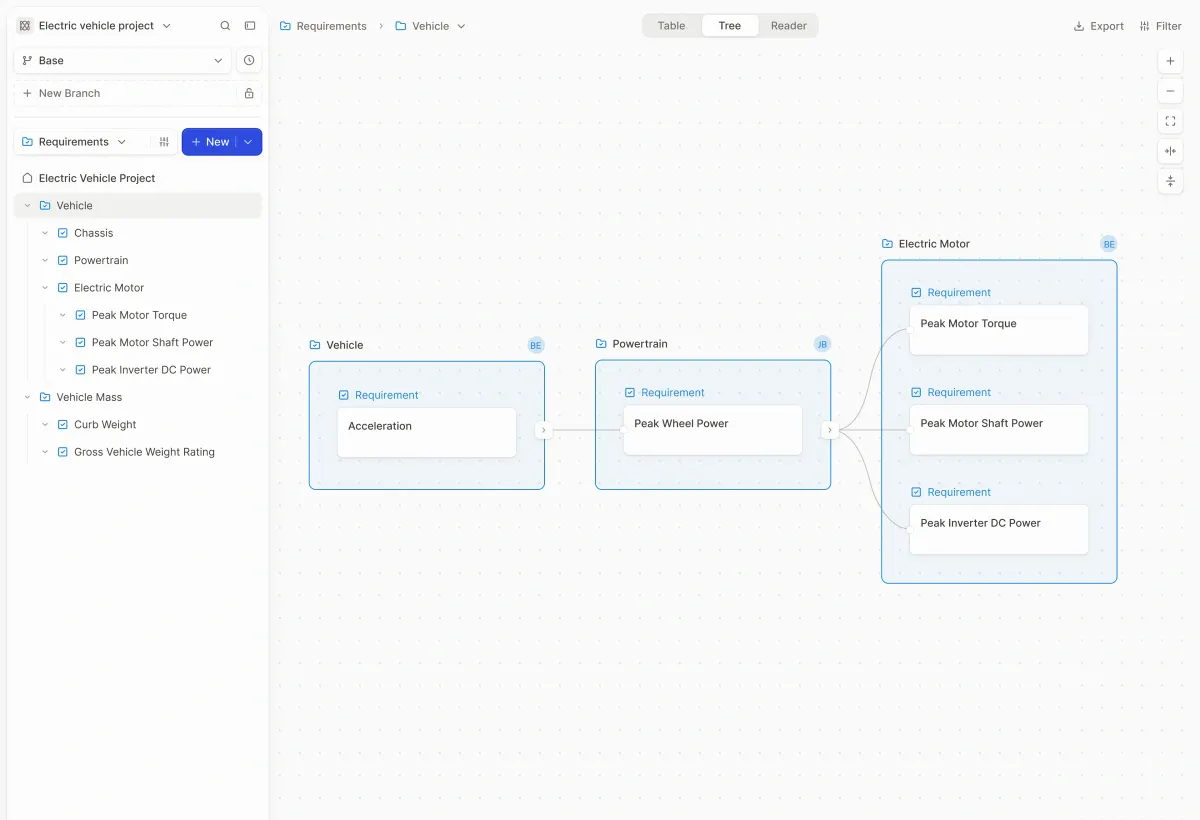
Flow Engineering’s user experience starts when a team connects the information that defines a product, including requirements, subsystem structure, interfaces, tests, CAD models, code repositories, simulations, risks, tickets, meeting notes, and related documentation. Users can also generate requirements directly in Flow Engineering or review requirements created by agents. Flow Engineering organizes this information into a shared systems graph that users can inspect, update, and automate against.
Source: Flow Engineering
For example, in a March 2026 demo with Contrary Research, Flow Engineering showed an EV project decomposed into systems such as vehicle, chassis, battery, battery pack, battery management system, charging, and powertrain. Each system included related requirements, such as vehicle mass, range, acceleration, battery life, battery mass, charging temperature, charge time, propulsion efficiency, gearbox mass, and torque. This gives users a map of the product, its subsystem structure, and the requirements tied to each part.
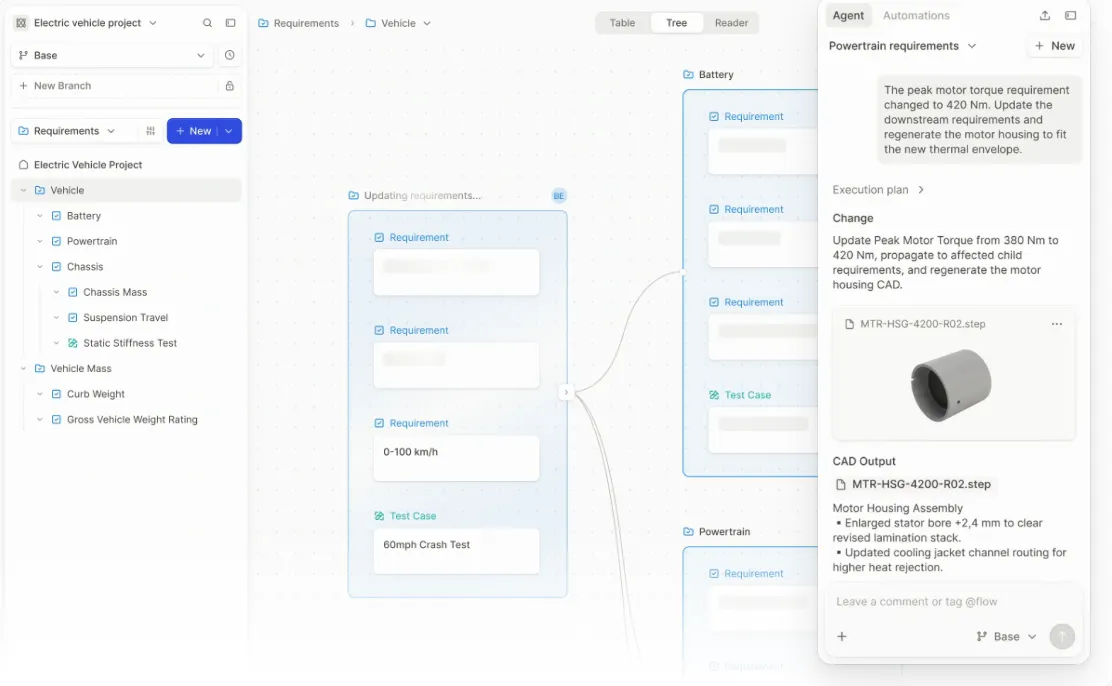
Users navigate the systems graph through workspaces for Systems, Requirements, and Tests. Systems shows product hierarchy and subsystem relationships. Requirements helps users manage requirements by category, status, owner, and relationship to other requirements. Tests shows how tests connect to the requirements they verify. Across these workspaces, users can switch between table, tree, and reader views to scan many items, inspect hierarchy, or read information in a document-like format. Users can also query the system through a co-pilot. The co-pilot answers based on the systems graph, such as where testing gaps exist, which requirements lack verification, or which subsystems are affected by a change. This helps users understand the current state of the product without manually searching across requirements documents, test plans, tickets, and design files.
Source: Flow Engineering
Engineering work still happens outside Flow Engineering, so the product connects to the tools where changes originate. Software engineers can work in GitHub, mechanical engineers in CAD, teams in Jira and Slack, and documentation in Confluence or Excel. Flow Engineering pulls information from those tools into its system and can respond to events such as pull requests, CAD changes, branch merges, or test results. When an event occurs, Flow Engineering compares it against relevant requirements, tests, interfaces, and other system context, then can notify an owner, create a ticket, comment in another tool, run a check, or prepare a proposed change.
Users review proposed changes before they affect the main system of record. Flow Engineering supports git-style branching and diffs, so users can see what changed, what improved, and what got worse before accepting an update. For users, Flow Engineering acts as a systems engineering layer across existing tools, improving visibility into changes, conflicts, and follow-up work.

Source: Flow Engineering
Users can also define their own custom agents, which specify repeatable engineering work. Agents can encode workflows such as running tests, regulatory review, risk evaluation, DFMEA, or manufacturability checks and run them on automation. The automation defines the trigger, while the agent defines the method. For example, a branch merge could trigger a requirements-quality agent, or a CAD change could trigger a manufacturability review.
According to an April 2026 interview with Singh, Flow Engineering users were already sharing agents across companies, and the company expects this to become a marketplace. In that model, users could reuse agents or skills for workflows such as DFMEA, testing, regulatory review, risk analysis, design-for-manufacturing, or cost optimization. Over time, teams could assemble agents for different engineering functions in the same way they currently assemble teams of human specialists.
Technology
Flow Engineering’s architecture is built around a shared systems graph. Physical engineering work is usually spread across requirements documents, CAD, simulations, code, tests, tickets, design reviews, and meeting notes. The systems graph connects these artifacts into a single model of the product. The graph stores relationships between requirements, subsystems, interfaces, CAD models, code, tests, simulations, tickets, risks, and engineering decisions. This lets users work in different views while operating on the same underlying system model. It also gives agents product-specific context, such as which requirements apply to a subsystem, which tests verify them, and which downstream artifacts may be affected by a change.
The agent layer sits on top of the graph. Agents can inspect the system model, identify issues, create Python code, run that code, determine what needs to be tested, and notify the relevant person. The graph provides the context for these actions; the agent performs the task. Because the graph can contain more context than an LLM can use at once, Flow Engineering is developing a routing LLM that selects the relevant requirements, tests, designs, simulations, and decisions for a given prompt or workflow. The routing model does not perform the engineering task itself; it decides what information the task-performing agent should see. The information is then given to a design LLM that crafts requirements based on this information.
In addition to the routing LLM and design LLM, an automation layer listens for changes across external engineering tools and uses the graph, routing layer, and agents to determine what should happen next. For example, in GitHub, Flow Engineering can act as an automated CI gate. When a software engineer opens a pull request, Flow Engineering reviews the code, compares it against the relevant system context, identifies conflicts, and comments directly in the pull request. In the demo, Flow Engineering identified a charging-temperature mismatch between the value assumed in code and the value stored in the system model. The same pattern applies to CAD. Flow Engineering can monitor design changes and compare them against requirements in the systems graph. In the demo, a CAD change produced a gearbox mass of 36.94 kilograms against a 13-kilogram requirement, which Flow Engineering flagged for review. In both cases, the external tool produces the change, the graph provides the relevant system context, the routing layer selects the information the agent should use, and the agent evaluates whether follow-up is needed.
When agents prepare follow-up work, Flow Engineering uses git-style branching and merging to keep proposed changes separate from the main system of record. Agents can experiment in a branch, generate alternatives, and prepare proposed updates without immediately changing the approved system model. Users can then review a diff that shows what changed, what improved, and what got worse. When a proposed change is ready to merge, Flow automatically runs agents such as test, regulatory, and requirements-quality agents to verify the change before it reaches the baseline. On each branch merge, Flow can automatically run agents such as a test agent, regulatory agent, or requirements-quality agent before the change is accepted.
Roadmap
As Flow told Contrary Research in June 2026, in the near term, the Flow team is focused on strengthening clash detection; hardening the platform for highly regulated industries through FedRAMP certification; and deepening collaboration capabilities for suppliers and external partners.
Longer term, Flow's scope expands beyond systems engineering into mechanical, electrical, and simulation work. The company is building toward agents that can generate CAD and engineering artifacts directly from requirements. The aim is very long design loops in which thousands of agents generate, evaluate, and retire candidate solutions until they converge on designs that satisfy performance, cost, manufacturability, and certification constraints. Ultimately, the aim is an engineering system where generating and evaluating new designs becomes nearly free, advancing Flow's mission of driving the cost of hardware design to zero.
Market
Customer
Flow Engineering serves cross-functional hardware teams developing complex, multidisciplinary physical products. Its customers operate in industries where mechanical, electrical, thermal, and software systems are tightly coupled and where local design changes propagate across multiple subsystems. Core verticals include space and launch, automotive, eVTOL, robotics, nuclear energy, defense, drones, satellites, and advanced manufacturing. According to a January 2026 Contrary Research interview with Flow Engineering’s head of business operations and finance, 80% of Flow Engineering’s customers were US-based.
The defining characteristic of Flow Engineering’s customer base is system complexity rather than company size. Customers are typically iterative engineering organizations building high-consequence systems such as launch vehicles, electric vehicles, humanoid robots, and small modular reactors. These programs can involve hundreds of thousands or millions of requirements and require coordination across CAD tools, simulations, spreadsheets, and documentation systems, with verification spanning analysis, simulation, and physical testing. Flow Engineering’s origins in rocket engine development shaped its focus on environments where tightly coupled subsystems and frequent design iteration make document-based systems engineering difficult to scale.
The company has focused primarily on next-generation hardware firms rather than retrofitting legacy enterprise workflows. Management describes this strategy as prioritizing the “new world” of engineering organizations designing new platforms from first principles. In a January 2026 Contrary Research interview, the company estimated roughly 3K next-generation hardware startups globally, with about 200 considered especially influential due to technical ambition and ecosystem reach. While large enterprises have expressed interest in broader deployments, Flow Engineering has focused on companies undergoing structural process change alongside active product development rather than incremental workflow upgrades within mature programs.
Flow Engineering has established early traction across space and launch, automotive, eVTOL, robotics, and nuclear energy. Customers include organizations such as Stoke Space, Astranis, Impulse Space, Apex, Mach Industries, Firehawk Aerospace, Space Machines Company, Rivian, Joby Aviation, Figure AI, Atomic Machines, Sunflower Labs, Gravities, and Radiant. Usage at Rivian reportedly expanded from roughly 40 to 1.5K users within four months while supporting approximately millions of requirements per vehicle variant. In regulated sectors such as nuclear energy, companies like Radiant use Flow Engineering to maintain traceable links between requirements, system architecture, and validation evidence, including sharing structured system models with regulators such as Idaho National Laboratory.
Market Size
Flow Engineering operates within the broader market for engineering lifecycle software. While Flow Engineering does not view itself as a replacement for PLM or MBSE systems, the category illustrates the broader market for software used to coordinate complex hardware development. A comparable category is requirements management, which serves as the company’s existing entry point. The global requirements management market was estimated at $3.3 billion in 2024 and is projected to reach $9.7 billion by 2035, representing a CAGR of 10.4% from 2025 to 2035. Growth is driven by increasing demand for traceability, compliance management, and structured requirement definition as companies develop more complex systems. Large enterprise vendors such as IBM and Siemens provide requirements management tools as part of broader engineering lifecycle platforms.
Another related category is model-based systems engineering (MBSE) software. The MBSE tools market was estimated at $4.5 billion in 2026 and is projected to reach $17.7 billion by 2035, growing at a CAGR of 16.5% from 2026 to 2035. MBSE tools replace document-centric engineering practices with structured system models that capture relationships between requirements, subsystems, and verification artifacts.
At a broader level, companies developing complex physical products rely on product lifecycle management (PLM) platforms to manage engineering data and processes across the product lifecycle. The global PLM market was estimated at $28.0 billion in 2022 and is projected to reach $54.4 billion by 2030, growing at a CAGR of 9.2% from 2023 to 2030. Growth is driven by the increasing demand for PLM solutions in small and medium enterprises to optimize manufacturing costs and go to market faster.
Flow Engineering’s market claim is that physical engineering could follow software engineering, where Gartner projects AI code assistant adoption will reach 90% of enterprise software engineers by 2028, as of July 2025. If AI-native tools can automate requirements authoring, traceability, design-change impact analysis, verification planning, test evidence management, and compliance documentation, Flow Engineering’s opportunity could extend beyond requirements management into the broader engineering services market, estimated at $3.4 trillion in 2024.
Competition
Source: Scale
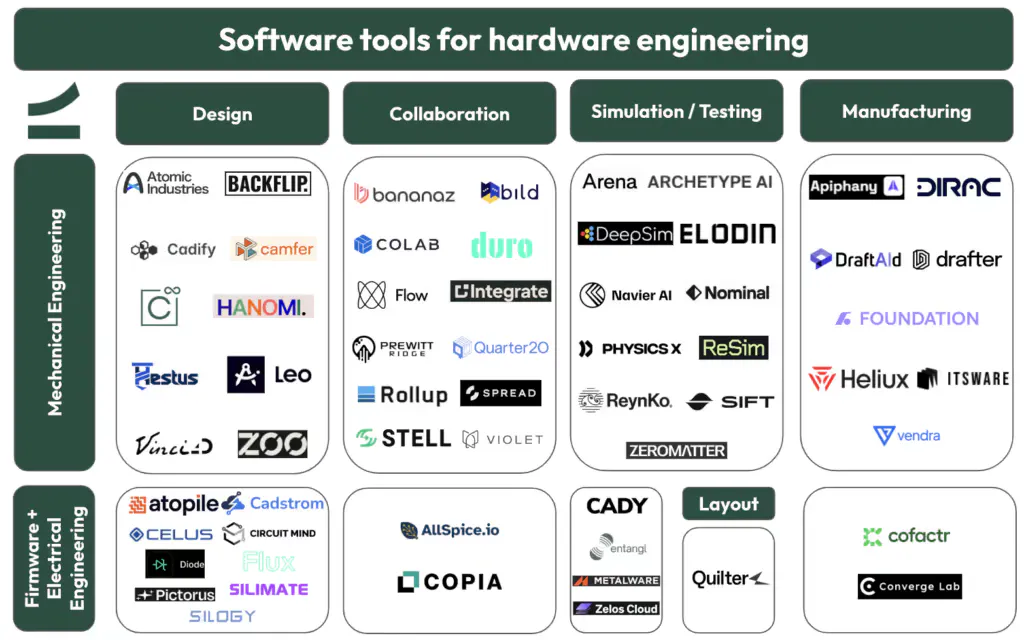
Flow Engineering is adjacent to systems engineering, requirements management, and product lifecycle management software, but does not frame itself as a traditional PLM company. The largest companies in those adjacent categories include Dassault Systèmes, Siemens, and PTC, which sell broad engineering suites through enterprise procurement processes, often with top-down adoption, long implementation timelines, and formal deployment support. The broader ecosystem also includes requirements management tools such as IBM DOORS and Jama Connect, as well as newer workflow-specific products such as Trace.Space, Valispace, and Sift Stack.
Rather than replacing the full enterprise engineering stack or serving as a standalone requirements database, Flow Engineering focuses on the system model that connects requirements, architecture, verification data, and engineering changes, with agents that act on that context. The product is designed for direct adoption by engineering teams and can sit across existing tools rather than requiring a formal PLM migration.
According to an April 2026 Contrary Research interview with Singh, Flow Engineering expects to expand from systems engineering into mechanical engineering, then electrical engineering, and then simulation. Over time, this could move the product from an agentic requirements and systems engineering layer into a broader AI platform for physical engineering. In that scenario, the relevant competitive set could expand beyond legacy requirements and systems tools such as IBM DOORS, Jama, and Cameo into larger engineering software categories associated with companies such as Autodesk and MATLAB.
Incumbents
Jama Connect: Founded in 2007 and headquartered in Portland, Oregon, Jama Software develops requirements management and traceability software for organizations building complex hardware and software systems. Its primary product, Jama Connect, enables engineering teams to define, review, and manage requirements while maintaining links to tests and verification activities. In 2018, the company raised a $200 million growth equity investment led by Insight Partners with participation from Madrona Venture Group. In March 2024, Francisco Partners agreed to acquire Jama Software for $1.2 billion.
Jama Connect is used as a system of record for requirements and associated traceability information within engineering programs. Requirements can be organized hierarchically and linked to related artifacts such as tests, risks, and review records, allowing teams to track verification status and document compliance. The platform’s Traceability Information Model (TIM) defines relationships between these artifacts and can be configured to align with industry development processes. Jama integrates with external engineering and development tools through APIs and connectors so teams can maintain traceability while continuing to use existing modeling, issue tracking, and testing software. Customers include organizations such as Panasonic Automotive Systems, Merck, Lyft, and Collins Aerospace.
IBM DOORS: IBM DOORS is a requirements management tool used in engineering programs that involve complex systems and regulatory oversight. The software was originally developed in 1991 by Quality Systems and Software Ltd. The company was later acquired by Telelogic, which in turn was acquired by IBM in 2008. DOORS became part of IBM’s engineering lifecycle management portfolio and is commonly used in industries such as aerospace, defense, automotive, and rail.
DOORS is used to capture, organize, and manage requirements in a structured database. Requirements can be linked to related artifacts such as design items, test plans, and other requirements to maintain traceability and track the impact of changes. The system includes functionality for version control, access management, change workflows, and collaboration with suppliers through standards such as the Requirements Interchange Format (ReqIF). IBM later introduced IBM Engineering Requirements Management DOORS Next, a web-based product built on the Jazz platform that integrates with other tools in IBM’s engineering lifecycle management suite.
Siemens Polaroid: Siemens competes in the PLM market through its Siemens Digital Industries Software division. One of its core offerings in this category is Polarion ALM, a requirements management platform first released in 2005. As of March 2026, Polarion was used by more than 200 Fortune 1000 companies to manage requirements and coordinate complex product development. The software helps engineering teams define requirements, track changes, and link them to system designs and testing activities so teams can verify that products meet technical and regulatory requirements.
Siemens connects Polarion with other products in its engineering software stack, including Teamcenter for product lifecycle management and Simcenter for simulation and testing. Engineers can use these tools to model system architectures, run simulations such as structural or fluid analysis, manage bills of materials, and track verification and validation work. The platform also supports workflow automation, configuration management, and collaboration across mechanical, electrical, and software teams.
Autodesk: Autodesk is a software company founded in 1982 that develops 3D design, engineering, and entertainment technology used across industries, including architecture, engineering, construction, manufacturing, and media. As of March 2026, Autodesk had a market capitalization of $54.9 billion. The company provides a wide range of tools for computer-aided design, modeling, simulation, collaboration, and data management. Its portfolio includes design platforms such as AutoCAD for drafting and design, Revit for building information modeling in architecture and construction, and Fusion 360 for product design and manufacturing. Compared with some engineering platforms that focus heavily on lifecycle management or systems engineering workflows, Autodesk’s software is more concentrated on design, modeling, and simulation.
Autodesk continues to expand its platform with artificial intelligence capabilities integrated directly into design tools. In October 2025, the company introduced what it describes as “neural CAD,” a category of generative AI models designed to automate routine design tasks such as geometry creation and modeling adjustments. Autodesk has also expanded Autodesk Assistant from a support chatbot into a system that can automate design workflows through natural language prompts. These features aim to reduce manual modeling steps and allow engineers and designers to focus on higher-level design decisions.
Dassault Systèmes: Dassault Systèmes is a French engineering software company founded in 1981 that develops design, simulation, and product lifecycle management tools for industries such as aerospace, automotive, industrial equipment, and life sciences. As of March 2026, the company had a market capitalization of $24.6 billion. Its core offering is the 3DEXPERIENCE platform, a unified software environment that connects engineering teams, product data, and development processes. The platform serves as the central system for designing products, running simulations, and managing lifecycle data across large engineering organizations. Customers include companies such as Airbus and Bosch.
The 3DEXPERIENCE platform integrates software products within the Dassault portfolio. CATIA provides advanced 3D design and systems engineering tools used to model complex products and architectures. SOLIDWORKS offers 2D and 3D CAD tools that are widely used by engineering and product design teams. SIMULIA enables virtual testing through simulation tools for structural analysis, fluid dynamics, and electromagnetics. ENOVIA provides product lifecycle management capabilities that allow companies to manage product data, coordinate development projects, and maintain traceability across the engineering process.
Codebeamer: Codebeamer ALM is an application lifecycle management platform originally developed by Intland Software, a company founded in 1998. In 2022, PTC acquired Intland Software for $280 million to strengthen its application lifecycle management and systems engineering capabilities. Codebeamer provides a unified environment for managing requirements, development tasks, testing, changes, configurations, builds, and documentation. The platform is designed to support the development of complex software and hardware systems by allowing teams to coordinate requirements, development work, and validation activities in one system.
In February 2026, PTC added AI features such as a Requirements Assistant that identifies quality issues and aligns requirements with industry standards, and a Test Case Assistant that generates test cases directly from requirements. Codebeamer also connects with other products in PTC’s broader engineering software portfolio, including Windchill for product lifecycle management, Creo for product design, and PTC Modeler. This integration allows companies to link requirements and development work with product design and lifecycle data across the engineering process.
Newer Entrants
Trace.Space: Trace.Space is a startup developing software for requirements management and systems engineering in complex hardware programs. The company was founded in 2023 in Riga, Latvia, by Jānis Vavere, Mik Krams, and Kārlis Broders, who previously worked on implementations of requirements management tools such as Jama and Polarion. In February 2025, Trace.Space raised $4 million in seed funding led by Cherry Ventures with participation from Outlast Fund, as well as earlier investors Nebular, Fiedler, and Change Ventures. As of March 2025, the funding was being used to continue product development, expand the engineering team, and build implementation and customer support capabilities needed to deploy the software within enterprise programs.
The Trace.Space platform focuses on requirements management and specification workflows for teams developing complex regulated products, including electric and autonomous vehicles, satellites, robotics, semiconductors, and medical devices. The software provides a cloud-based environment where teams can define product requirements, collaborate across engineering disciplines, and manage specification changes with traceability to related artifacts. The platform incorporates AI tools to assist with drafting requirements, structuring specifications, and identifying inconsistencies across documentation.
As of March 2026, Trace.Space was primarily targeting large enterprises with established engineering processes that require implementation support and structured rollouts. Flow Engineering, by contrast, is initially focused on smaller and faster-moving engineering organizations that are more open to adopting new development workflows without extensive customization or consulting.
Valispace: Valispace develops systems engineering and requirements management software for teams building complex hardware products. The company was founded in 2016 and created tools intended to connect system architecture, requirements, and verification data within a shared engineering workspace. In February 2024, Valispace was acquired by Altium, a provider of electronics design software, with the goal of integrating systems engineering and requirements management capabilities into its cloud collaboration platform, Altium 365.
Valispace provides a cloud environment where engineering teams can manage requirements, link them to system parameters and design artifacts, and track verification progress. Requirements can be connected to design elements such as schematics, layouts, and bills of materials, allowing engineers to maintain traceability from system specifications through implementation and testing. The platform also includes tools for verification planning, compliance tracking, and collaboration across multidisciplinary teams. The product has also introduced AI-assisted functionality to help import requirements from documents, structure specifications, and refine requirement statements.
Sift Stack: Sift Stack develops software for managing and analyzing telemetry and operational data generated by complex machines. The company was founded in 2022 by Austin Spiegel and Karthik Gollapudi, both former engineers at SpaceX. Spiegel worked on internal manufacturing systems, test automation infrastructure, and telemetry systems for Starlink, while Gollapudi led the flight software operations team for the Dragon spacecraft. In November 2023, Sift raised $7.5 million in seed funding led by Riot Ventures and Fika Ventures, with participation from First Resonance, Datum, Duro, and Earthrise Ventures. The company’s stated objective is to build a unified data platform for operating and validating mission-critical machines.
Sift’s platform focuses on the ingestion, storage, and analysis of high-volume telemetry data produced by sensors, simulations, manufacturing systems, and flight or system tests. The software provides infrastructure designed for high-rate and high-cardinality hardware telemetry, allowing engineering teams to store large datasets and query signals across long operational histories. Its analysis pipeline evaluates signals over time to detect patterns, measure changes in system behavior, and identify anomalies. Engineers can visualize and explore signals through a unified interface, compare runs against historical data, and perform root-cause analysis across time-series data, logs, and other telemetry sources.
The platform also includes reporting and governance features designed to support engineering validation and compliance processes. Test and operational data can be aggregated into structured reports used in internal reviews, audits, and certification workflows. Access controls, deployment options, and audit logging allow organizations to manage data sharing across teams while maintaining security requirements. While Flow Engineering helps teams structure requirements and system architecture earlier in the development cycle, Sift focuses on telemetry analysis and validation infrastructure once machines begin generating operational data.
Business Model
Source: Flow Engineering
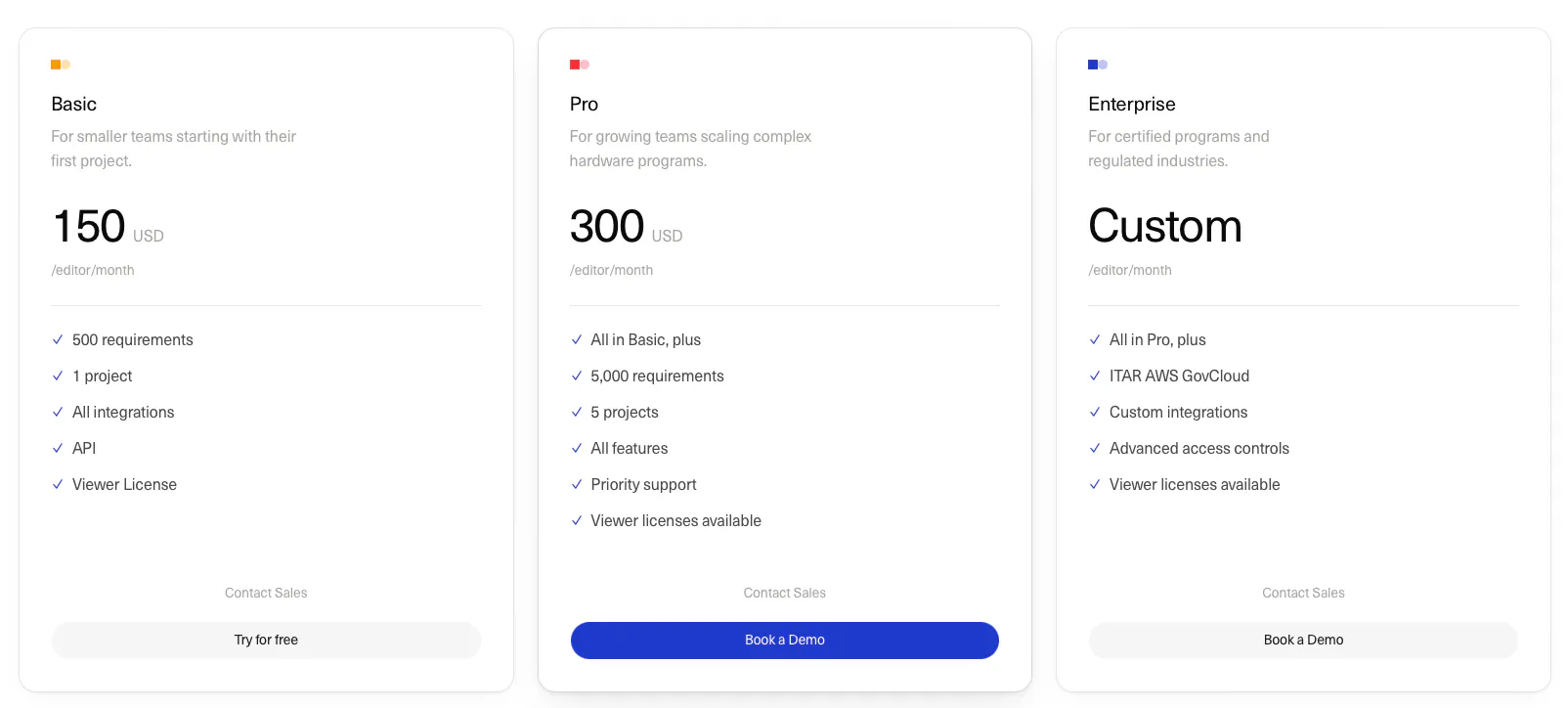
As of June 2026, Flow Engineering operated as a B2B SaaS platform with tiered, per-editor pricing. The Basic plan is $150 per editor per month and supports up to 500 requirements within a single project. The Pro plan is $300 per editor per month and supports up to 5K requirements across five projects, with full feature access and priority support. Enterprise plans are custom-priced and include expanded capacity, advanced access controls, dedicated support, tailored integrations, and options such as ITAR-compliant GovCloud deployment. Enterprise contracts are typically 1-3 years, according to a Contrary Research interview with Flow Engineering in January 2026. The team indicated that it plans to move towards offering a free platform with usage-based pricing.
However, as of April 2026, Flow Engineering had longer-term plans to shift from requirements management toward an AI-native physical engineering platform. Pricing is expected to follow an AI-tool model rather than a traditional requirements-management SaaS model: customers buy seats, each seat includes a set amount of token usage, and heavier users move into higher tiers such as light, pro, or ultra seats. Over time, the company expects monetization to become increasingly usage-based, with customers effectively buying additional token capacity as agents perform more work across requirements, CAD, code, simulations, tests, and downstream workflows.
Flow Engineering’s go-to-market motion centers on end users. According to a February 2026 Contrary Research interview with CEO Pari Singh, engineers can begin using the platform immediately without formal training, and the company offers a two-week trial with an activation rate of 80%. Competing systems often require 6-12 months of implementation before achieving broad productivity.
Sales follow a bottom-up, product-led motion. Initial adoption had previously come from systems or architecture teams replacing spreadsheet-based requirement management. As requirements, architecture, and verification artifacts consolidate within the platform, adjacent teams adopt it to maintain alignment, increasing seat count over time. Network effects reinforce distribution. According to a February 2026 Contrary Research interview with the Flow Engineering team, one of its customers, Radiant, invited regulators from Idaho National Laboratory into the platform to review safety requirements and maintain a shared digital thread for regulatory changes. The Idaho National Laboratory then generated introductions to seven additional nuclear companies. Employee mobility provides a second channel, as engineers who use Flow Engineering at one organization introduce it at subsequent employers.
As Flow Engineering becomes more deeply embedded in a customer's engineering workflow, switching costs may increase. The platform's systems graph connects requirements, tests, CAD, code, simulations, risks, tickets, and engineering decisions into a single model. Over time, customers also build integrations, automations, and reusable skills that reflect their own engineering processes, from requirements authoring and risk reviews to manufacturability and regulatory workflows. Replacing Flow would require not only migrating data, but also recreating the relationships, workflows, and institutional knowledge encoded within the system.
Traction
The company which would later become Flow Engineering was founded in 2016 as a consultancy called The Engineering Company. While working on rocket design projects, the founders built internal software to manage engineering workflows across requirements, models, CAD designs, and simulations. The system connected tools such as MATLAB and CAD environments so that changes to one part of the design could automatically update related models and requirements. According to the company, the software allowed some engineering tasks that previously took about 12 weeks to be completed in roughly 2.5 hours. Within its first year, the consultancy generated revenue and worked with customers in the United States.
In 2019, the company decided to shift away from consulting and focus on developing software. It renamed itself The Engineering Company and later rebranded as Flow Engineering. The team began turning its internal tooling into a product that other engineering organizations could use. Early demonstrations were conducted with engineering groups at companies including McLaren and Rolls-Royce. While these teams were interested in the approach, Flow Engineering found that large engineering programs often could not adopt a completely new platform in the middle of ongoing development cycles.
In February 2023, the company released the product in private beta and made it available to early users for free while collecting feedback. During the same year, Flow Engineering partnered with Autodesk to integrate the system with Autodesk Fusion 360 and Autodesk Inventor, allowing engineering teams to connect requirements and parameters with existing CAD workflows. Flow Engineering later adopted a product-led distribution model centered on a two-week trial period, according to CEO Pari Singh. According to the company, during an interview with Contrary Research in February 2026, approximately 80% of trial users activate the product, and about 80% of those users convert to paid usage. The platform is designed to be deployed without formal onboarding or implementation projects, in contrast to legacy engineering software that often requires long deployment cycles.
In February 2026, Flow Engineering announced a collaboration with OpenAI focused on developing models for engineering workflows. During a February 2026 interview with Contrary Research, CEO Pari Singh stated that through the partnership, Flow Engineering receives early access to pre-release models and provides feedback on engineering use cases and data context. The collaboration is focused on improving how large language models incorporate engineering data and context rather than on post-training or custom model development. Also in February 2026, the company announced a partnership with Rivian. Rivian initially deployed the system with 40 users and expanded to 1.5K users within four months. According to the company, Rivian manages more than one million software and hardware requirements through the system and generates roughly 95K API calls per night. Flow Engineering serves as the system of record for requirements associated with Rivian’s R1 and R2 vehicle programs.
In March 2026, Flow Engineering announced that Xcimer Energy was using the platform in the development of high-power laser systems intended for commercial fusion energy. During this time, Flow Engineering also relocated its headquarters from London to San Francisco while continuing to hire across both San Francisco and London. The company had previously recruited talent from organizations including Applied Intuition, Anduril Industries, Archer/X-Wing, Rollup, and DroneDeploy, and as of March 2026, had plans to further expand its team. The relocation placed the company closer to AI research groups and hardware companies adopting AI-assisted engineering workflows.
In June 2026, Flow Engineering officially launched Flow v3, which was the AI-native iteration of the product built around the systems graph. In a March 2026 interview with Contrary Research, Singh claimed that the company saw customers move quickly toward this new product direction. RVT, the Rivian-Volkswagen joint venture, initially planned to spend a year on Flow’s v2 product but instead went directly to v3. Singh also claimed that customer usage has increased exponentially since the v3 deployment.
Valuation
As of March 2026, Flow Engineering had raised a total of $31.5 million in Seed and Series A funding. In October 2025, Flow Engineering raised a $23 million Series A round led by Sequoia Capital, with participation from John Collison and Patrick Collison of Stripe, Kyle Parrish, formerly of Figma, David Helgason of Unity, and Alastair Mitchell of Odyssey. As part of the round, Roelof Botha joined the board, and John and Patrick Collison became advisors. The company previously raised an $8.5 million seed round in December 2022, led by EQT Ventures.
At the time of its Series A, Flow Engineering had a team of eight. As of June 2026, the company has grown to 25 employees and plans to quadruple headcount by year-end, according to an interview with Contrary Research. The funding is being used to accelerate product development and scale the organization. Singh has described Flow's culture as one of extreme talent density, with a hiring philosophy that values ambition, learning velocity, and non-linear career paths over traditional credentials or progression.
Key Opportunities
High Switching Costs
Flow Engineering can become stickier as customers use it across more of their engineering workflow. The platform links requirements, tests, CAD, code, simulations, risks, tickets, and engineering decisions in a shared systems graph. As users add integrations, agents, skills, and automations, Flow Engineering captures more product-specific context and company-specific workflows. This raises switching costs over time: replacing the platform would require customers to migrate data and rebuild graph relationships, tool integrations, agent workflows, automations, and reusable skills that support daily engineering work.
Government Contracts
A 2023 US Government Accountability Office report on defense acquisition found that agile development approaches depend on modern engineering tools to support systems engineering, mission engineering, and software engineering across defense programs. The report recommended that the US Department of Defense develop an overarching plan to enable the adoption of these tools across programs. Guidance from the Office of the Under Secretary of Defense for Research and Engineering emphasizes the role of digital engineering platforms in reducing design, development, and testing timelines for complex defense systems. The department’s modernization efforts focus on tools that improve collaboration, support iterative development, and allow models and engineering data to inform requirements and acquisition decisions earlier in the lifecycle.
Platforms that structure requirements, system architecture, and verification relationships could align with these priorities. As defense agencies and military services evaluate new engineering infrastructure to support digital engineering initiatives, Flow Engineering can secure opportunities to participate in modernization efforts or secure contracts related to engineering tool adoption across defense programs.
Automating Engineering Labor
Agentic orchestration layers have the opportunity to replace product lifecycle management tools by coordinating specialized tasks across hardware development. In March 2026, Flow Engineering CEO Singh claimed that 90% of activities in the engineering stack, including requirements and test design, mathematical analysis, CAD modeling, simulation, and software or firmware development, are already partially automated. However, these capabilities remain fragmented across separate tools and workflows. Because hardware systems involve thousands of tightly coupled technical decisions across disciplines, managing dependencies and propagating changes remains largely manual.
Flow Engineering’s product addresses this coordination problem through its systems graph, automations, and skills. The systems graph gives agents shared context across the engineering program. Automations let agents act when changes occur. Skills define how agents perform repeatable workflows such as requirement generation, test gap analysis, impact review, compliance checks, and change propagation. Over time, as Flow Engineering expands into CAD generation, simulation, mechanical engineering, and electrical engineering, the product could cover more of the work currently performed across PLM, CAD, simulation, and engineering project management tools.
Telemetry, Modeling, and Simulation
Another potential expansion area is modeling, simulation, and operational telemetry data. As of June 2026, Flow Engineering focused on structuring requirements, architecture, and verification early in the engineering lifecycle. However, once systems move into modeling, simulation, and physical testing, large volumes of telemetry and performance data are generated that must be analyzed to determine whether systems meet design requirements. Platforms such as Sift provide infrastructure for storing and analyzing this data, allowing engineers to query signals, compare runs, detect anomalies, and perform root-cause analysis across tests and simulations.
Expanding into these areas could allow Flow Engineering to link requirements directly to simulation outputs, modeling results, and operational telemetry. Simulation and test data often reveal constraint violations, performance gaps, or new system limits that require updates to requirements. Connecting these feedback loops to the system model would allow requirements to evolve based on real engineering data while supporting faster root-cause analysis when failures occur. Extending the platform into telemetry, modeling, and simulation infrastructure could move Flow Engineering closer to an end-to-end system where requirements, design artifacts, and validation data remain continuously connected. Flow Engineering appears to be moving closer in this direction with its fully connected systems graph, which connects requirements, design decisions, interfaces, budgets, tests, and compliance evidence.
Cost of Late-Stage Rework
Another opportunity relates to the rising cost and frequency of late-stage rework in complex hardware programs. An April 2025 study found that 90% of engineering leaders have delayed some portion of product launches due to late-stage design changes. An October 2017 McKinsey study further showed that a 6-month launch delay resulted in a 33% drop in profitability over the product’s lifetime.
In industries such as aerospace, electric vehicles, defense, and energy systems, design changes made late in development can trigger cascading updates across simulations, safety analyses, verification plans, and physical tests. Because these dependencies are often managed across disconnected tools and documents, the full impact of a change may only become visible after significant engineering work has already been completed. For example, in October 2021, Boeing reported $1 billion of abnormal costs due to low production rates and rework.
By structuring requirements, system architecture, and verification relationships within a shared model, platforms like Flow Engineering can make these dependencies visible earlier in the development process. When a requirement or design parameter changes, affected subsystems and verification activities can be identified immediately. As system complexity increases, tools that help teams detect conflicts earlier and reduce late-stage rework become vital in preventing late-stage rework.
Increasing Adoption of Systems Engineering
A market shift toward model-based systems engineering (MBSE) may create additional demand for platforms that structure engineering work around shared system models. As hardware systems become more complex and multidisciplinary, many organizations are moving away from document-based processes toward digital system models that connect requirements, architecture, analysis, and verification across the product lifecycle. In MBSE, these models act as the primary mechanism for exchanging information and maintaining alignment across engineering teams.
Adoption of systems engineering practices appears to be increasing among more mature organizations. Research summarized by Ansys in September 2023 found that 47% of the most advanced companies have fully adopted systems engineering solutions and practices, compared with 13% of moderately mature organizations and 3% of the least mature. These companies are also more likely to maintain dedicated systems engineering roles, verification teams, and synchronized system models that connect analysis with design decisions.
Flow Engineering aligns with this shift by using a connected systems graph as the basis for automating parts of the systems engineering role. The graph links requirements, architecture, interfaces, tests, simulations, and engineering decisions, giving agents the context needed to flag inconsistencies, maintain traceability, update requirements, and keep verification evidence tied to the relevant system context. As AI coding tools have begun to generate and review software within existing development workflows, Flow Engineering is applying a similar model to systems engineering artifacts in hardware workflows, increasing adoption of systems engineering and MBSE while allowing engineers to focus on high-value tasks.
Key Risks
Integration Maintenance
Flow Engineering’s value depends in part on connecting requirements and system architecture to downstream artifacts such as analysis models, CAD geometry, simulations, and test data. In practice, these artifacts are generated and maintained in a wide range of specialized tools used by different engineering disciplines.
Maintaining reliable integrations across these systems can be difficult. Engineering tools frequently change versions, APIs, and data formats, and many organizations maintain customized internal workflows. If integrations break or data synchronization fails, the system model may become outdated or inconsistent with the underlying engineering work. In that scenario, engineers may lose confidence in the platform as a reliable source of truth.
There is also an operational burden in supporting a broad ecosystem of integrations across CAD, simulation, analysis, and testing environments. Ensuring that data flows remain stable and accurate across these systems may require significant engineering effort, and failures in these connections could undermine the core premise of maintaining a continuously synchronized system model.
Slow Adoption of Incumbents
Large, incumbent engineering organizations tend to have deeply embedded workflows built around existing tools, documents, and review processes. Even when these systems are inefficient, they are familiar and integrated into certification procedures, supplier contracts, and internal governance structures. Requirements, verification evidence, and design documentation often flow through established approval chains and compliance processes. Replacing or restructuring these workflows with a new system requires coordination across engineering, quality, IT, and program management teams, which can slow adoption. Even if there is interest from large aerospace, automotive, or defense companies, internal inertia, certification dependencies, and established toolchains can make implementation difficult. In these environments, adoption may require longer evaluation cycles, phased rollouts, or coexistence with legacy systems before a platform like Flow Engineering could be deployed broadly.
As a result, Flow Engineering has largely targeted smaller and faster-moving organizations where these constraints are less entrenched. Startups and newer engineering teams often operate with lighter processes and fewer legacy systems, making it easier to adopt new infrastructure for requirements and system coordination. These organizations may also be more motivated to experiment with new approaches if they believe it can accelerate development cycles.
Summary
Flow Engineering is an AI-native physical engineering platform focused initially on systems engineering: helping teams keep requirements, systems, tests, CAD, code, simulations, and related workflows aligned as a product changes. The product offers a shared systems graph, role-specific workspaces, a co-pilot, automations, skills, and agent workflows for requirements generation, traceability, verification planning, change-impact analysis, risk review, and compliance documentation. Customers include companies building advanced hardware such as Stoke Space, Astranis, Rivian, Volkswagen, Joby Aviation, and Radiant across sectors including aerospace, robotics, automotive, and nuclear energy. As of March 2026, the company had raised $31.5 million, including a $23 million Series A led by Sequoia Capital. Its long-term ambition is to expand from systems engineering into mechanical, electrical, and simulation work, becoming an AI-native platform for designing complex machines.